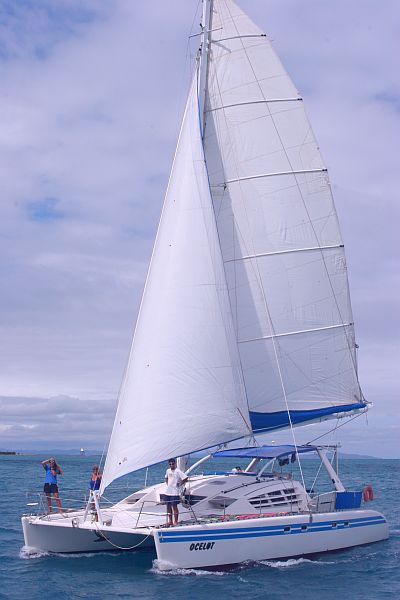
Flat sailing off Fiji
|
Top Level Ocelot Pages |
Ocelot's Deck
|
Flat sailing off Fiji |
SAILING:
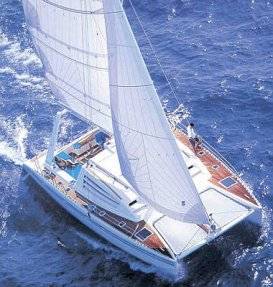 Rocketing along, hard on the wind! |
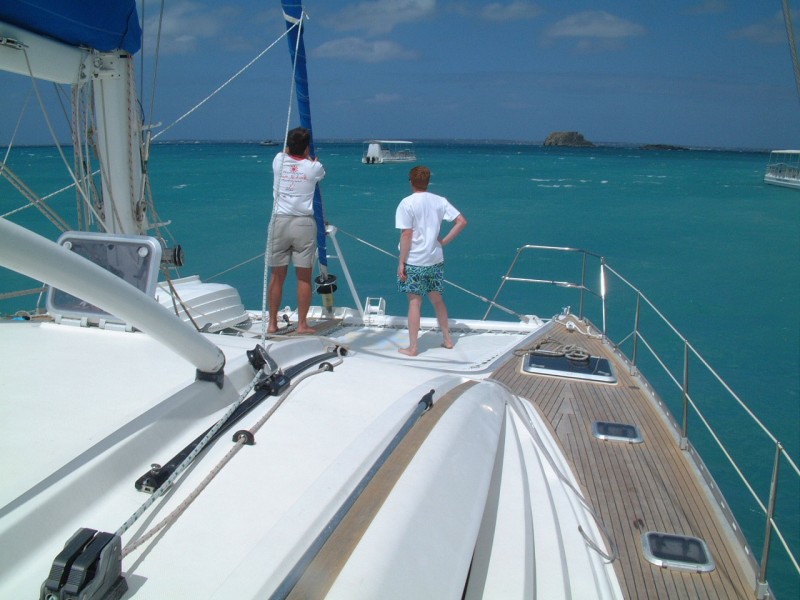 Note the jib-track, and the stainless steel pulpits up forward. |
Sailing a catamaran is wonderful. We don't heel over significantly, so drinks tend to stay where we put them, and we don't have to hold on at all times. Moving around Ocelot while underway is both easy and safe. The above photo at left is from Kronos promotional material (it's difficult to get a photo of your boat from the air) and was apparently taken of a boat with the bimini and davits removed, but it's otherwise quite similar. In the photo above right, you can see our name on the bows. More importantly, you can't see any white-caps, so there's less than 12 knots of wind yet we're making 6+ knots under just working rig.
In the photo at right you can see the jib sheet track mounted on the top of the salon. It’s nice and inboard, which means the jib can be sheeted‑in well for going to windward. Note the line to adjust the position of the jib car, even under load.
Now that we have new sails on Ocelot, we're really pleased with her sailing performance. We've had her out close-reaching in 25‑30 knots of wind and 10‑foot (3m) seas, and she was thundering along at 8‑9 knots. She tacks through about 90 degrees which is about par for a cruising boat, and much better than how she performed with the old sails.
Ocelot at anchor in Moorea, French Polynesia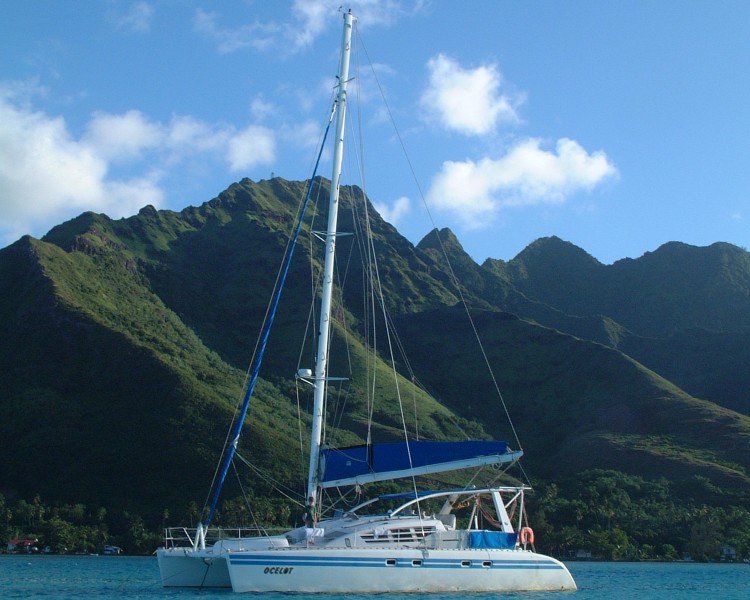 All 8 diamond stays of the triple-spreader rig are rod-rigging. The headstay and cap-shrouds are ½" (12.7mm) & 14mm Dyform. Nikka, our sailing dinghy, is usually lashed to the tramps. The louvers over the big side windows keep the salon nice and cool while giving us excellent visibility out. |
Up On Deck:
The rig (see photo at left) has 3 sets of spreaders, with the bottom 2 sets of spreaders being triangular. The 8 diamond stays are done in rod rigging. This makes the mast so stiff and strong that it needs no lowers or intermediates. The head‑stay, is ½" (12.7mm) Dyform, an extra-strong 1x19 rigging wire, new in 2004. The Cap‑shrouds are 14mm Dyform (new in 2006) and the bow-tensioner is 16mm standard 1x19 rigging wire. The roach on the fully battened main sail means we don't have a backstay. Instead, the cap‑shrouds have been moved aft 6 feet (2m) from the base of the mast and they double as backstays. Most modern catamarans seem to be rigged this way. The slight rake to the mast is really from the bottom of the mast being moved forward, to give more space in the salon. Many cats these days seem to have fractional rigs, which seems a bit silly on a cruising boat, but if we think about it as a masthead rig where the main can be raised a bit higher in light airs then it feels better. One nice aspect of multihulls is that it doesn't take much wind to move us along.
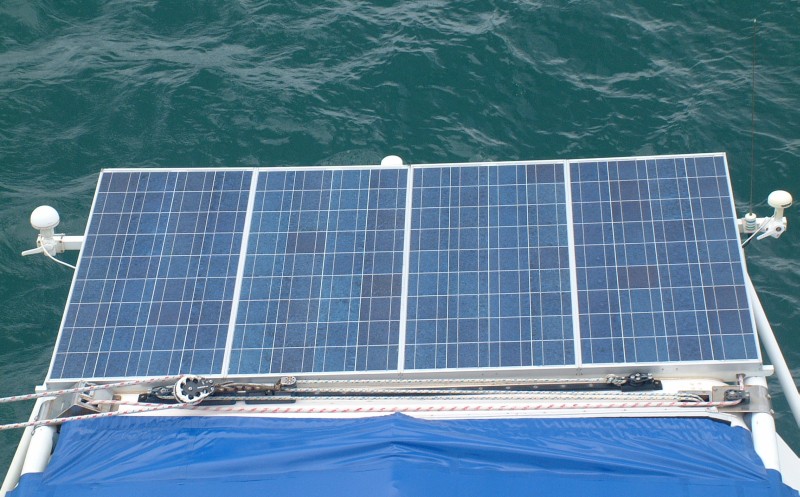 Ocelot's solar array, mainsail track, and twin GPS receivers. The blue at the bottom is our bimini over the cockpit. |
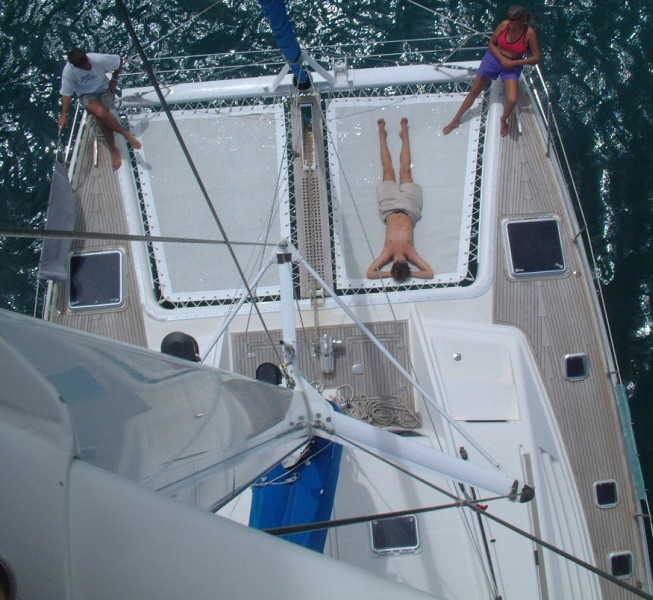 The foredeck, from the 2nd spreaders. Note Jon & Sue sitting on the new pulpit seats. |
The 4 solar panels usually provide 100% of our electrical needs. They're mounted above the davits, just aft of the mainsail track and targa bar. The 2 control lines for the main-traveler go down the inside of the targa‑bar to their own winch and rope-clutches. The 2 GPS antennas as well as the AIS/backup VHF antenna are mounted next to the solar panels. The AIS/backup VHF antenna can really only be seen in the blowup image.
This early photo to the left does not show the radar, now fitted to the first spreader, or the mast-steps. The roller gear is a top‑quality, 3‑bearing titanium Profurl unit which can take the torque of a partially reefed head-sail.
The teak decks seem extravagant on a cat, but they sure provide an excellent grip! The trampolines (tramps) are rugged, and made for lying and walking on. Their light weight and water-shedding design lets the bows rise faster in a rough seaway.
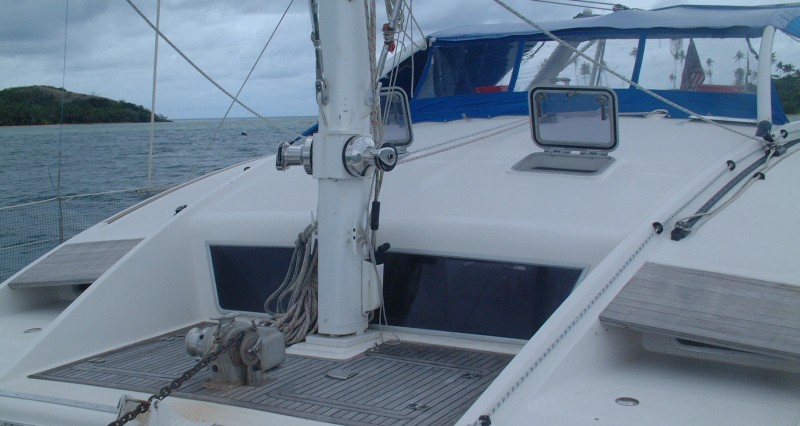 The front of the salon, showing the long front window, the 2 big hatches, and the dodger. There are 2 additional opening ports under the steps in the lower left and right corners of the picture. These are protected by the steps and can often be left open, even in the rain, to provide ventilation to the salon area. |
Ocelot now sports custom made stainless steel pulpits on each bow, with 2 lifelines across the front. The pulpits have seats on them to accommodate mermaids (like Sue, on the right) and mermen (like Jon, on the left). The dark squares are all hatches. The big forward hatches are entry into the fo'c's'les (storage lockers for us.) The other hatches are what provide ventilation to the cabins for sleeping. Each cabin has 2 overhead hatches and one side porthole. Each head has one overhead and one side hatch which we often leave open while at anchor, as the heads are quite waterproof and don't mind getting a bit of rain.
The photo on the left shows the front of the cabin, seen from the port bow seat. The anchor winch is a Lofrans 'Tigre' 1 watt unit with both rope and chain gypsies which seems ample for our needs. On each side of it are chain and rope lockers for our additional anchoring gear. The forward teak steps over the hatches protect the hatches from rain, so we can often leave them open to provide ventilation to the salon and galley area. We can use the cabin top as a rain catch but it's usually not necessary.
The picture shows the dodger up, but we usually leave it rolled up just in front of the cockpit unless it's about to rain. The side‑curtains zip onto the main bimini and tension to the life-lines. We don't usually sail with them, but they provide great shade and privacy for the cockpit.
Top Level: Home | Destinations | Cruising Info | Underwater | Boat Guests | Ocelot | Sue | Jon | Amanda | Chris | Site Map | Make a Comment
|
If our information is useful, you can help by making a donation |
Copyright © 2000‑ Contact: Jon and Sue Hacking -- HackingFamily.com, svOcelot.com. All rights reserved.