|
Underwater Pages Reef Animals |
Other Reef Fish
As we take more photos of reef fish we'll be adding them to the families that we've categorized on this and other pages. For now, we have only one or two examples of fish from the families below.
Also on this page are some examples of how marine animals live together for mutual benefit. See Animal Buddies, below.
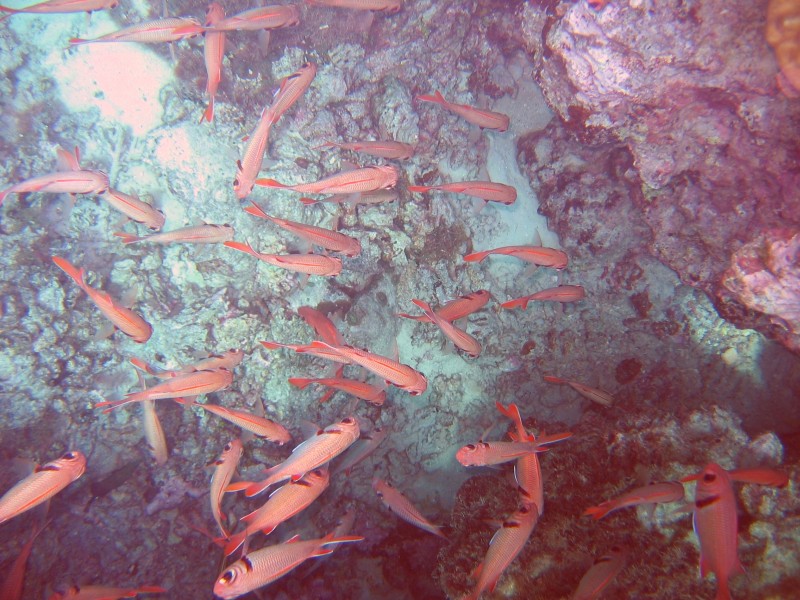
| Soldierfishes (right) and squirrel fishes are in the same family Holocentridae, and include a number of fairly primitive species. Many tend to be nocturnal, and even those that are seen on the reefs in daylight are likely to be hiding in the recessed areas of the coral. They are characterized by large eyes (specialized for night vision), and are usually reddish in coloring. Some have distinctive stripes. We have read that they have the habit of turning their heads either upwards or downwards to enter grottoes or crevices, but we've not seen this, and will now be looking for this behavior. |
|
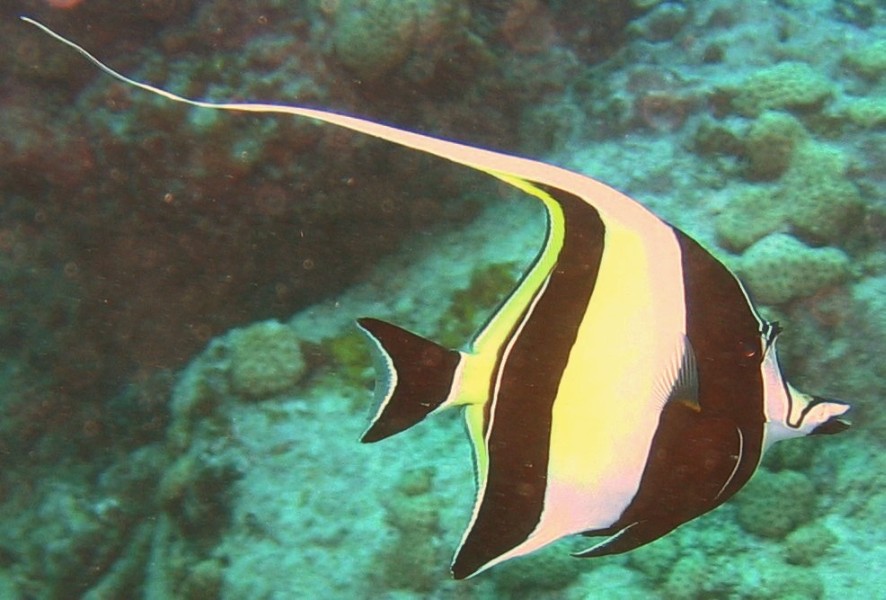 |
Although it looks like it should be a member of the same family as either the angelfishes or butterflyfishes, the Moorish idol Zanclus cornutus is a unique species in its own family, Zanclidae. It is one of the more striking oval fish on the reefs with its elongated dorsal fin and vivid bars. Feeding mainly on sponges, it is found throughout most of the Indian and Pacific Oceans. (Society Islands, Fr. Polynesia) |
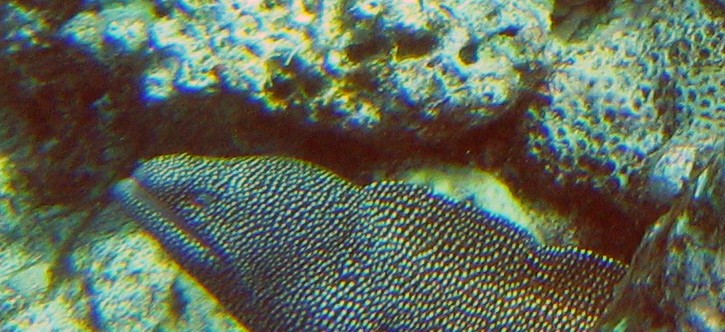 |
Camouflaged by the pocked surface of the reef, the Whitemouth Moray Eel Gymnothorax meleagris blends in well while awaiting prey to come close. This medium-sized eel (up to 1.2 m, or 4 feet) is a solitary creature staying close to its recess in the reef. So named for the white inside its mouth, it also has a white-tipped tail. It is found across most of the Indo-Pacific. (New Caledonia) |
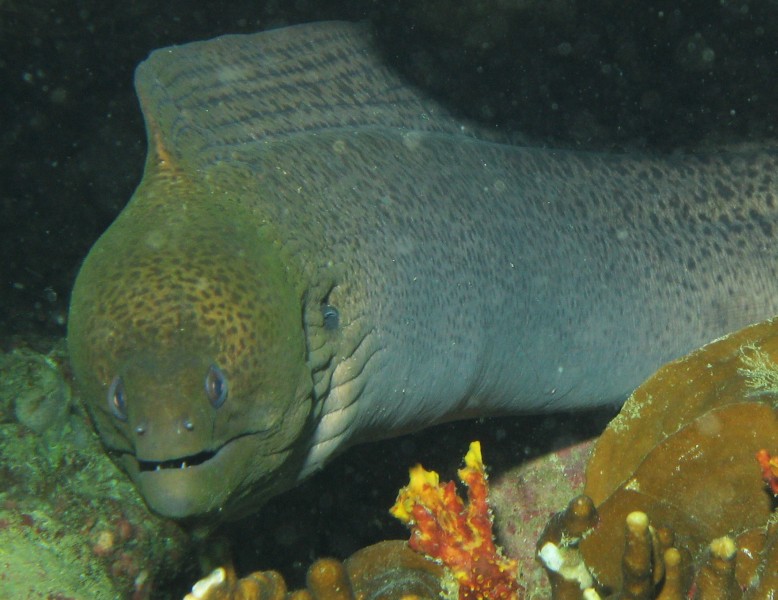
| The Giant Moray Gymnothorax javanicus usually keeps hidden in its den, just sticking its head out to watch for unwary fish - or unwary swimmers. Its teeth are nasty and hooked back, so if you offer one a taste of your hand you won't be getting away anytime soon. However, if you keep your distance they won't bother you. The Giant Moray looks similar to the Green Moray in the Caribbean, but they are two different species and their ranges do not overlap. The Giant is throughout the Indo Pacific from East Africa and the Red Sea to Pitcairn Island, and north to southwest Japan. (Butang Islands, Thailand) Photo by Chris Hacking. |
 |
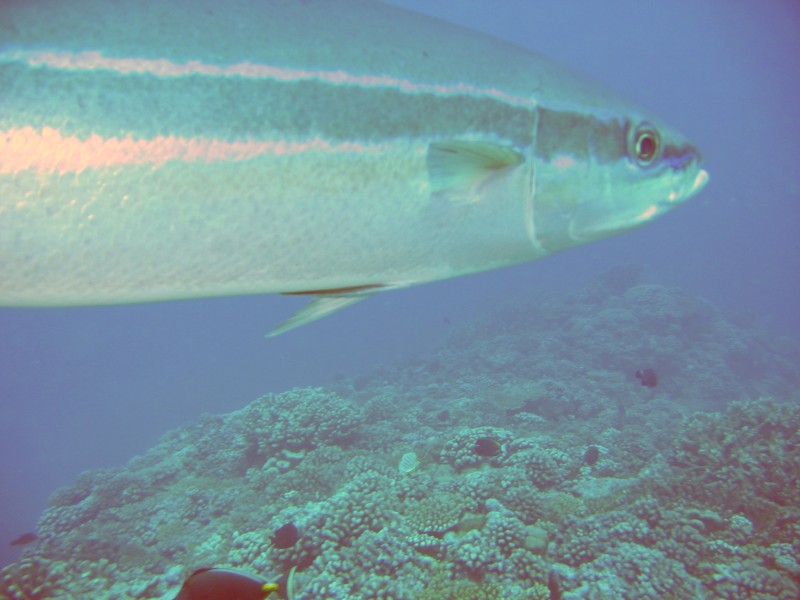 |
Rainbow Runners Elagatis bipinnulatus are found circumtropically, and we have swum with them in both Venezuela and French Polynesia. Growing up to 1.5 m (about 4 feet), they are silvery, with light blue and olive green stripes on their long, slender bodies. In Venezuela they are called "salmon". They are very good eating! |
 The Cornetfish Fistularia commersonii (aka flutefish
in the Indian Ocean) is sometimes mistaken for the
trumpetfish, because both are elongate with pointed snouts, but the
cornetfish can reach lengths of 5 feet, while the trumpetfish adults
reach only half that length. The tail is another identifying aspect:
the cornetfish's tail is long and whip-like, while the trumpetfish's tail
is flattened and broad, often with stripes. The powerfully beaked
trumpetfish Aulostomus chinensis often hover over puffer fish or
parrotfish as they feed on coral. The bits of coral and algae that
float free attract myriad small fish, upon which the trumpetfish preys
with rapid, darting motions, spearing the fish on its beak.
The Cornetfish Fistularia commersonii (aka flutefish
in the Indian Ocean) is sometimes mistaken for the
trumpetfish, because both are elongate with pointed snouts, but the
cornetfish can reach lengths of 5 feet, while the trumpetfish adults
reach only half that length. The tail is another identifying aspect:
the cornetfish's tail is long and whip-like, while the trumpetfish's tail
is flattened and broad, often with stripes. The powerfully beaked
trumpetfish Aulostomus chinensis often hover over puffer fish or
parrotfish as they feed on coral. The bits of coral and algae that
float free attract myriad small fish, upon which the trumpetfish preys
with rapid, darting motions, spearing the fish on its beak.
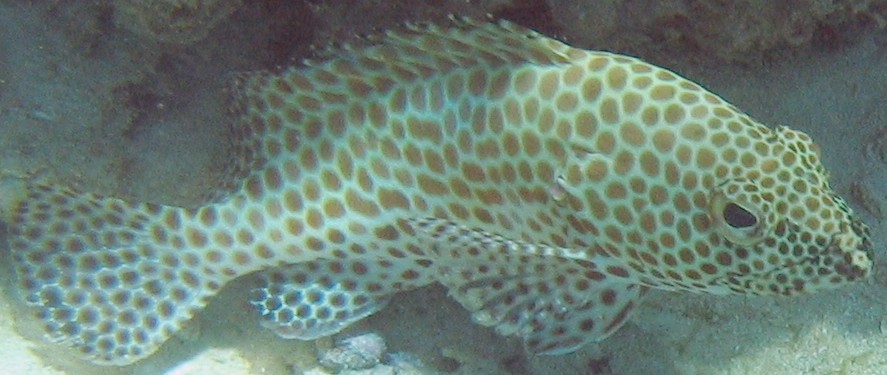 |
Groupers (aka sea basses, cods, hinds and sea trout) are in the family Serranidae which includes 6 genera made up of 57 species. The Giant Grouper can attain a size of over 2m (6.5 ft) long. Groupers all have strong, heavy bodies, with large lips. They are carnivorous, sucking small crustaceans and fishes into their mouths as they feed near the sea bottom. Large groupers are slow to mature, taking many years to reach maturity, while small ones may be mature in one year. Most are hermaphrodidic, beginning life as female and later changing to male. At left is one of the smaller species, the Honeycomb Grouper Epinephelus merra which has large polygonal spots over a white body and attains a length of about 32 cm or 13 inches. (New Caledonia) Photo Sue Hacking |
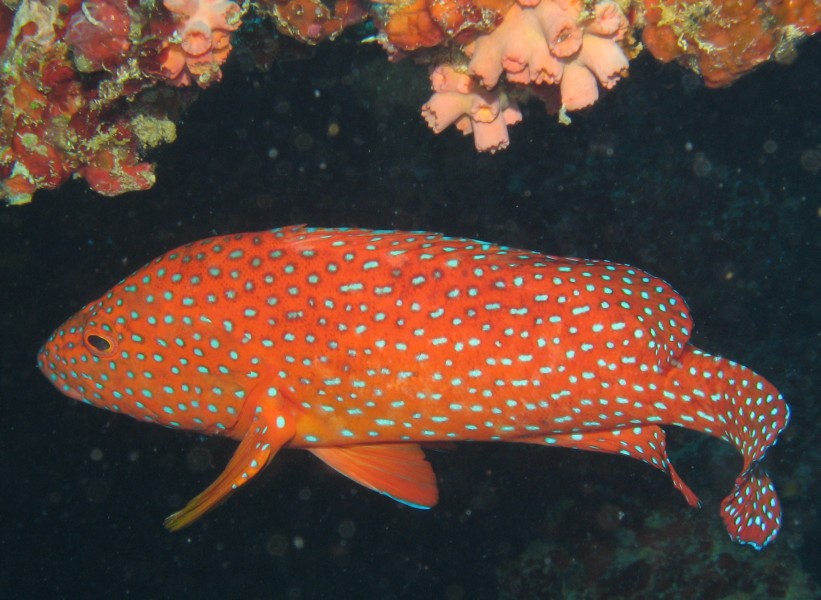 |
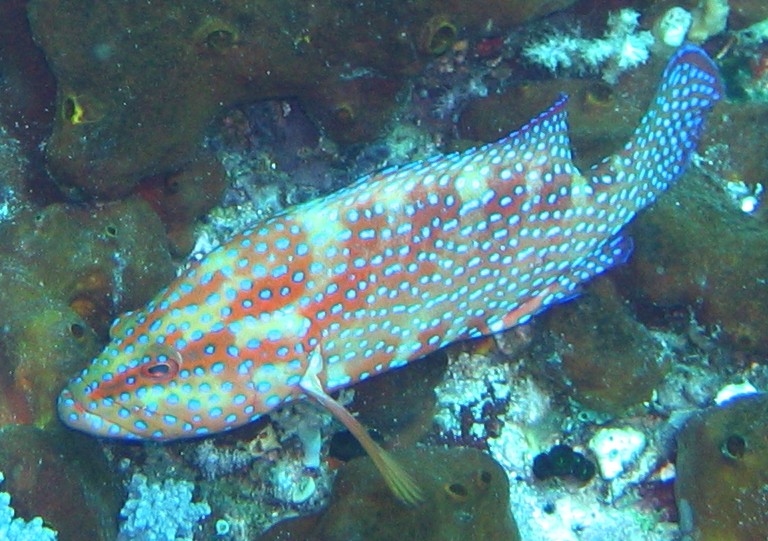
Vermillion Rock Cod Cephalopholis miniata is a strikingly beautiful grouper with red-orange body highlighted by light blue spots (left). Interestingly, the individual (right) with its whitish body with patterned red-orange (still highlighted by blue spots) is also a Cephalopholis miniata, perhaps an older adult. This species does not appear in our Reef Fish of the Tropical Pacific book, but is in our Fish of the Maldives book, leading us to believe the range is at least Indian Ocean to Indonesia. (Photo left: Addu Atoll, Maldives. Photo right: Komodo Nat. Park, Indonesia). Photos by Amanda Hacking |
 |
 Animal Buddies
With both the anemonefish and the shrimp goby
you can see how pairs of quite dissimilar animals live together offering mutual protection.
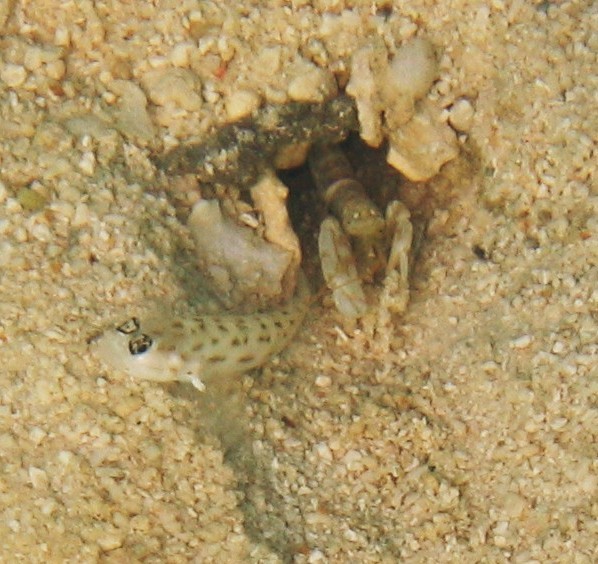 Shrimp gobies (family Gobiidai) live commensal lives with snapping
shrimp (genus Alpheus), so called for the clicking noise they make with their
pincers, in shallow sand banks (right). The burrow, dug by the shrimp, serves as
home and protection for both species. The nearly blind shrimp rely on
the sharp eyes of the goby to warn of danger, and the goby needs a
quick place to hide from predators. The fish rarely wanders far from the
tunnel except to grab a bite of sand which it filters for food. When the
shrimp is not rebuilding its tunnel and entrance (which is almost a
full-time job) it rests just inside the entrance, usually with one
antenna touching the tail of the goby. A slight twitch from the fish
warns of danger. A violent thrashing means Hide! It takes less than
1/10th of a second for the two to disappear.
Shrimp gobies (family Gobiidai) live commensal lives with snapping
shrimp (genus Alpheus), so called for the clicking noise they make with their
pincers, in shallow sand banks (right). The burrow, dug by the shrimp, serves as
home and protection for both species. The nearly blind shrimp rely on
the sharp eyes of the goby to warn of danger, and the goby needs a
quick place to hide from predators. The fish rarely wanders far from the
tunnel except to grab a bite of sand which it filters for food. When the
shrimp is not rebuilding its tunnel and entrance (which is almost a
full-time job) it rests just inside the entrance, usually with one
antenna touching the tail of the goby. A slight twitch from the fish
warns of danger. A violent thrashing means Hide! It takes less than
1/10th of a second for the two to disappear.
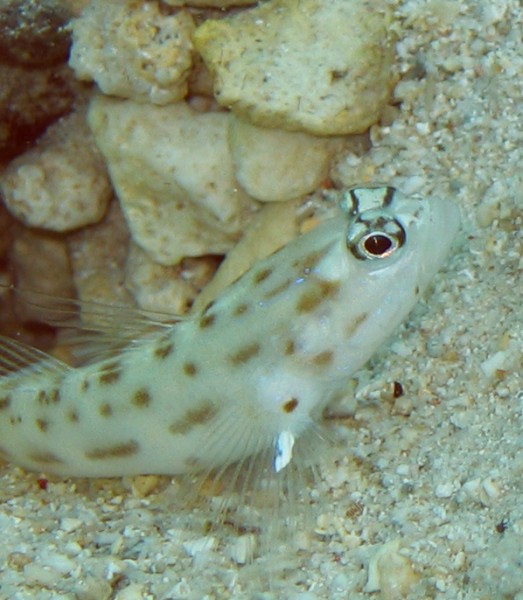
It seems that both of these are the Sand Shrimpgoby Ctenogobiops feroculus, distinguished by its pale body, dark blotches, and several blue spots behind the eyes. Other similar species have tiny orange spots as well, which these lack. The white spot on the pectoral fin is also characteristic. However, our guide says the Sand Shrimpgoby extends only as far east as New Caledonia, while both of these pictures were shot in French Polynesia.
Top Level: Home | Destinations | Cruising Info | Underwater | Boat Guests | Ocelot | Sue | Jon | Amanda | Chris | Site Map | Make a Comment
|
If our information is useful, you can help by making a donation |
Copyright © 2000‑ Contact: Jon and Sue Hacking -- HackingFamily.com, svOcelot.com. All rights reserved.