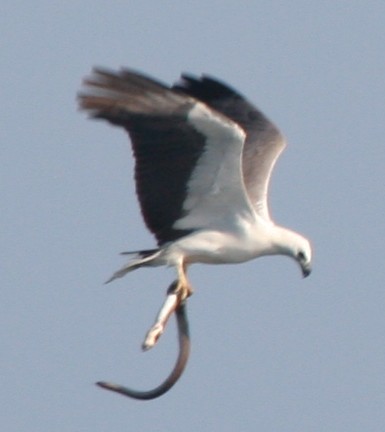
Sea eagle with a snake
|
Flora & Fauna Areas SE Asia Flora/Fauna Related Pages Southeast Asia HomeSoutheast Asia Letters |
Southeast Asia Birds
|
Sea eagle with a snake |
BIRDS of Southeast Asia
This section features some of the birds of Indonesia, Malaysia and Thailand, including Kalimantan (Indonesian Borneo), Malaysian Borneo, the Malaysian Peninsula and Langkawi Island. Southeast Asia (including Indonesia) is home to over 3,000 species of birds, many of which are endemic (meaning they occur in one region, and no where else). More than 1,500 of those occur in Indonesia alone.
|
Birding trips can be organized in Indonesia, Malaysia and Thailand. Birdlife in Doi Inthanon National Park in northern Thailand is exceptionally prolific. A birding expedition into Indonesia's Tanjung Puting National Park would yield numerous sightings of sea eagles, hornbills and kingfishers, among others. To get there by boat, you sail up the Kumai River to the town of Kumai where you can hire a klotok boat to take you into the park. By air, you can fly from Jakarta (Indonesia's capital) to one of the main towns in Kalimantan such as Banjarmasin or Palangkaraya, then to Pangkalanbun, the airport nearest Kumai and the park. Guides can be arranged upon arrival or in advance. Bali, Indonesia, is another great Indonesian birding destination. The island of Langkawi, Malaysia is accessible either by ferry from the Malay Peninsula or by air from Bangkok or the capital of Kuala Lumpur. Birding is rewarding in Malaysia's national parks. Malaysian Borneo (accessible via flights from Singapore or Kuala Lumpur) is an exceptionally great birding destination, especially in the lowland areas such as along the Kinabatangan River in Sabah, and Bako NP in Sarawak. Unusual mountain species can be found in the highlands such as on the slopes of Mt Kinabalu and Mulu National Park, but birding is always more challenging in forested areas! |
An interesting thing about Indonesia is that it is divided into 2 very distinct ecological regions as defined by the 19th century naturalist Alfred Wallace, namesake of the "Wallace Line". He observed that in the eastern part of Indonesia (including Papua and most of East Nusa Tenggara west through Lombok), the birds and plants more closely resemble (and are related to) those of Australia than those of Asia. To the west and north through all of Kalimantan (Indonesian Borneo), Borneo and the Malay Peninsula the birds, animals and plants are more closely related to those of Thailand and the rest of Asia.
An excellent field guide which we use is the New Holland Field Guide to the
Birds of South-East Asia by Craig Robson. This book limits its scope to
those birds found in Peninsular Malaysia, Singapore, Thailand, Myanmar, Vietnam,
Cambodia and Laos.
A Field Guide to the Birds of Borneo
We saw and heard some lovely birds in Tanjung Puting National Park, Kalimantan, Indonesia. Perched on the Nipa palms and mangroves bordering the meandering rivers we saw the large Stork-billed Kingfisher Halcyon capensis with its huge red bill, buff chest and blue wings and tail (see below). Like other kingfishers it is able to hover above the water while it searches for fish. A frequent sight was that of the large black and chestnut Greater Coucal Centropus sinensis which moved from tree top to tree top with its mournful call. We watched both the Black Kite Milvus migrans and the Changeable Hawk Eagle Spizaetus cirrbatus soaring above the rainforest canopy. Sandpipers, magpies and tailorbirds were all common but we didn't get photos.
All images including their larger counterparts are copyrighted material by Amanda Hacking or Sue Hacking. For purchase of one-time-rights or permission to use an image, please contact us.
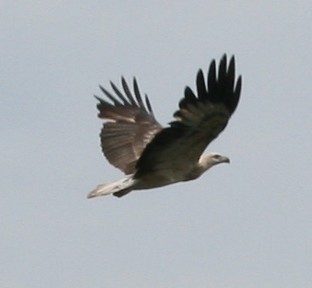 |
The White Bellied Sea Eagle Haliaeetus leucogaster is a constant companion to those of us at anchor on the coasts of Indonesia, Malaysia and Thailand. Feeding on fish and snakes (see above!) it circles over the water using its incredible eyesight to find its next meal. The fish (or sea snake) is grasped in talons and taken ashore to a roosting spot for consumption. These sea eagles may travel inland in search of food. Their white bellies and head are unmistakable in flight or as they soar with wings held in an upright V. They are very large birds, up to almost 3 feet (85 cm) from head to tail. |
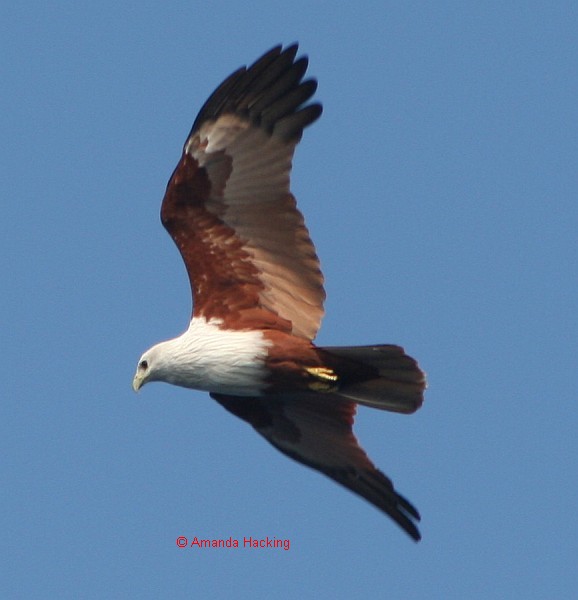
| The magnificent Brahminy Kite Haliaster Indus with its white head, neck and chest and cinnamon-bronze colored wings is a common sight in both the Malaysian and Thai islands where it is a resident. These birds often scavenge around harbors but are also found well inland. They are relatively small (up to 48 cm or 19 inches long) and fly with swift kite-like flight pattern. They feed on small rodents, snakes and carrion. Brahminy kites are found all across SE Asia, and west to the Indian sub-continent. |
 |
 |
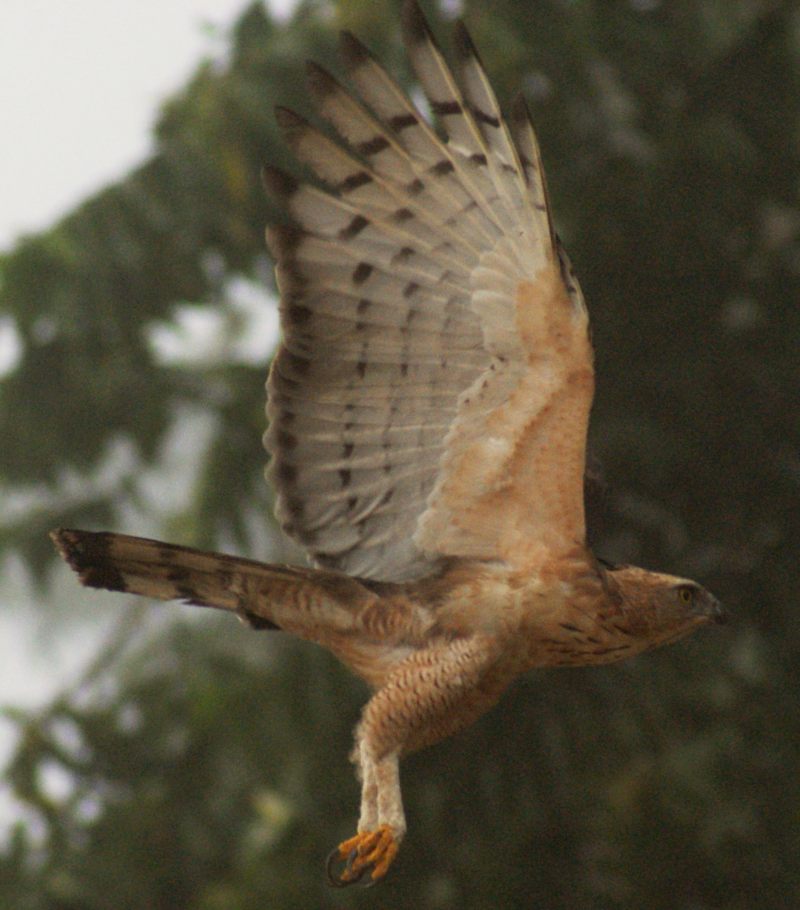 |
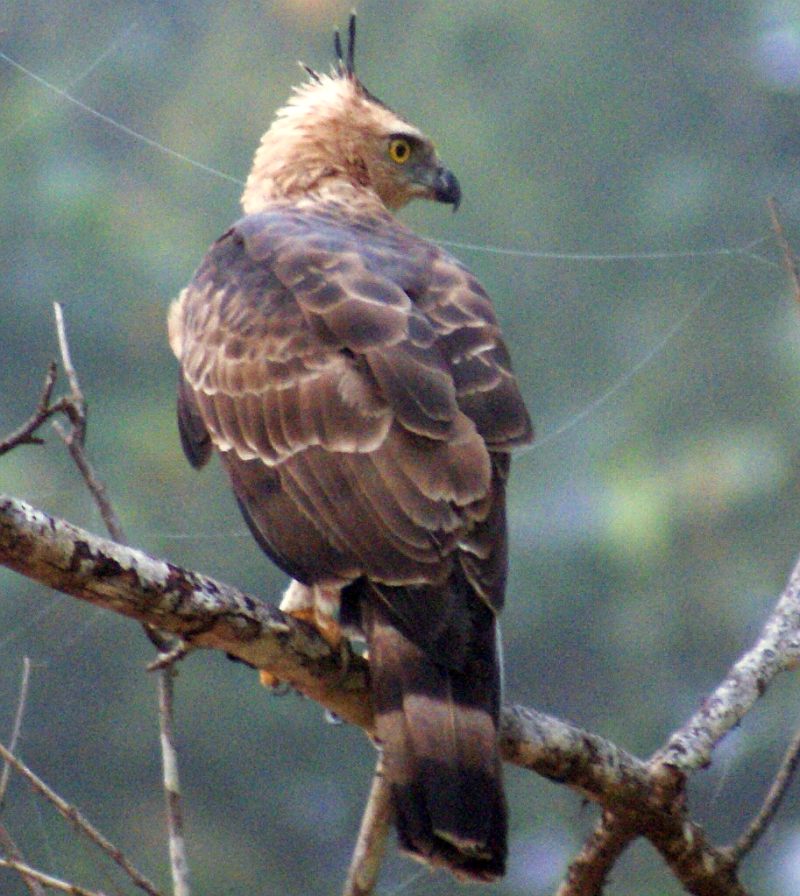
Patiently awaiting signs of prey, this juvenile Wallace's Hawk Eagle Nisaetus
nanus (left) perched on branches along the shores of the Kinabatangan River, in
Borneo. This crested bird of prey feeds almost exclusively on arboreal prey: birds,
mammals and reptiles. The adult Wallace's Hawk Eagle has a dark head with dark streaks on
the chest and belly. Found from Thailand to Peninsular Malaysia and Borneo, it is uncommonly
seen n Borneo. Lucky us! It inhabits lowland forests, swamp and riverine
forests. Its call is a flat pit weeee.
Blythe's Hawk Eagle juvenile is very similar, and we have to go with the judgment of our eco-guide, Mirwan, who called this as a Wallace's. |
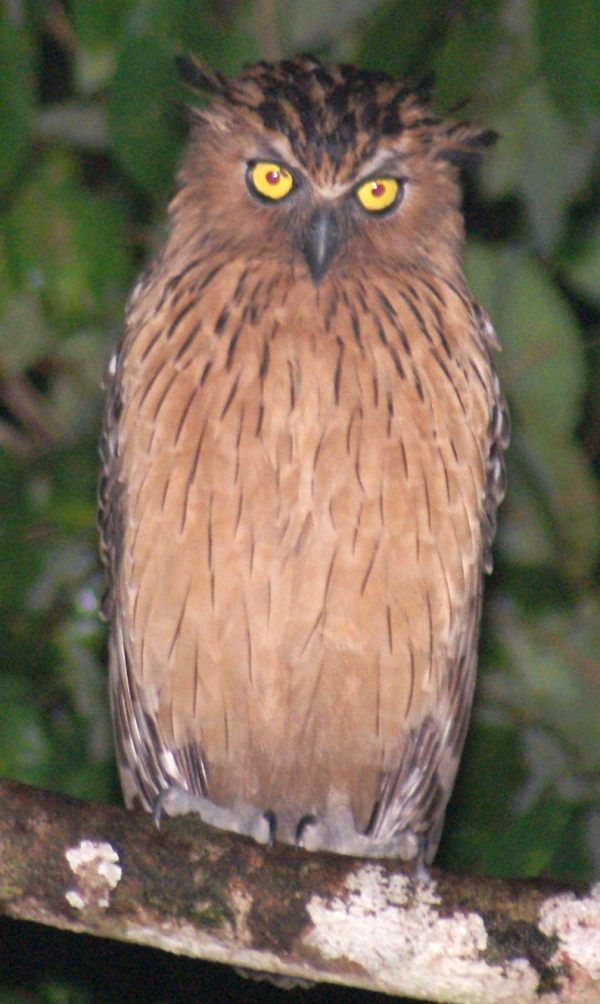 |
On a night boat safari on the Kinabatangan River in northern Borneo we came upon this
Buffy Fish-Owl Ketupu ketupu (left) perched over the river. This juvenile (noted
as juvenile because of lack of buffy‑white on the eyebrows and ear tufts) was very alert, no
doubt searching the water below for small crustaceans, fish, frogs, and aquatic
invertebrates. They also prey on small birds and mammals. Nocturnal, they roost in thick
foliage and palms during the day. They nest in epiphytic plants or tree hollows. They
are primarily found in lowland forests near water, including forest-rimmed rice paddies,
parks and plantations. They have a variety of calls: an up-slurred scream, a long wail and a
more melodic fluting sound like someone blowing over a bottle.
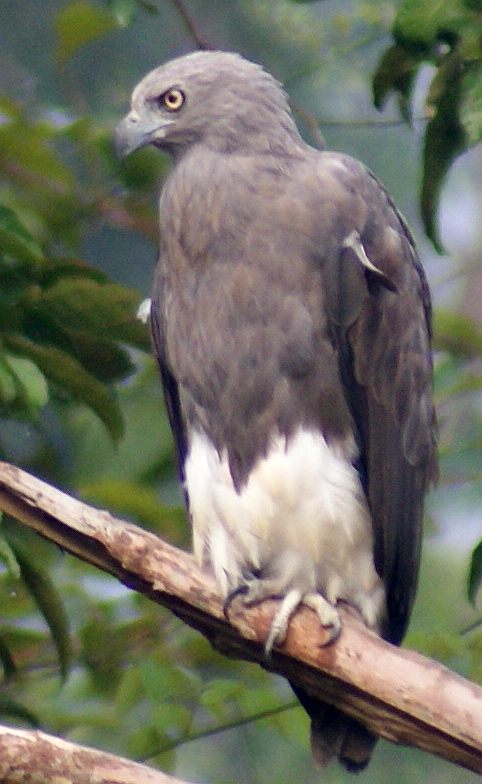
In the lowland forests of Borneo, the Lesser Fish Eagle Ichthyophaga humilis (right) might be seen perched over the water where it is on the lookout for fish, it's only prey. The adult Lesser Fish Eagle has a paler, more gray chest than the juvenile we photographed here. They live in narrow, undisturbed forests that border rivers, mangroves and plantations. They can be found from the Himalayas to most areas of Southeast Asia, Borneo and Indonesia. They emit a 2‑part call and a 4‑note whistled foo‑foo‑foo‑foooo. |
 |

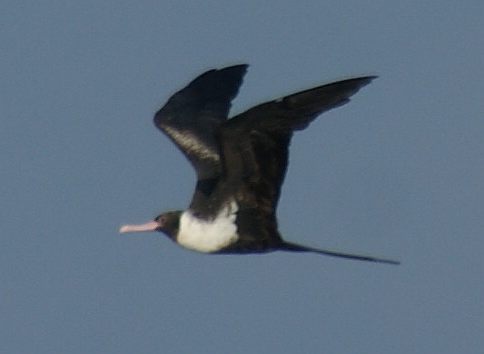 Both
the Great Frigatebird Fregata minor and
the Lesser Frigatebird Fregata ariel (female, right) are commonly seen
soaring over the coasts of SE Asia. In fact, these 2 species
of frigate bird have been with us all across the Pacific Ocean! It is
sometimes hard to get a field ID because you have to see the color of the
underwing. Frigatebirds are almost prehistoric looking with their
sharply angled wings and split tails. Great Frigatebirds reach
1 meter (40 inches) in length, while the Lesser Frigatebirds are
about 20 cm (8 inches) shorter. Both species are aggressive and
attack smaller birds such as terns to steal their fish. When they get their own fish,
they use their powerful hooked beaks to pluck the fish from the ocean. They are related
to pelicans, boobies and cormorants. Both
the Great Frigatebird Fregata minor and
the Lesser Frigatebird Fregata ariel (female, right) are commonly seen
soaring over the coasts of SE Asia. In fact, these 2 species
of frigate bird have been with us all across the Pacific Ocean! It is
sometimes hard to get a field ID because you have to see the color of the
underwing. Frigatebirds are almost prehistoric looking with their
sharply angled wings and split tails. Great Frigatebirds reach
1 meter (40 inches) in length, while the Lesser Frigatebirds are
about 20 cm (8 inches) shorter. Both species are aggressive and
attack smaller birds such as terns to steal their fish. When they get their own fish,
they use their powerful hooked beaks to pluck the fish from the ocean. They are related
to pelicans, boobies and cormorants. |
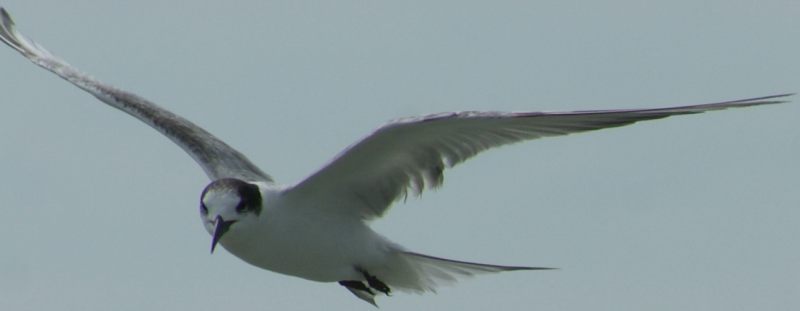
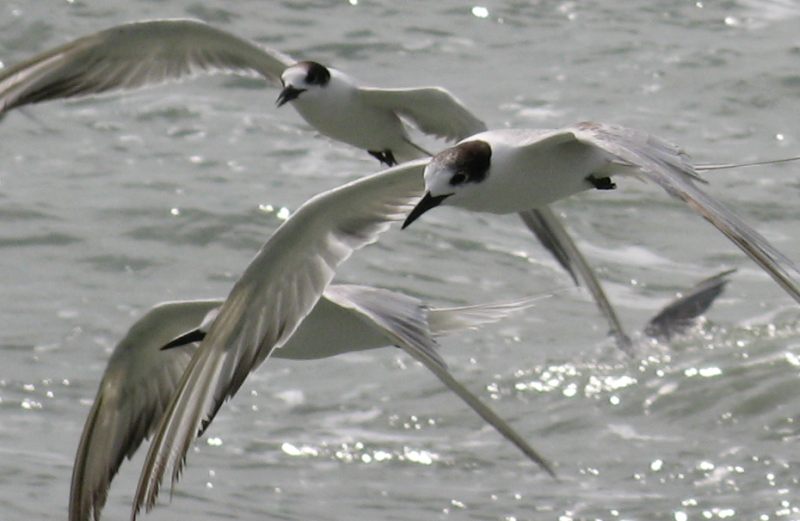 Feeding
terns often fill the air around the Thai & Malay islands (and
fishing boats!) as they scour the ocean surface for schools of small
fish. It's sometimes very hard to identify birds on the wing, unless they come very close.
One day in the Strait of Malacca we were lucky to be followed by a raucous flock of
Common Terns Sterna hirundo.
Terns most often nest on the ground with at most a few sticks for the nest. They
are related to gulls, and are found world-wide, but especially in the tropics. Feeding
terns often fill the air around the Thai & Malay islands (and
fishing boats!) as they scour the ocean surface for schools of small
fish. It's sometimes very hard to identify birds on the wing, unless they come very close.
One day in the Strait of Malacca we were lucky to be followed by a raucous flock of
Common Terns Sterna hirundo.
Terns most often nest on the ground with at most a few sticks for the nest. They
are related to gulls, and are found world-wide, but especially in the tropics. |
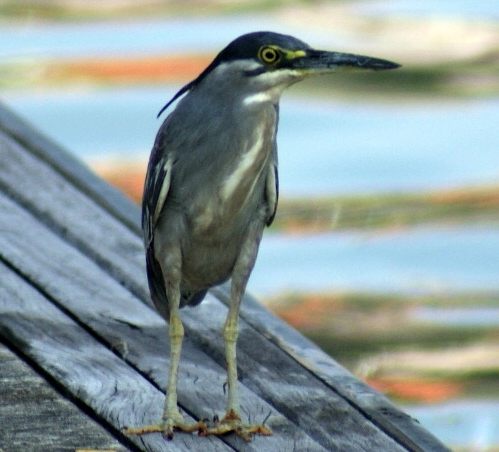 |
On mudflats and marina docks in both Peninsular Malaysia, and Borneo, the Little Heron Butorides striata (left) is a common sight. This solitary heron flushes easily, and flies low, often with an alarm squawk of kyu. This species is found throughout many parts of the world: Central and South America, sub-Saharan Africa, the Indian subcontinent, E and SE Asia, Indonesia, the Philippines and Australia. Their nests in Borneo can be seen in mangrove trees: look for messy soccer-ball-sized clumps of sticks and grasses. |
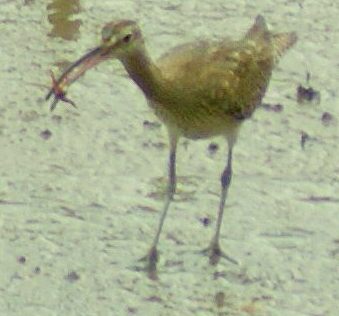
| In September, on the mudflats of Bako National Park, Sarawak, Borneo, Malaysia we saw this curlew (right) stabbing small mollusks and crabs. Due to the poor photos (mine!) and the distance, we could not tell if this was a Eurasian Numemius arquata or a Far Eastern Curlew Numenius madagascariensis. Both of these species breed in the far northern hemisphere and visit Borneo from the months of August or September until March or April. They have similar calls: ku-ree |
 |
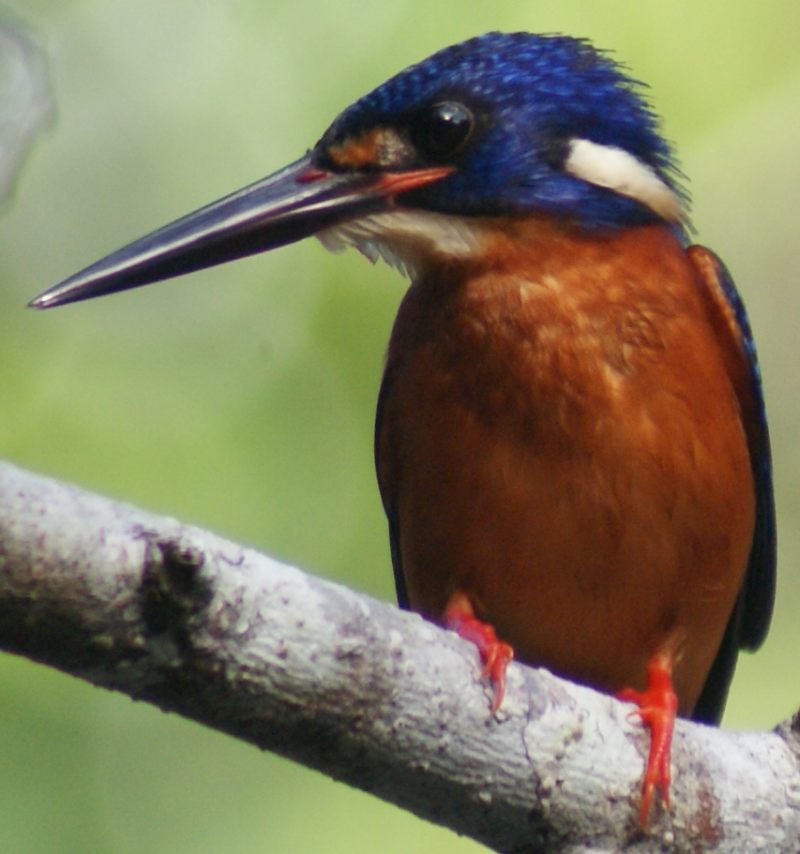 Of
the smaller kingfishers of SE Asia, the Blue-Eared Kingfisher Alcedo meninting
(right, 17 cm or 7") was the one we saw most often, especially along the rivers of
Borneo. Despite its small size, its blue head and striking white earmark and rufous chest
help it stand out from the green foliage. It is found near water: lakes, ponds, rivers and
mangroves, up to about 1000m (3300') elevation. These kingfishers hunt from
perches, looking for small aquatic invertebrates and small fish which they spear with their
pointed beaks. Of
the smaller kingfishers of SE Asia, the Blue-Eared Kingfisher Alcedo meninting
(right, 17 cm or 7") was the one we saw most often, especially along the rivers of
Borneo. Despite its small size, its blue head and striking white earmark and rufous chest
help it stand out from the green foliage. It is found near water: lakes, ponds, rivers and
mangroves, up to about 1000m (3300') elevation. These kingfishers hunt from
perches, looking for small aquatic invertebrates and small fish which they spear with their
pointed beaks.
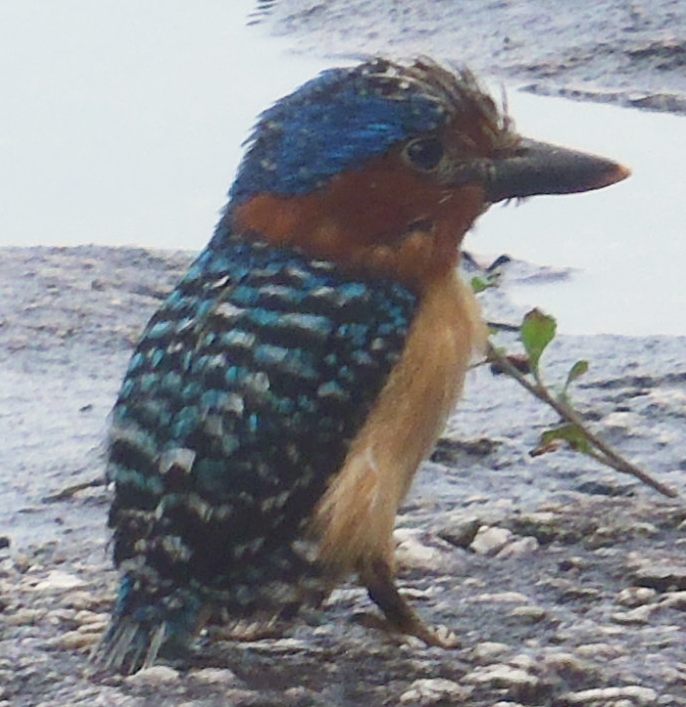
The petit Banded Kingfisher Lacedo pulchella (left) we saw in the hills of Langkawi, Malaysia. Given its short tail, it was possibly injured by the local (aggressive) monkeys, but it was still able to fly. The Banded Kingfisher is unusual as it tends to live in the middle story of forests from which it hunts for small lizards and larger invertebrates. They have a lovely call and more often heard than seen, so we were quite lucky to find this one in the open. They are found throughout SE Asia, Java and Sumatra, Indonesia. |

 The
Collared Kingfisher Todiramphus chloris (left) is found in Africa, the
Indian subcontinent, Southeast Asia, Australia and the SW Pacific. One of the less brightly
colored kingfishers, with its characteristic blue and white, it nonetheless has the distinguishing
kingfisher beak: long and hefty, capable of spearing small fish. The collared kingfisher can
be found in paddyfields, plantations, and coastal woodlands up to about 300m (1000') elevation. The
Collared Kingfisher Todiramphus chloris (left) is found in Africa, the
Indian subcontinent, Southeast Asia, Australia and the SW Pacific. One of the less brightly
colored kingfishers, with its characteristic blue and white, it nonetheless has the distinguishing
kingfisher beak: long and hefty, capable of spearing small fish. The collared kingfisher can
be found in paddyfields, plantations, and coastal woodlands up to about 300m (1000') elevation.
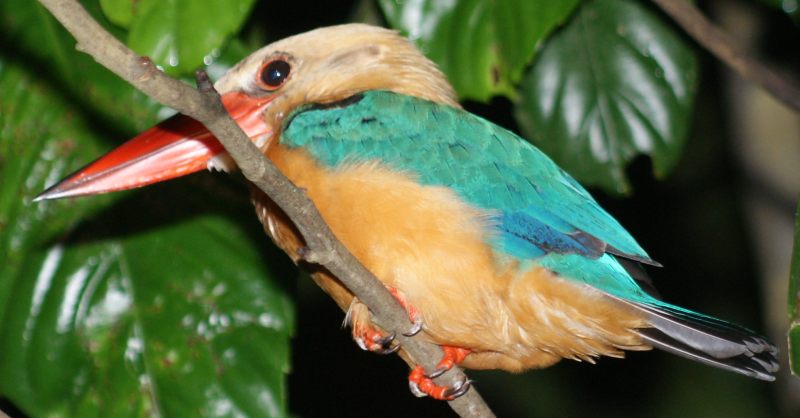
The Stork-billed Kingfisher Pelargopsis capensis (right) with its massive red bill, is a common sight in Borneo. Its range is smaller than that of the collared, and includes the Indian subcontinent, Southeast Asia, Indonesia and the Philippines. It feeds on small fish and crustaceans. During mating season it is monogamous, and can be very territorial. |
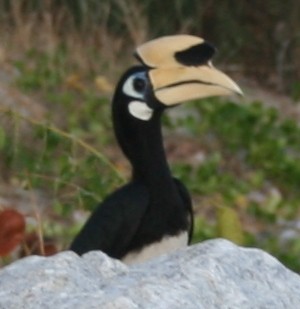 |
Stunningly marked with its black body, pale belly, white and blue facial markings and unmistakable bill, the Oriental Pied Hornbill Antbracoceros albirostris is common on the islands near Langkawi, Malaysia. They are found in most of SE Asia, and perhaps south into Kalimantan where we think we saw them flying over the jungle. These birds are noisy and gregarious, bustling about the trees, rooftops and rocky shoreline in small to large flocks. Hornbills nest in large holes in trees, and once the eggs are laid the male seals the female into the hole using mud and saliva, feeding her through a small hole. The large protuberance on the upper bill of the Oriental Pied Hornbill is called a "casque" and is present in varying sizes and colors on many other hornbill species. |
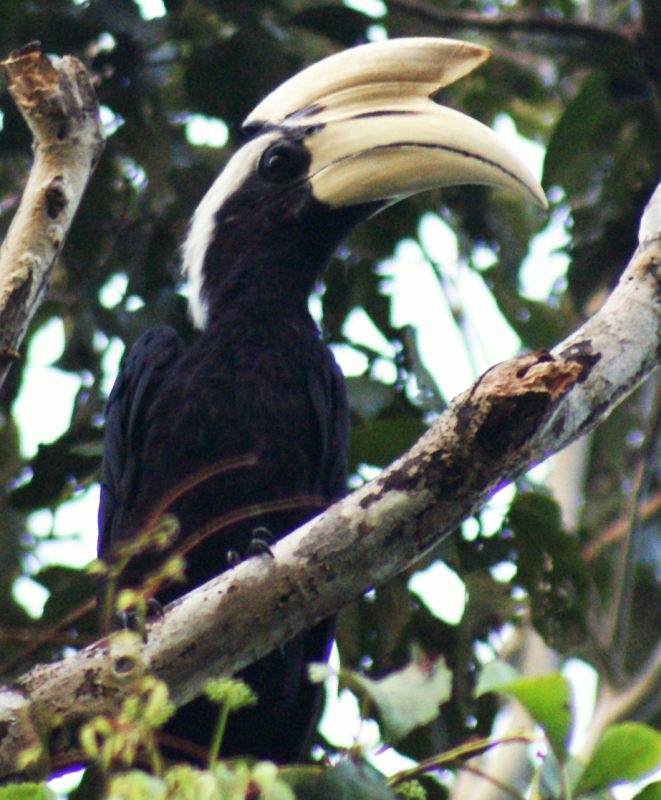
 The
Black Hornbill Anthrcoceros malayanus (left) is found on the Thia-Malay
Peninsula, Borneo, and the Indonesian island of Sumatra. It lives primarily in lowland
forest, in everything from primary dipterocarp (rainforest) to secondary growth and
plantations. Often found in pairs, this relatively small (60cm or 23") hornbill appears all
black when in flight, except for the bill and a wide white stripe near the tail tip.
Black hornbills eat large fruits and also small vertebrates and insects. We saw several
family groups in the trees bordering the Kinabatangan River, Sabah, Borneo, where this photo
was taken. The
Black Hornbill Anthrcoceros malayanus (left) is found on the Thia-Malay
Peninsula, Borneo, and the Indonesian island of Sumatra. It lives primarily in lowland
forest, in everything from primary dipterocarp (rainforest) to secondary growth and
plantations. Often found in pairs, this relatively small (60cm or 23") hornbill appears all
black when in flight, except for the bill and a wide white stripe near the tail tip.
Black hornbills eat large fruits and also small vertebrates and insects. We saw several
family groups in the trees bordering the Kinabatangan River, Sabah, Borneo, where this photo
was taken.
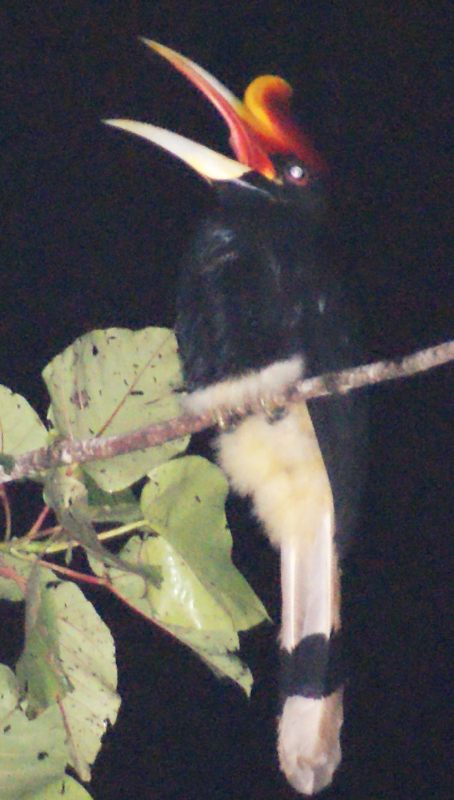
High in the treetops above the Kinabatangan River, on a night safari, our guide picked out the unmistakable color and shape of the Rhinoceros Hornbill Buceros rhinoceros (right). With spotlight and powerful flash we were able to capture an image of this large (up to 90cm or 3') showy hornbill. The tail pattern is unique among hornbills: a long white tail with a broad black band. And the casque, too is unique: red and yellow, with an elegant upsweep to the end, the amount of which varies from individual to individual. These birds nest in naturally occurring holes in trees, and the female is sealed in for up to 50 days. They may lay one or 2 eggs, but usually only 1 chick fledges. Rhinoceros hornbills prefer figs, but will eat other fruits, insects, spiders and even lizards. They range from the Thai-Malay Peninsula to Sumatra, Java, and Borneo, where this picture was taken. |
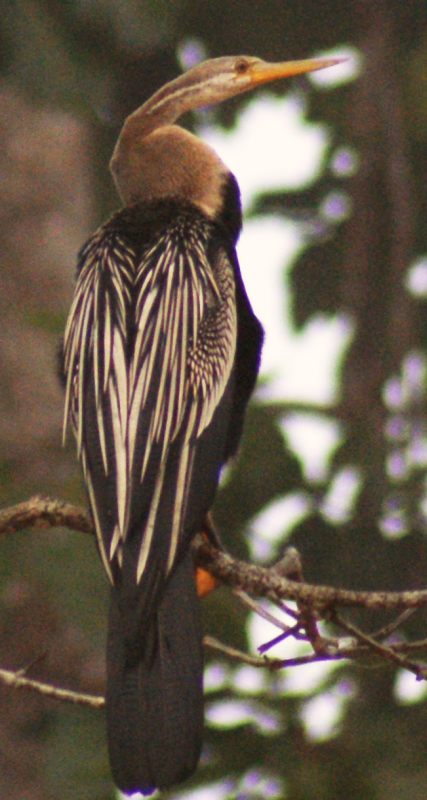
 Silent
and unmistakable with its snake-like kinked neck and long yellow bill an
Oriental Darter Anhinga melanogaster (left) perched in the trees over an oxbow
river in Borneo. This bird is large (85‑90cm or 33‑35") and often sits with
wings outstretched to dry while perched on conspicuous branches. It feeds by swimming (with
only its neck and head visible above water) then dives underwater to spear fish with its
long sharp bill. Oriental Darters are found in South and Southeast Asia, Indonesia,
Philippines, New Guinea and Australia. Darters prefer undisturbed wetlands, and their
numbers are declining as their habitat is destroyed. Silent
and unmistakable with its snake-like kinked neck and long yellow bill an
Oriental Darter Anhinga melanogaster (left) perched in the trees over an oxbow
river in Borneo. This bird is large (85‑90cm or 33‑35") and often sits with
wings outstretched to dry while perched on conspicuous branches. It feeds by swimming (with
only its neck and head visible above water) then dives underwater to spear fish with its
long sharp bill. Oriental Darters are found in South and Southeast Asia, Indonesia,
Philippines, New Guinea and Australia. Darters prefer undisturbed wetlands, and their
numbers are declining as their habitat is destroyed.
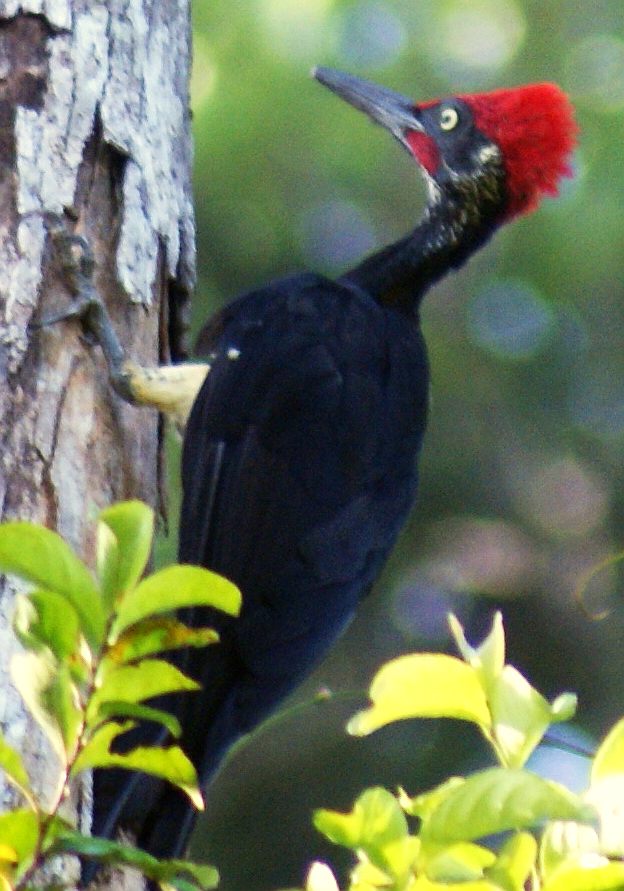
Alerted by the drumming sound of a woodpecker, we scanned the trees along the edge of the Kinabatangan River, Borneo to see a a pair of White-Bellied Woodpeckers Dryocopus javensis (right). This very large (40‑48cm or 16‑19") black, red and white woodpecker is found primarily in lowland forest, most commonly in primary forest. They are noisy, and usually in pairs. They feed on insects in (usually) rotted wood, but can be seen working their strong large beaks into everything from downed logs on the ground to tall trees. Pairs work together to excavate nest holes in damaged trees about 2‑6 meters off the ground. |
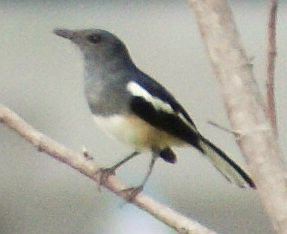 A
noticeable, and common passerine in Southeast Asia is the Oriental Magpie Robin
Copsychus saularis. This distinctive bird has several subspecies, each with
slight pattern/color variations. On the right is the Peninsular subspecies, C. s.
erimelas in which the female is decidedly more gray than black. A
noticeable, and common passerine in Southeast Asia is the Oriental Magpie Robin
Copsychus saularis. This distinctive bird has several subspecies, each with
slight pattern/color variations. On the right is the Peninsular subspecies, C. s.
erimelas in which the female is decidedly more gray than black.
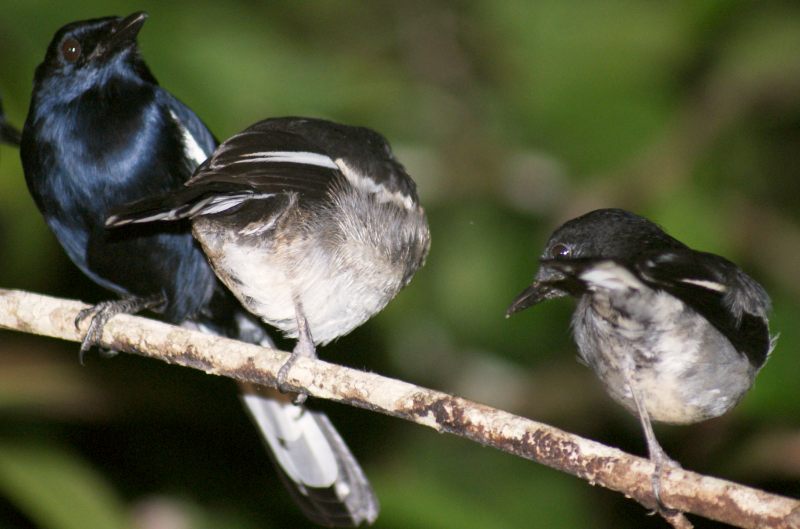
In Borneo we came upon a sleeping family of Oriental Magpie Robins, with a very black male (C.s. adamsi) and the grayer juveniles. C.S. admasi and the all black C.S. pluto are endemic subspecies, found only in Borneo. Oriental Magpie Robins are very territorial and aggressive, and often seen in pairs. They feed on small vertebrates such as geckos, plus insects. To capture their prey, they wait on perches, then pounce down onto the ground. Their varied song is a musical warble with churrs and whistles. They are found in cultivated areas, gardens, and woodland up to 1800m (about 6000'). |
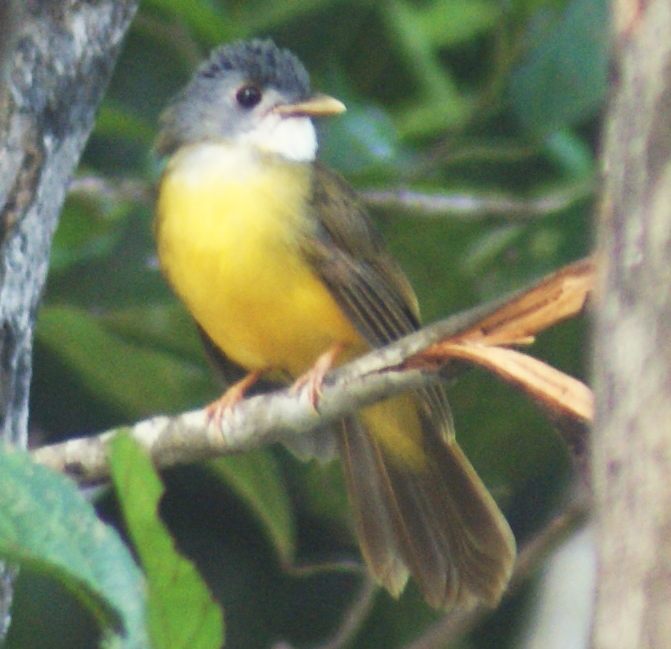 Yellow Bellied Bulbul Alophoixus phaeocephalus |
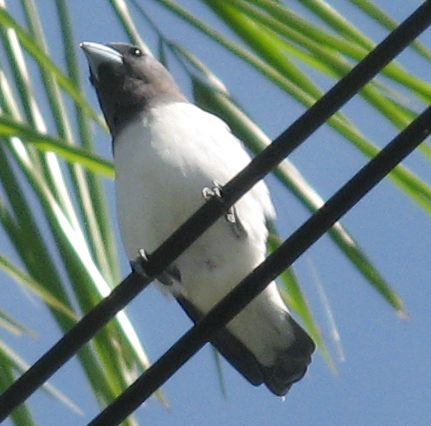 White Breasted Woodswallow Artemus leucorynchus |
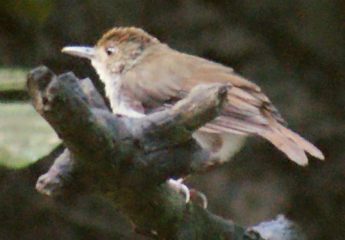 White-Chested Babbler Trichastoma rostratum Subspecies macropterum endemic to Borneo |
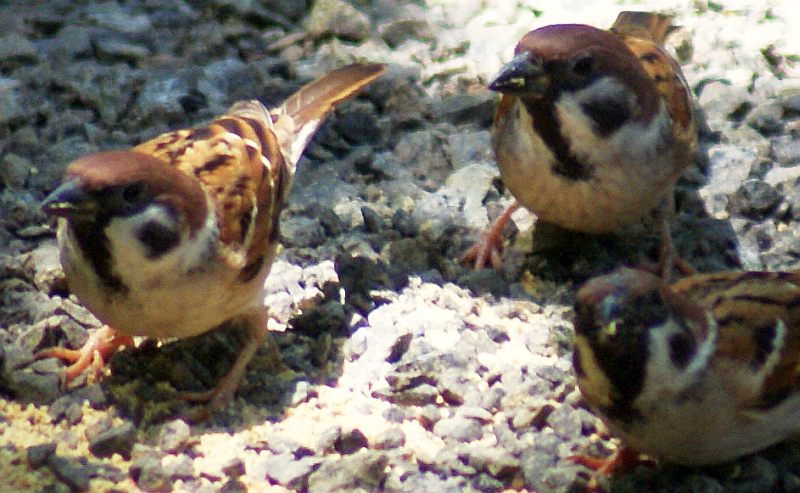 Eurasian Tree Sparrows Passer montanus. Very common |
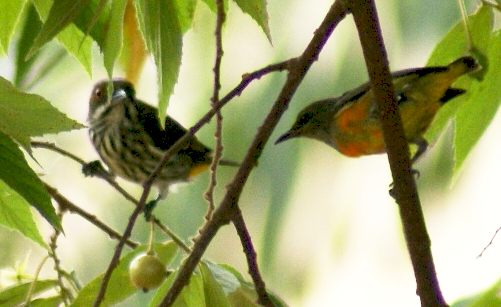 Two small birds in lowland Malaysia. No ID. Babblers? |
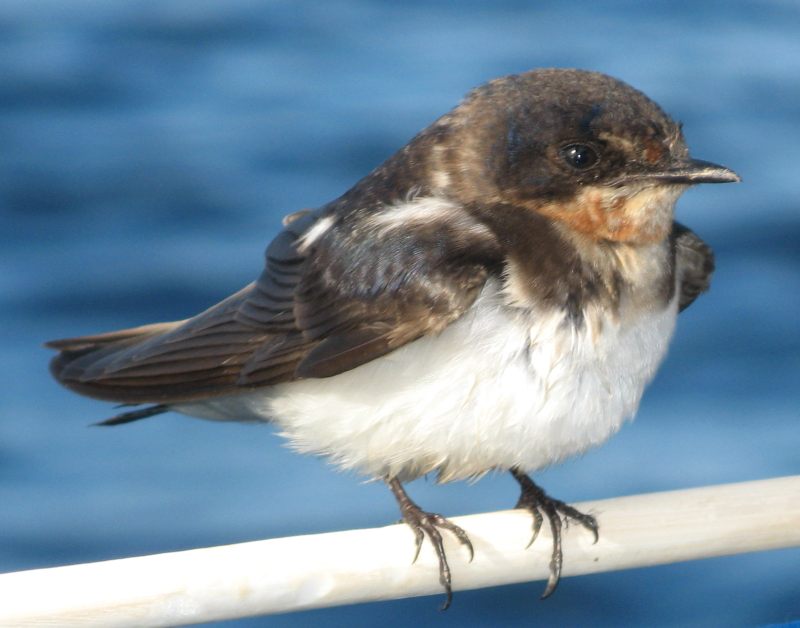
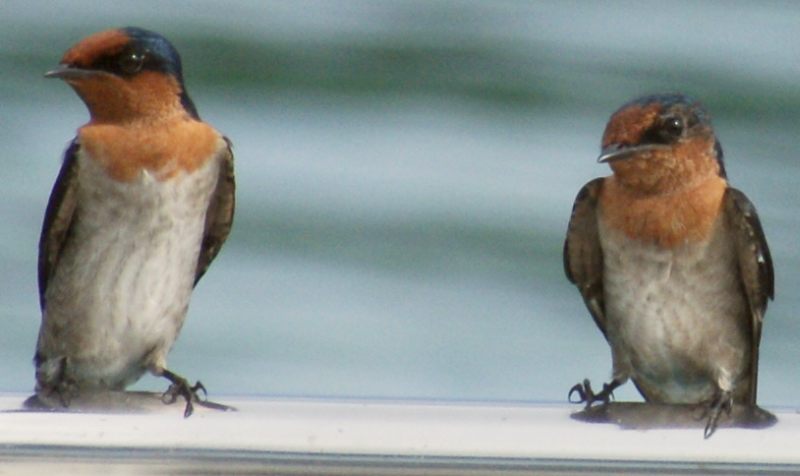 Taking
a few hours of rest during migration, small flocks of Barn Swallows
Hirundo rustica (left) often perched on the lifelines of our boat, Ocelot, as we crossed
the South China Sea in September. This juvenile was one of several that spent the
night aboard the boat, some of whom, sadly, did not survive. Barn swallows breed in the
northern hemisphere (e.g. the Himalayas) migrating to Southeast Asia where they are
abundant from July to May. The black bar on the chest distinguishes this swallow from the
Pacific Swallow. Taking
a few hours of rest during migration, small flocks of Barn Swallows
Hirundo rustica (left) often perched on the lifelines of our boat, Ocelot, as we crossed
the South China Sea in September. This juvenile was one of several that spent the
night aboard the boat, some of whom, sadly, did not survive. Barn swallows breed in the
northern hemisphere (e.g. the Himalayas) migrating to Southeast Asia where they are
abundant from July to May. The black bar on the chest distinguishes this swallow from the
Pacific Swallow.
Also hitching a ride on our boat were many Pacific Swallows (aka House Swallows) Hirundo tahitica (right) often in mixed flocks with the Barn Swallows. Similar in size and jizz to the Barn Swallow, Pacific Swallows have no dark bar on the chest separating the upper reddish parts from the gray-white breast and belly. Pacific Swallows live in Southeast Asia year round, nesting under eaves of buildings or bridges in mud nests. All swallows are aerial insectivores, meaning they prey on flying insects (like mosquitos!) They are seen over water, rice paddies and towns, swooping and sweeping in search of their flying meals. |
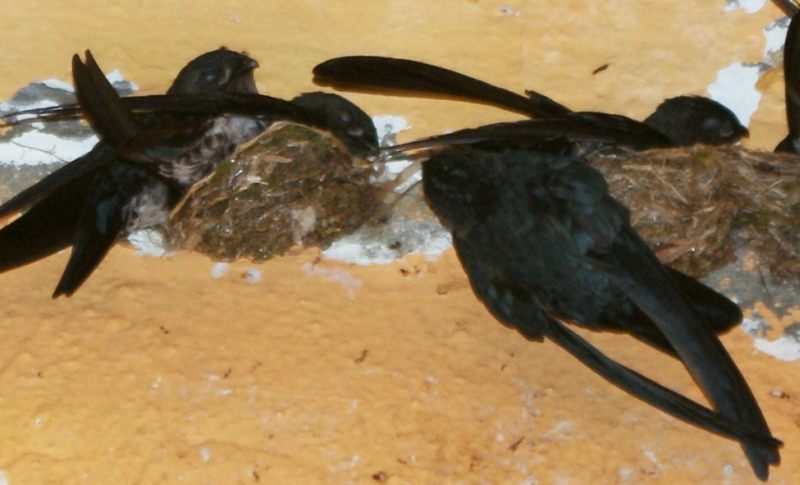 |
Under the rafters of a concrete hotel in the interior of Borneo we found these very gregarious small birds. Given the different nesting patterns of swiftlets (most nest in caves or rack walls), we are guessing these are Glossy Swiftlets Callocalia esculenta (left). They are aerial insectivores, and can be found in forests or near human habitation. Like other swifts they have long curved wing for their aerial acrobatics, and very short legs and feet. They are found on the Thai-Malay Peninsula, through Indonesia and into the SW Pacific. They breed mainly in May and June, but may breed year round. |
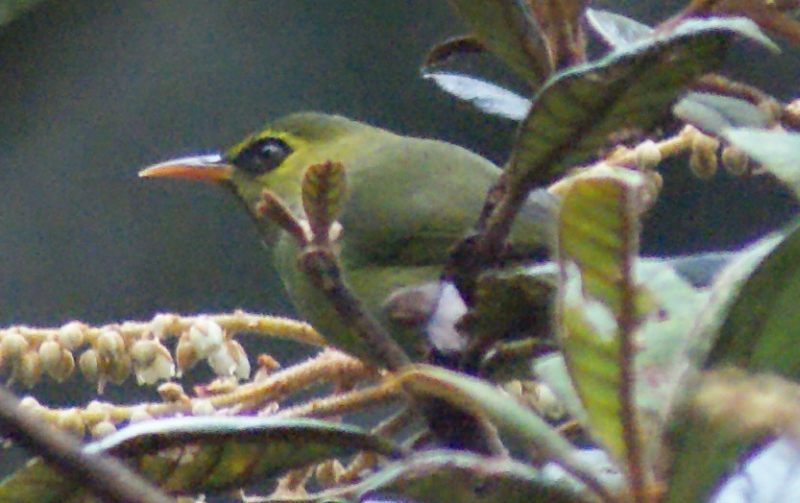
| This beautiful small (12‑14cm or about 5") Mountain Blackeye Chlorocharis emiliae (right) is endemic to the mountainous regions of north central and western Borneo. We came upon a pair of them in this flowering tree, feeding on the nectar on the slopes of Mt. Kinabalu, Sabah, Borneo. They also feed on small invertebrates. They are the most commonly seen small bird on the slopes of Mt. Kinabalu from 1500‑2600 meters (5000‑8500') elevation. They have a sweet, melodious thrush-like song. |
 |
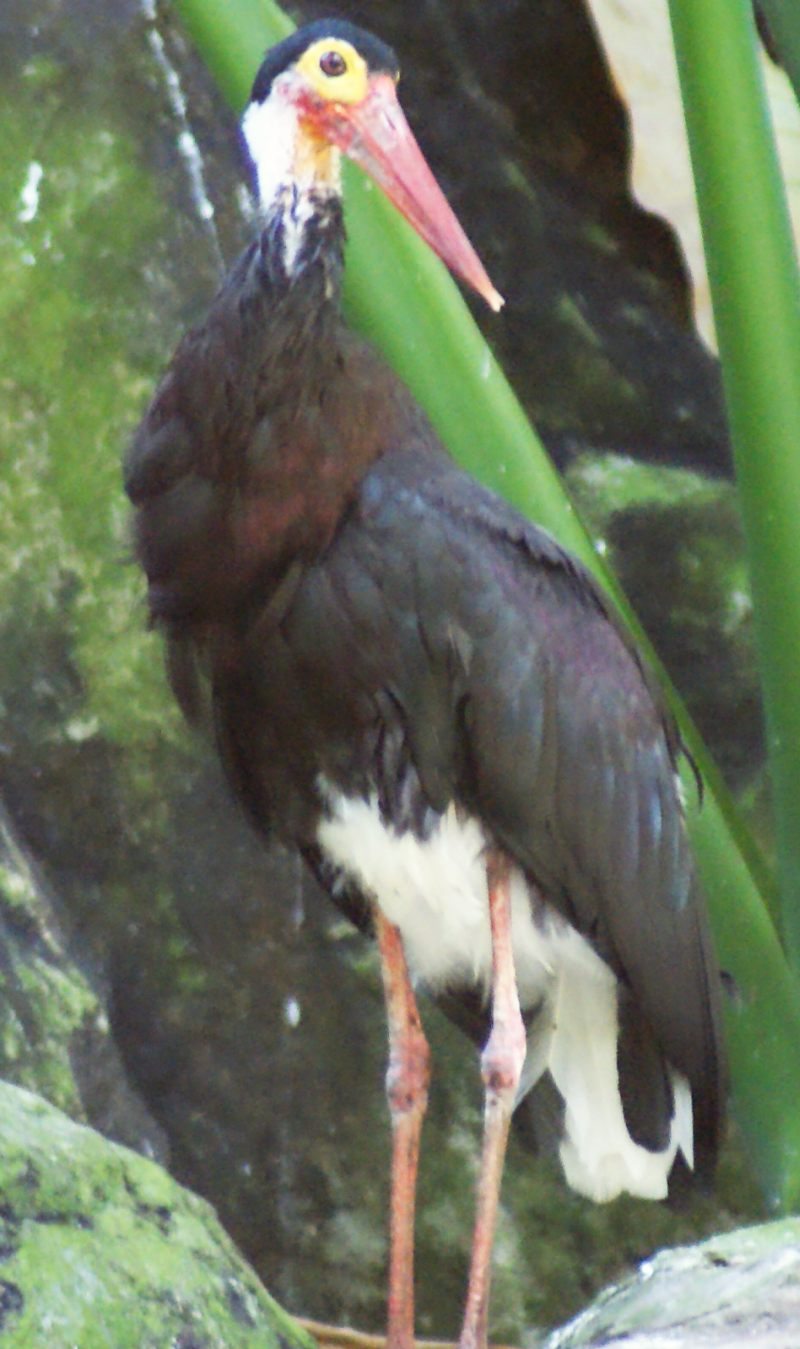 |
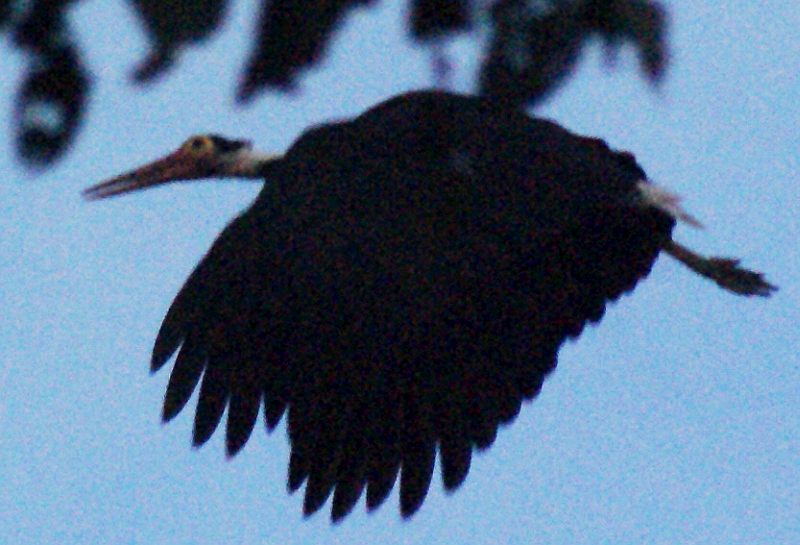
The secretive Storm's Stork Ciconia stormi inhabits lowland forest, flood plains, and mangrove forests of the Thai-Malay Peninsula and Borneo. It feeds, like other storks, by quietly stalking prey (large invertebrates and small vertebrates) in tall grass, then spearing the animal with its pointed bill. We were very lucky to see a Storm's Stork fly overhead while on the Kinabatangan River in Borneo. Later, we saw the bird (left) in captivity at the Labuan Bird Park, Labuan, Malaysia. In the wild, these birds often are seen perched high atop a tree. This stork is Endangered, and one its last strongholds is the state of Sabah, Borneo, Malaysia, where we saw one in flight. |
 |
 |
The Green Imperial-Pigeon Ducula aenea (left) is frequently seen in small flocks atop fruiting trees (their primary diet being fruit). These imperial-pigeons range from the Indian subcontinent, through South China, Southeast Asia to Indonesia and the Philippines. They inhabit primary and secondary lowland forests up to 1000m (3300ft). They can fly with amazing acrobatics during their display flight -- a steep climb, almost stall, followed by a sudden steep dive. Their call is a descending two-note ka khoon. |
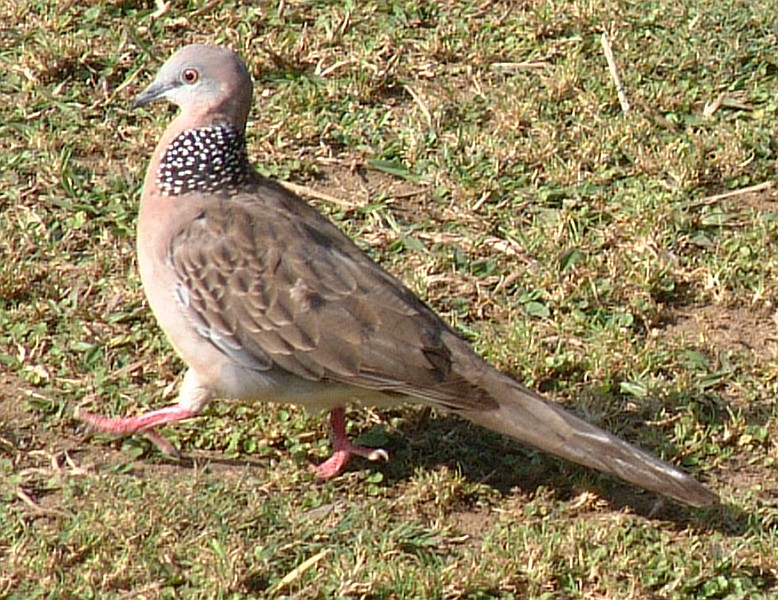
| Common throughout SE Asia and south into Bali is the lovely Spotted Dove Streptopelia chinensis (right). This bird has an unmistakable necklace of black with white spots, a buff-gray head and back with a pale chest and belly. About 30 cm (1 foot) long, the spotted dove is found in gardens, parks, open woodland, open areas and scrub from sea leel up to 2,000 meters (6,600 feet). This dove has been successfully introduced in California. |
 |
Top Level: Home | Destinations | Cruising Info | Underwater | Boat Guests | Ocelot | Sue | Jon | Amanda | Chris | Site Map | Make a Comment
|
If our information is useful, you can help by making a donation |
Copyright © 2000‑ Contact: Jon and Sue Hacking -- HackingFamily.com, svOcelot.com. All rights reserved.