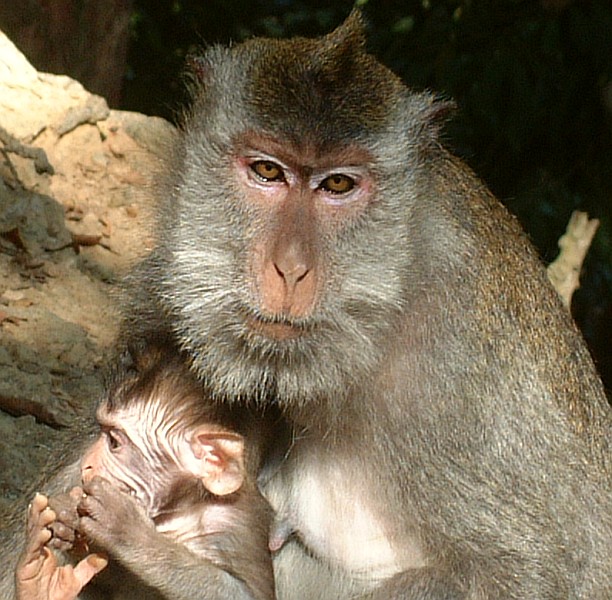
A Macaque mother and baby
|
Flora & Fauna Areas SE Asia Flora/Fauna Related Pages Southeast Asia HomeSoutheast Asia Letters |
Southeast Asia Primates
|
A Macaque mother and baby |
Orangutans, gibbons, proboscis monkeys, macaque monkeys and langurs are all primates found in Southeast Asia. You can see them in Indonesia, Malaysia (the Malaysian Peninsula, and Borneo) and Thailand.
In the world of mammals, the order Primates includes some 235 species of animals, including the obvious ones like humans, gorillas and chimpanzees, but also less known ones like lorises. As humans we seem to have a fascination with the sub-order of primates known as anthropoids, meaning they are human-like. These include the great and lesser apes and the monkeys. Primates that are the least like humans are in the sub-order prosimian.
| Where to find primates in Indonesia,
Malaysia and Thailand. Macaque monkeys are just about
everywhere -- sitting by the roadside in forests, on roof-tops, around
temples and shrines, and unfortunately, picnic areas and parks where
they have become accustomed to hand-outs. Please Do Not Feed Them. Human food
is not a natural part of their diet, and they can become aggressive
towards people. A monkey bite can easily become infected or give the recipient rabies. An alert visitor to Southeast Asia might see langurs as well as macaques. The apes and larger monkeys of Southeast Asia are concentrated in the rainforests of Sumatra and Borneo (both Malaysian and Indonesian). Here you'll find proboscis monkeys, gibbons, langurs and orangutans. Their habitat is threatened by the increasing expansion of palm oil plantations and the orangutans' very existence is now endangered. Political activism and Eco-tourism may be their only chances for survival (for instance, we don't buy palm-oil products). Educational opportunities abound! Expeditions can be organized to access the habitats of these animals, and there are volunteer opportunities for those with more time. |
In Southeast Asia the largest (and therefore sometimes the most exciting) group of primates to see are the monkeys and apes. In the rainforests of Kalimantan (Indonesian Borneo) we saw 7 different species! Macaque monkeys are found throughout Asia and are common in and around religious shrines and roadside parks (where, unfortunately, they are often given hand-outs). The Dusky Langur we saw in Langkawi was an unexpected treat as they are somewhat shy. This page is not attempting to show anywhere near all the primates of SE Asia, but highlights the few that we were able to photograph.
Many of the primates shown here were seen and photographed in Tanjung Puting National Park, Kalimantan, Borneo, Indonesia. To get there by boat you sail up the Kumai River to the town of Kumai where you can hire a klotok boat (so named because of the sound of their single-cylinder diesel engines) to take you into the park. By air, you need to fly from Jakarta (Indonesia's capital) to one of the main towns in Kalimantan such as Banjarmasin or Palangkaraya, then to Pangkalanbun, the airport nearest Kumai and the park.
Getting to Langkawi, Malaysia one can travel by ferry from the Peninsula or by air from Kuala Lumpur or Bangkok. The national parks of Malaysian Borneo are easily accessed by air from Kuala Lumpur.
For more on other animals (fauna) of SE Asia, both reptiles and mammals, see our Other SE Asia Animals page. Check our SE Asia Birds page for more on the birds we saw.
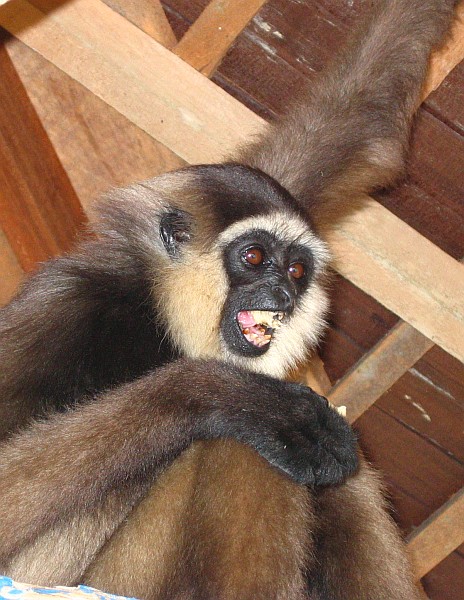
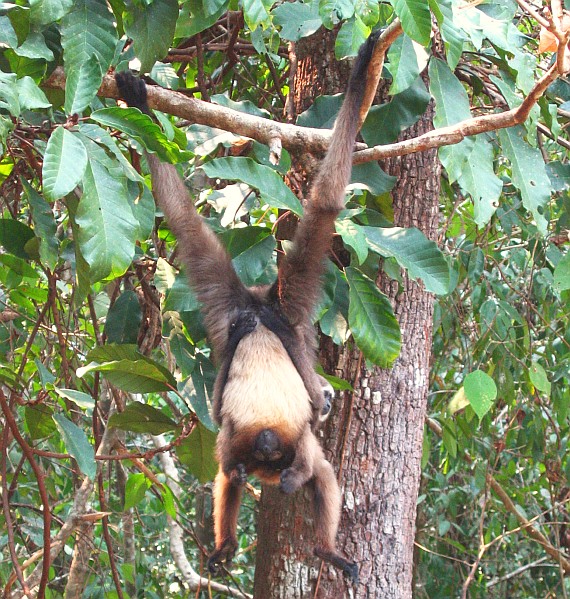
While
walking around the grounds of the Orangutan sanctuary in
southern Borneo we came upon a troop of Gibbons Hylobates
agilis who had taken over the a picnic shelter. And feeling very
possessive of it! Swinging with incredible swiftness and agility, they
moved from shelter roof to tree limbs to the ground like flashes of
brown, black and white. Then we saw a female and baby suspended
upside down in a nearby tree, so intertwined we couldn't tell which
was which! These distinctively long lesser apes are found only in SW
Borneo and are sometimes known as the Black Handed Gibbon. (Their faces
are also black, some with a white fur fringe.) Their diet consists of
fruit, leaves, flowers and insects. Their very long limbs allow them
to brachiate easily through the trees where they spend most of their time,
though they do come to ground to feed and play. The mate for life, are
very territorial and live in small family groups. A large gibbon,
either male or female, might stand 75‑90 cm (30‑35 inches)
high, with an arm span nearly twice as long. |
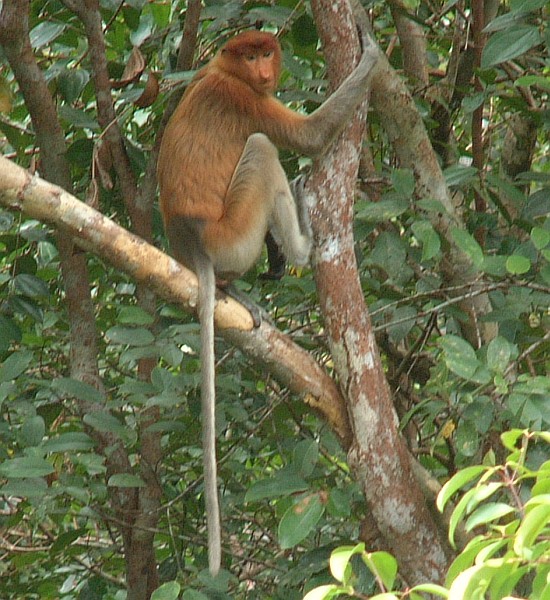
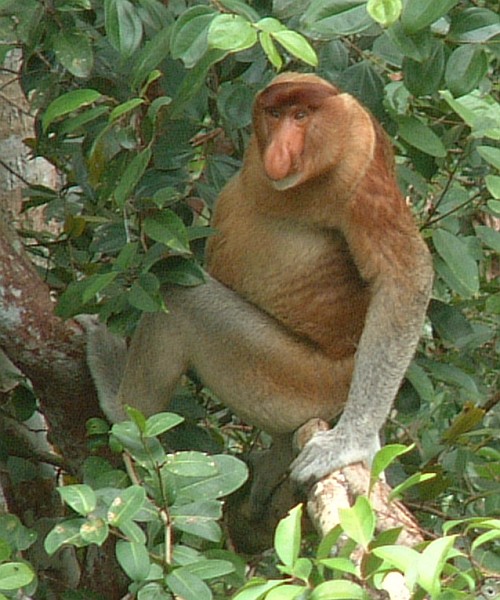
As we glided through the silent rivers of Borneo in our hired klotok (river boat) we heard deep honking noises coming from the trees above the riverbank. There, perched on the branches of a huge mangrove tree sat several large red-brown and grey Proboscis monkeys Nasalis larvatus. What strange looking apes they are! The males (right) have distinctive long, drooping noses (proboscis means nose) which begins to grow during puberty. Females (left) have much smaller, and up-turned noses, as do all juveniles. The young have blue faces and dark fur which turns lighter with age. These leaf-eating apes are found only on Borneo and a small nearby island. They have specially adapted digestive systems that allows them to eat huge quantities of mature (i.e. tough!) leaves. They also eat fungi, insects, and other plant parts such as fruits, seeds and buds. They live in the mangroves and Nipa palms on the edges of rivers, especially near the coast. The honking sound comes from the horn-like shape of the male's nose. Males weigh about 29 kg (64 lbs) and are 75 cm (30 in) tall. Females are smaller, about 10 kg (22 lbs) and 67 cm (26 in) tall. We also saw many proboscis monkeys along the banks of the Kinabatangan River, in Sabah, Malaysian Borneo, and also in the mangrove mudflats of Bako National Park, Sarawak, Malaysia. They are amazing jumpers -- we saw both full adults and juveniles reaching out their long arms, then leaping, fully stretched, to "fly" to a nearby tree trunk which they then climbed with ease. Photos © Amanda Hacking, Tanjung Puting NP, Borneo, Indonesia |
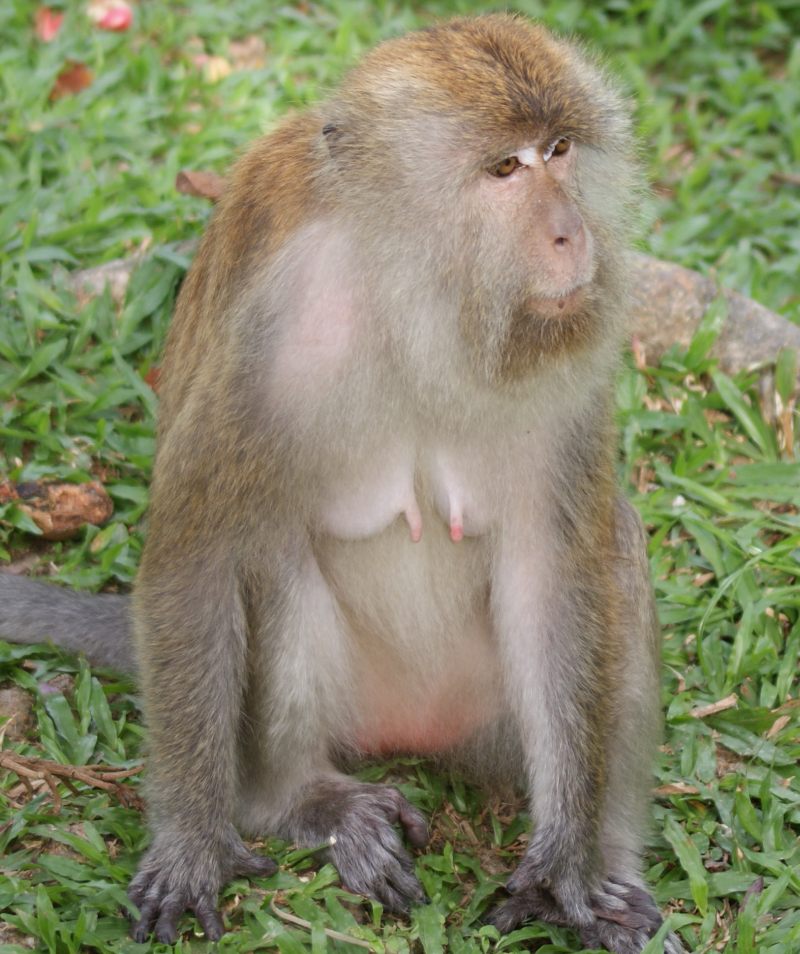
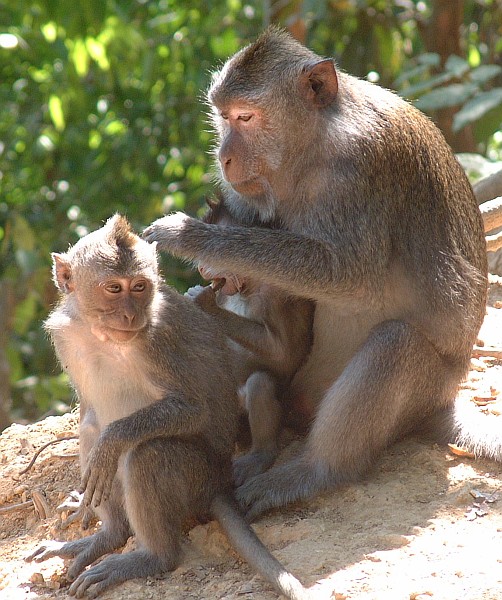
We saw our first troop of Macaques Macaca spp on the roadside in Lombok. Our guide, unfortunately, pulled over and handed us bags of peanuts. We didn't want to insult him by refusing, so against our better judgment we held out the peanuts to the monkeys. They had obviously been fed a lot, for some were very aggressive. But it is fun to get close to the animals and watch as they groom, play and nurse. In some areas, notably Seven Wells Waterfall, Langkawi Malaysia, and Weh Island, Indonesia, the macaques can be very aggressive to humans: barring their teeth (BIG teeth), hissing and feigning (or NOT feigning) attack. They can be quite scary, so be very careful if approaching a wild troop of monkeys. One of the main reasons for the aggression is the desire to be fed -- and the anger at not being fed. It's probably our own fault. They don't need our food. They can forage on their own well enough, thank you very much! Photos © Amanda Hacking, Lombok, Indonesia |
|
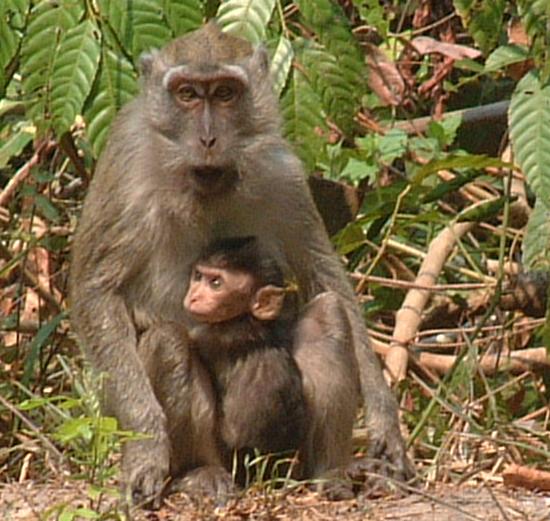
It was nice to see wild Long Tailed Macaques
(aka Crab-eating Macaque) Macaca fascicularis that are protected, and
not fed human food! In Tanjung Puting NP, Indonesia, no one is
allowed to feed them! The smallest of the
macaque family, they are grey-brown, and some mature ones have cheek
tufts. They live in groups of up to 30 individuals and gather by the
dozens in trees near the river in the evening. These macaques do eat
invertebrates (including crabs, hence the name) but are also found in
cultivated lands raiding crops. Photo © Amanda Hacking,
Tanjung Puting NP, Borneo Indonesia Much of the above information on lesser apes - Gibbons, Long-tailed Macaques and Proboscis Monkeys - comes from a guidebook to Tanjung Punting National Park by BMF Galdikas & G Shapiro |
 |
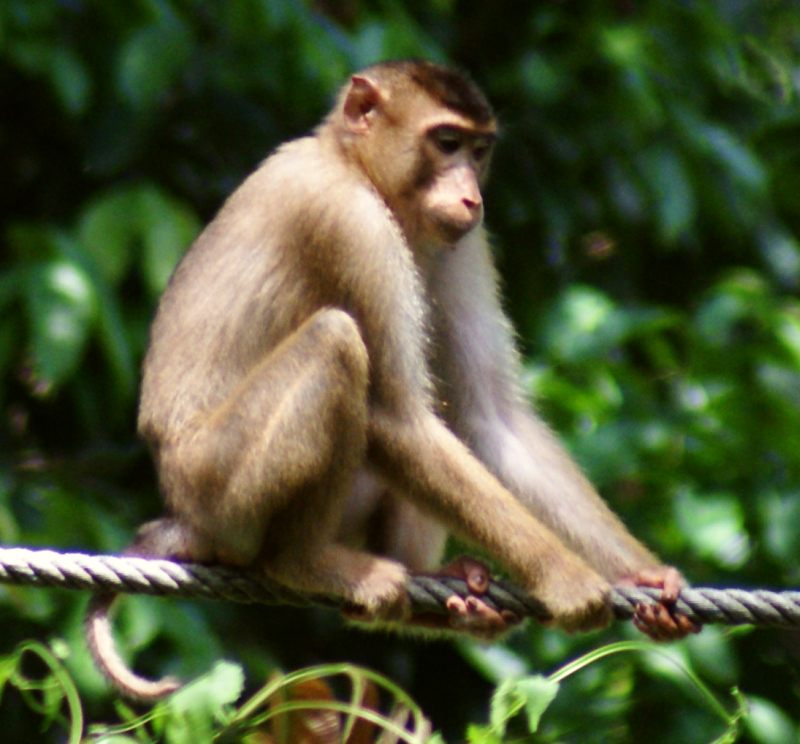 |
This was a new (for us!) species of Macaque which we met in 2010. At Sepilok
Orangutan Sanctuary in Borneo we were introduced to this interesting character: the Pig Tailed
Macaque Macaca nemestrina. The head seems to have a sort of dark cap, and the tail, as opposed to being
long and prehensile (a la Long Tailed Macaques) is short and curled, sort of like a
pig's tail. Hence the name. These monkeys were very aggressive and
barred their big fangs at the orangutans who did not give way when they wanted to eat at the
feeding platform. This species is listed as vulnerable, due to decimation of habitat.
Photo © Sue Hacking, Sabah, Borneo, Malaysia 2010 |
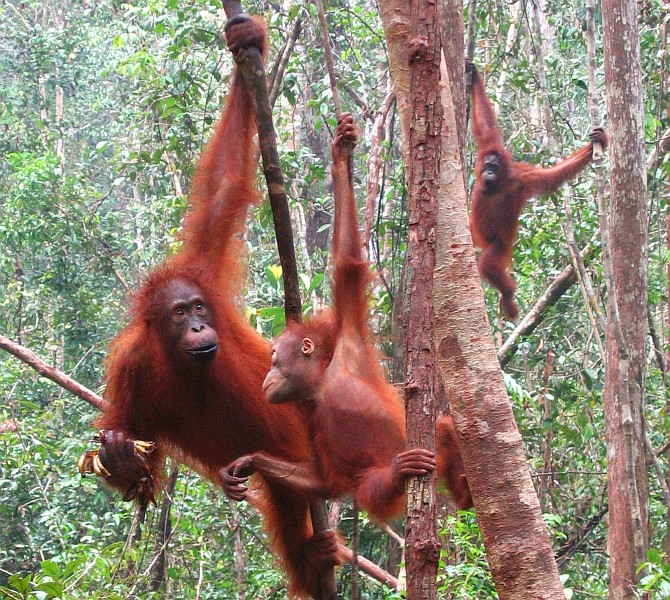 Orangutans are great acrobats |
We traveled for 4 days in the southern Kalimantan (Indonesian Borneo) fulfilling our goal of spending time with the wild and rehabilitated Orangutans Pongo pygmaeus. Classified as great apes, these large, reddish-brown primates are found only in Borneo and northern Sumatra, Indonesia. It is illegal to kill, capture or own an orangutan, but poaching continues and the Indonesian authorities often have other priorities. Many of the animals who live in the heavily forested Tanjung Puting Reserve have been re-taken from captivity or brought in when they were orphaned. Visitors are allowed to visit the feeding platforms where both wild and ex-captive orangutans are free to come feed on bananas and milk twice a day. The rangers call them by whistle, and the number of animals that feed varies from day to day and season to season. The protected rain forest in which they live supports over 200 different tree species that provide the orangutans with fruits, seeds, nuts and shoots. Orangutans also occasionally eat small animals, including young monkeys.
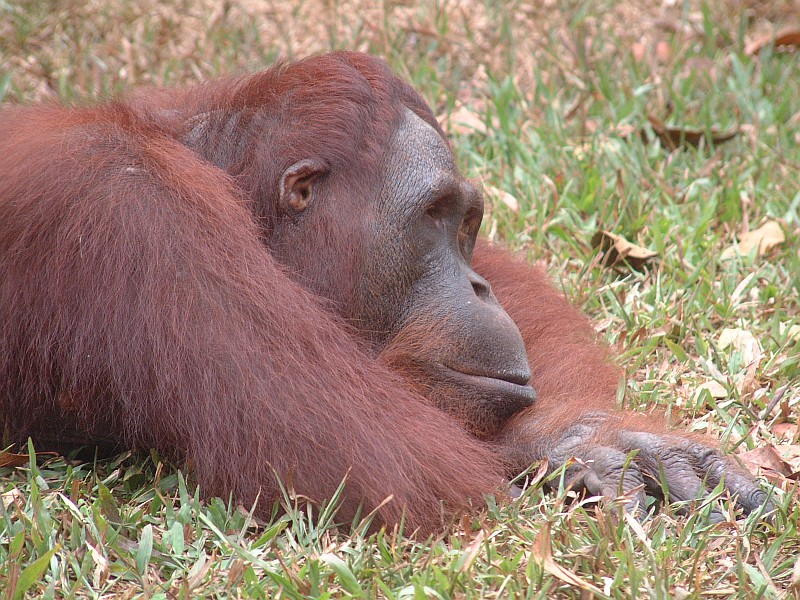 Samson, a young adult male |
Orangutans are generally solitary, females seeking out males when they are ready to mate. They then spend several days together until the female is pregnant. About 9 months later one baby is born. The babies stay with their mothers for up to 3 years, then go off on their own. Orangutan males are larger than females (95 cm tall and 77 kg vs 78 cm tall and 37 kg) and have large cheek pouches which give their voices a deep resonant sound. Orangutans spend most of their time in the trees, making nests in tree tops each night. Occasionally, solitary males will nest on the ground. When they do come out of the trees, orangutans walk on all fours.
Canadian researcher Biruté Galdikas has been the primary researcher involved
with the Borneo orangutans since the early 1970's. Her autobiography,
Reflections of Eden: My Years with the Orangutans of Borneo
In 2010 we travelled to Malaysian Borneo, to the states of Sabah and Sarawak. The Sepilok Orangutang Rehabilitation Center outside the city of Sandakan is the better known of the 2 sanctuaries, and we saw a number of juvenile orangutans there. In Sarawak, outside the city of Kuching is the Semmengoh Sanctuary where there are more orangutans of various ages. The trick with Semmengoh is to visit when it is NOT fruiting season -- this forces the rehabilitated orangutans to come to the feeding platform. From November through February they have enough wild fruits to eat in the forest, so they don't need to come to the platforms and visitors are often disappointed.
Another amazing place to see really wild (not rehabilitated) orangutans in along the Kinabatangan River, in northern Sabah, Malaysian Borneo. Here you can take river boat rides with the various eco-lodges, and if you're lucky you'll see wild orangutans, proboscis monkeys and long tailed macaques.
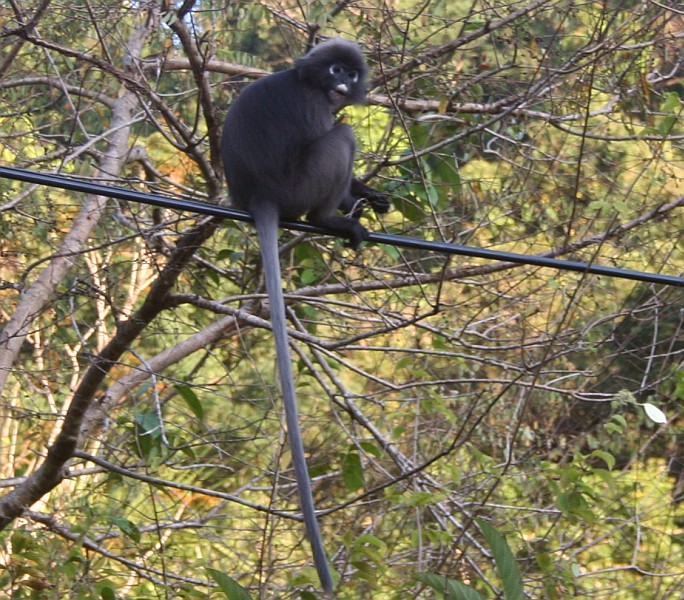
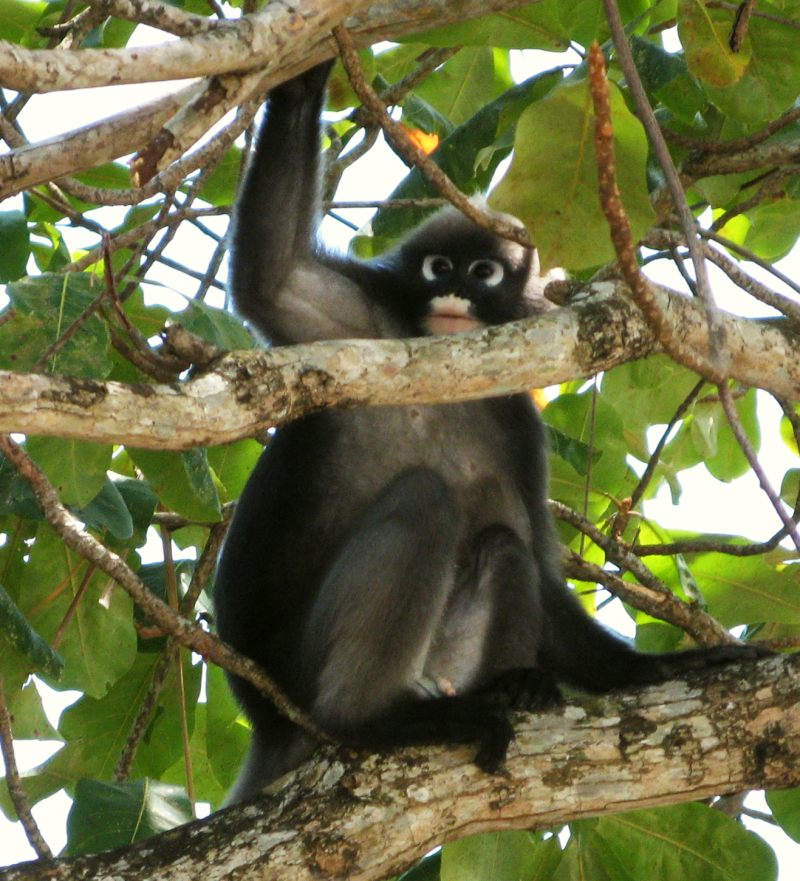 On
the island of Langkawi, in northern Malaysia, we came upon this elusive and
shy Dusky Langur Trachypithecus obscurus obscurus resting on the telephone wires over the road one early
evening. And later we saw Dusky Langurs again at Raile Beach, near Krabi, Thailand. Langurs are members of the family Cercopithecidae, which includes the
macaques and proboscis monkeys. Langurs (also known as Leaf Monkeys or Lutungs) are long-tailed monkeys that live in
troops, in trees. The Dusky Langur is found on the Malaysian Peninsula and parts of
southern Thailand. It is also called the Spectacled Leaf Monkey, due to the obvious
"spectacles" around it's eyes, and the fact that its diet consists entirely of leaves. It has
dark hair and a long gray tail. Its face is dark with characteristic white nose
and eye circles. Unlike the macaque monkeys, langurs are not aggressive; in fact they
tend to ignore human beings -- probably because we are not in the trees with them! On
the island of Langkawi, in northern Malaysia, we came upon this elusive and
shy Dusky Langur Trachypithecus obscurus obscurus resting on the telephone wires over the road one early
evening. And later we saw Dusky Langurs again at Raile Beach, near Krabi, Thailand. Langurs are members of the family Cercopithecidae, which includes the
macaques and proboscis monkeys. Langurs (also known as Leaf Monkeys or Lutungs) are long-tailed monkeys that live in
troops, in trees. The Dusky Langur is found on the Malaysian Peninsula and parts of
southern Thailand. It is also called the Spectacled Leaf Monkey, due to the obvious
"spectacles" around it's eyes, and the fact that its diet consists entirely of leaves. It has
dark hair and a long gray tail. Its face is dark with characteristic white nose
and eye circles. Unlike the macaque monkeys, langurs are not aggressive; in fact they
tend to ignore human beings -- probably because we are not in the trees with them!Photo left © Amanda Hacking, Langkawi, Malaysia. Photo right © Sue Hacking, Railay Beach, Thailand |
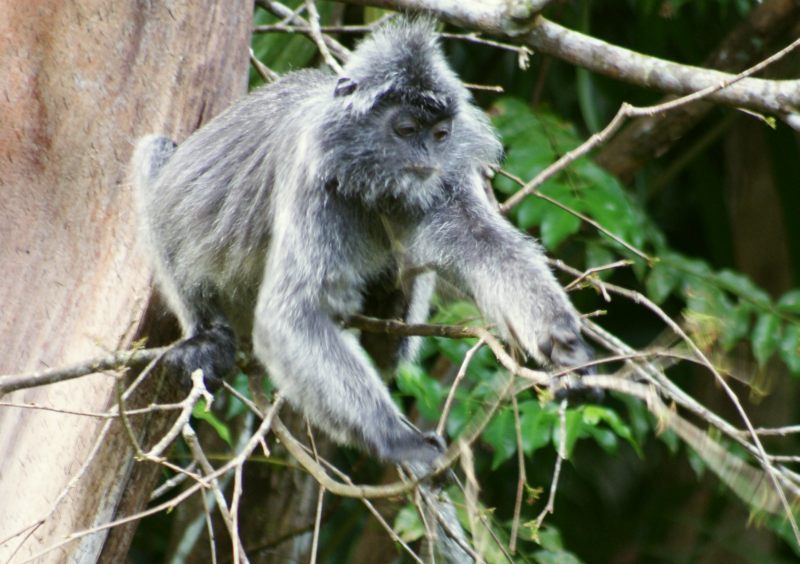
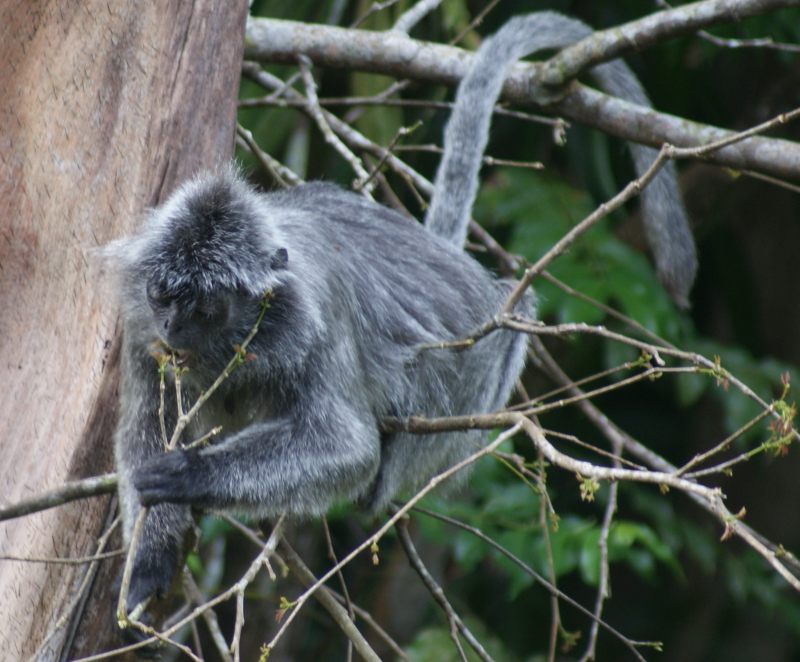
On the Malaysian part of the island of Borneo we met these Dr. Seuss-like critters -- the Silver Langur Trachypithecus cristatus (aka Silver Leaf Monkey and Silvery Lutung). I prefer the term Langur to Leaf Monkey, but in fact they are named for their eating habits -- they munch away all day long on leaves, the more tender and young the better. Whole troops of them will nearly strip a tree, then move on to the next. Like other leaf-eating primates, they have specially adapted 3‑chambered stomachs to digest the tough cellulose of leaves. They are arboreal, with very long, prehensile tails. They are found in Sumatra Indonesia, Borneo and the southern Malaysian Peninsula. They tend to live near the coast, and are often found in mangrove trees or nearby forests. They live in troops that are matrilineal, and the females give birth to one young after gestation periods of 180‑200 days. They are listed in the CITES appendix as Near-Threatened, due to loss of habitat to palm oil plantations and deforestation, and for hunting for food and the pet trade. These animals were photographed in Bako National Park, Sarawak, Borneo. Photos © Sue Hacking, 2010 |
Top Level: Home | Destinations | Cruising Info | Underwater | Boat Guests | Ocelot | Sue | Jon | Amanda | Chris | Site Map | Make a Comment
|
If our information is useful, you can help by making a donation |
Copyright © 2000‑ Contact: Jon and Sue Hacking -- HackingFamily.com, svOcelot.com. All rights reserved.