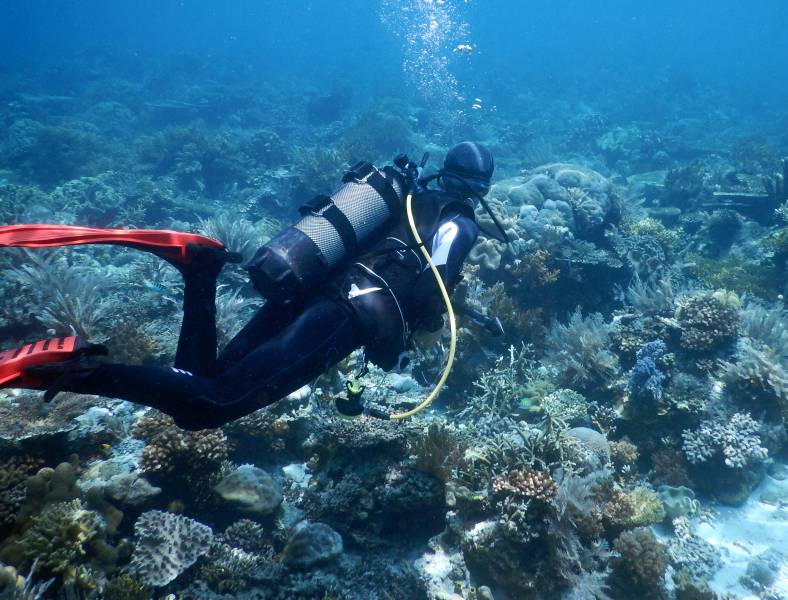
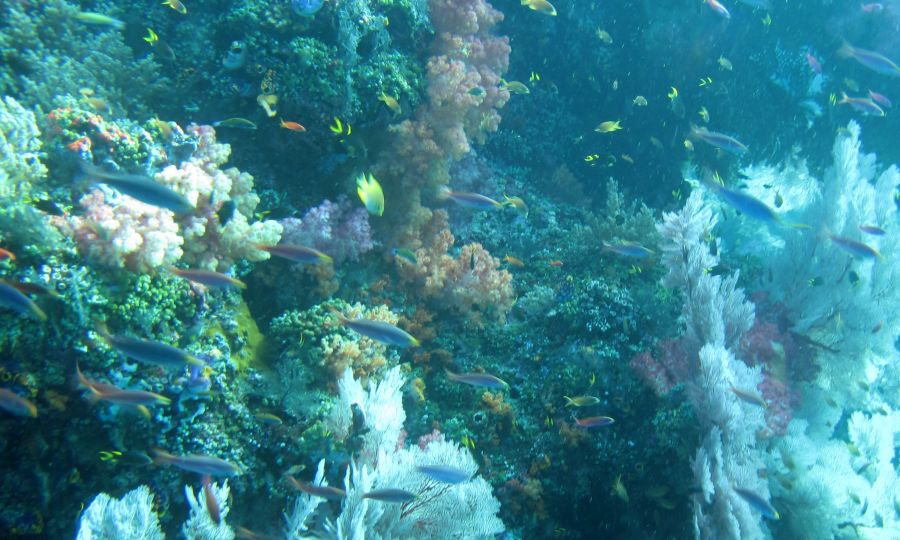
Diving Indonesia
NORTHERN INDONESIA
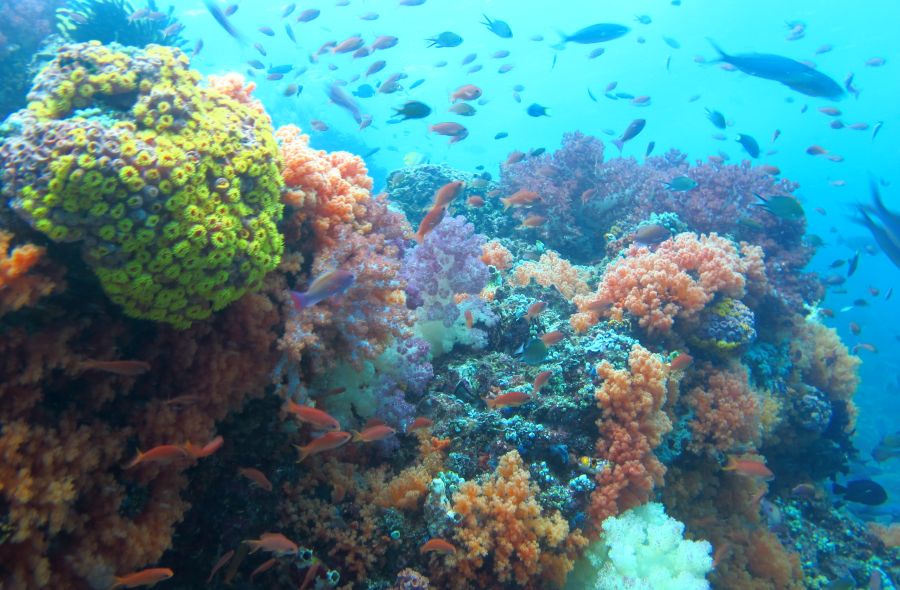
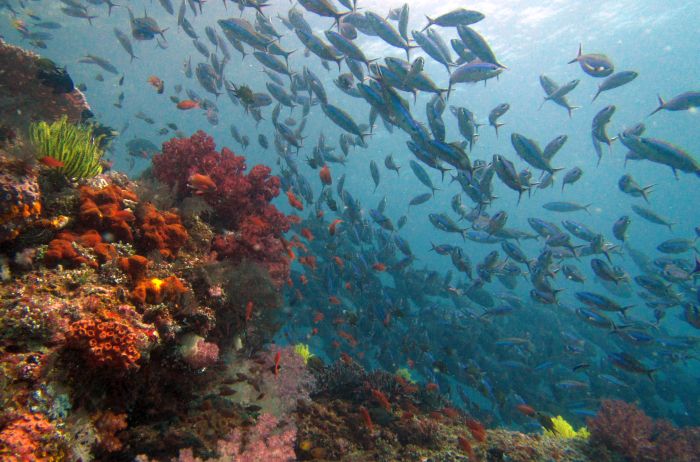
World-class diving! Amazing creatures from whale sharks and mantas to pygmy seahorses! Year-round
adventures! That's diving Indonesia! And we've barely begun!
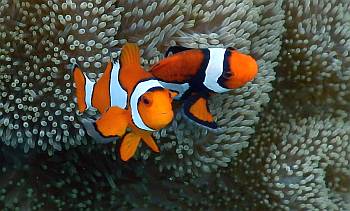
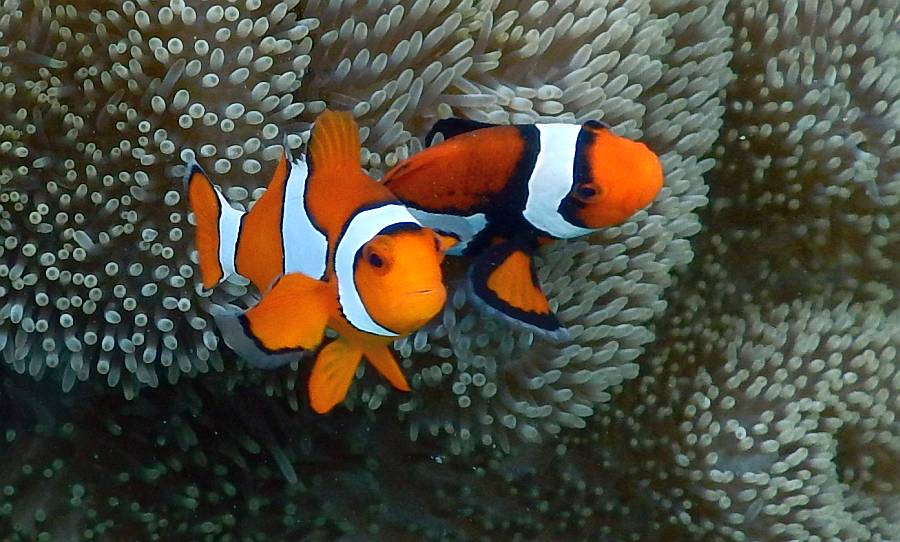
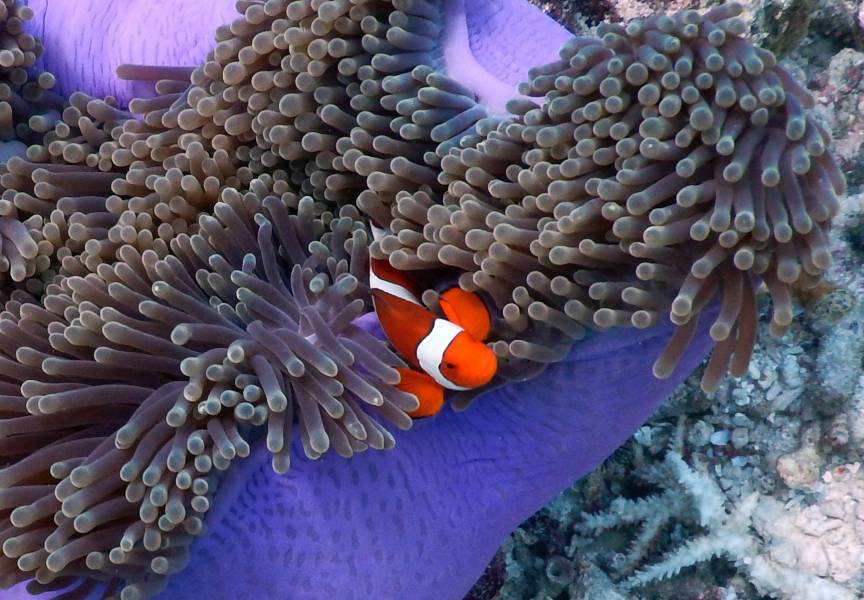
False Clown Anemone Fish, Kabui Cut, Raja Ampat |
There is so much to see underwater in Indonesia, with over 17,000 islands, that we had to divide this page
into 2 parts. The first half is northeastern Indonesia, which we cruised through in
2014‑15, in 2016‑17 and again in 2018. Below that you'll find dive sites for
southern Indonesia,
including dives in the Komodo National Park area, Lombok, Moyo and Bali. In 2006 we often dove with our friends on
Ventana,
and in 2014‑2017 we dove with several cruising friends, plus professional companies.
In 2016, after sailing over the top of Malaysian Borneo (where we dove Sipadan!) we dove with cruising friends on
Aosango in the beautiful atoll of Maratua, just south of the Malaysian/Indonesian border. We got to re‑visit
Sipadan in 2018 with son Chris and his friend Scy, newly certified as a diver. What a great place to start diving!
Our dives in eastern Indonesia were all in Raja Ampat and Triton Bay, areas that claim the highest marine
biodiversity in the world. These areas have very low populations, which means less pollution
and less destruction of the reefs. Unfortunately, shark finning was very common until about
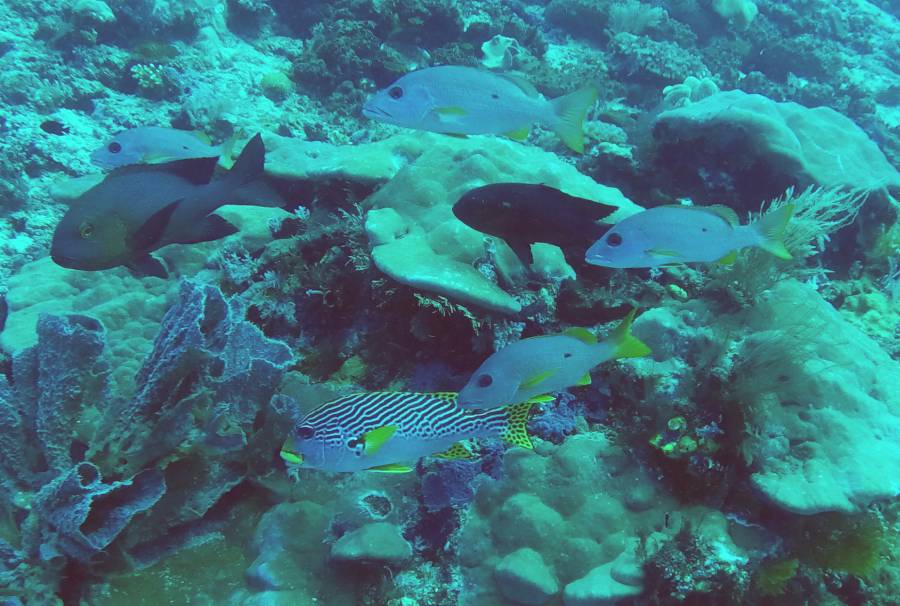
2005 and the sharks are just barely beginning to return. Beside the 1700 species of reef fish, and 75% of the
world's species of coral, this area also hosts some big creatures, like whale sharks and manta rays.
We were so lucky to get to visit for 6 months in 2014‑15, another 8 months in 2016‑17,
and again for 4 months in 2018. We can't seem to get enough of Raja Ampat!
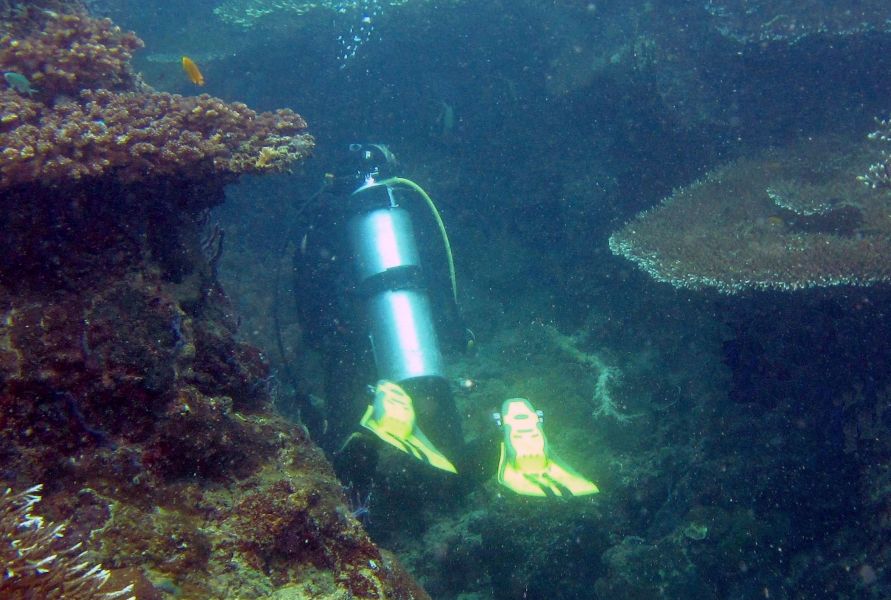
We dove both independently and with dive companies. Sometimes we also snorkeled these famous dive sites and we provide information on that as well.
There is a fairly comprehensive guide to diving in eastern Indonesia published in
2010, called "Diving Indonesia's Bird's Head Seascape" by Burt Jones and Maurine Shimlock,
which covers both Raja Ampat and Triton Bay (and Cenderwasih Bay in the north which
we didn't visit). It gives lots of great information!
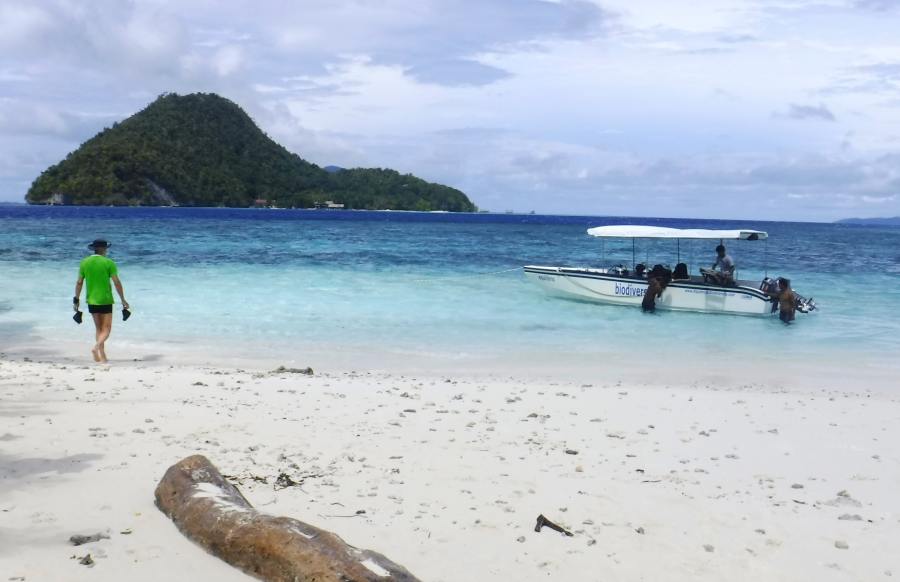
In Raja Ampat we have been doing most of our guided diving with the wonderful folks at
Biodiversity Eco Resort. They're on the
southeast end of Gam Island, about 40nm NW of Sorong, and just a mile north of the
Frewin anchorage. The owners,
Rey and Patricia (phone/SMS/WhatsApp +628‑124‑881‑3677)
are very friendly. Their resort customers obviously come first, but cruisers are welcome to snorkel the excellent
house reef if they ask permission first. If you give them a day's advance notice, you can often get an excellent meal at
the resort or join them on dives (on a space‑available basis). Their rates are the best we found in all of
Raja Ampat. Highly recommended.
Because Triton Bay is so newly "discovered" (first comprehensively dived by a team from the Papuan University and Conservation
International in 2001) there are many sites not listed in the Bird's Head book that
offer great potential. We had a chance to dive more than 16 sites with
Triton Bay Divers, and
that's only about half of the ones they take guests to. The resort owners are very personable, and their dive
staff are highly knowledgeable about the area and where to find special critters like pygmy seahorses and wobbegong
sharks. The resort is situated in a beautiful protected bay on the east side of Aiduma island and caters to divers and
dive photographers from around the world. We even had the fun of
joining them on a couple exploratory dives, which meant we had pot luck in terms of what
we'd see, but we got some fun exploratory underwater time! We highly recommend Triton Bay Divers, and if you
arrive by boat and want to dive, check with Leeza or Jimmy to see if they have space available on their dive boats.
But diving wasn't our only pastime. We also spent many hours snorkeling on fabulous reefs. The Arborek Pier and the
Biodiversity Eco Resort house reef in Raja Ampat, the
house reef at Misool Eco Resort in
southern Raja Ampat and the house reef at
Triton Bay Divers in Triton Bay were especially bountiful
in corals and fish. For incredible marine life, the snorkeling around the rocky
islands of Kalig and Balbulol in Misool, southern
Raja could not be surpassed. A favorite blue water mangrove site, with fish‑filled passes as well, was
Yangello (aka Yangeffo) in central Raja Ampat.
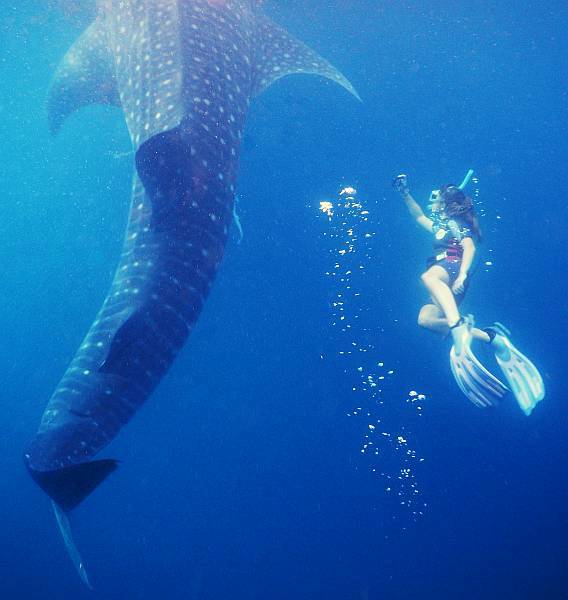
One of the best experiences, not to missed, is to swim with the whale sharks in Triton Bay.
These gentle behemoths visit the big trimaran fishing platforms called "bagans" early each morning
to collect the small fish that are dropped. Or, they hang around and feed for an hour or so on
buckets of small fish that are fed to them by the fishermen when we crazy divers come to swim!
Triton Bay Divers customers usually have a chance to
dive with whale sharks, too.
|
| Whale Sharks, Triton Bay |
| Type: |
Snorkel or dive |
Position: |
03°42.93'S 133°53.0'S |
| Depths: |
Deep, but sharks on surface |
Access: |
Dive boat or dinghy |
| Date: |
Feb & Apr '15, '17 |
Dive Pros: |
Triton Bay Divers |
| Visibility: |
About 30' |
Snorkeling: |
Yes |
| Divers: |
Sue, Jon, Rachel, Rainer |
Features: |
Swim with whale sharks |
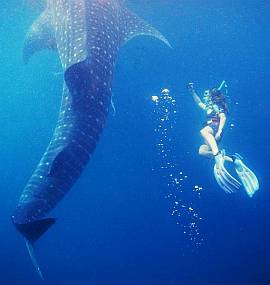
Rachel snorkels with an 18m shark |
Getting in the water with the world's largest sharks is a thrill not to be missed! And in
Triton Bay it's not yet such a big commercial draw that it costs a fortune. In fact, an
attempt (no guarantees, as these are wild animals!) with Triton Bay Divers it's included in the dive
packages. If you go with your own boat, you can still make it happen! Here's how:
Anchor in protected Raf anchorage (03°44.81'S, 133°55.04'E) or on the NE corner of Namatote Island
(see lat/lon above). At first light, or just before, gear up for snorkeling and head out to
the bagans in the bay. You can't miss them: they are 20m long trimarans with 2 stubby masts and
endless ropes attached to the outriggers. Huge nets are suspended beneath them. They
anchor in place for days at a time.
As you approach, call out a greeting "Selamat pagi!" (Good morning!) then inquire,
"Ikan besar?" You are asking if the "big fish" are there. You will be answered with a shake of
the head and maybe pointing to another bagan, or a happy nod and pointing into the water. "Ada"
means "They are!" Don't give up if they aren't at the first bagan. Once we had to
visit 4 different bagans before we found the whale sharks!
The sharks come up from the depths of the channel and sweep around past the sterns of the bagans to collect fish.
If a whale shark is present, tie off the dinghy and jump in. The whale sharks will basically ignore you, to the point
that you might have to fend them off as they pass below or beside you. Their focus is clear: fish!
To keep this activity from becoming insanely expensive (like it already is in Cenderwasih Bay) after you swim
with the whale sharks, offer the fishermen some packs of cigarettes, maybe some
noodles, rice, coffee, sugar, and/or clothing. One cruising family had old foul weather gear
to donate. Consider that these men are on these rafts for weeks at a time, and have less need
of money than food and comfort clothing. If you want to pay cash, here's the deal: 1 bucket of
small fish brings in IDR 50,000, or about $4.50. And they'll go through 1‑2 buckets
in an hour of swimming with the sharks. They won't turn down the cash, but best to include it in a
bag full of other goodies.
UPDATE: In 2017 we paid about Rp100,000 ($8) per diver. Note that the waters towards the north end of
the Namatote Channel are claimed by a local village, and the chief is now wanting insane prices, but the bagans further
south had no fixed rates and were glad to get anything. Also, we've now seen the whale sharks as late as 11am, so
it may be possible to take your big boat further down the channel about 9am, checking each bagan you come to, and when
you find an Ikan Besar, tie off your boat to the bagan with a long bow line and jump in!
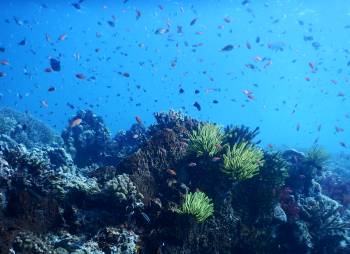
The Maratua reef sparkles with fish |
| Maratua South of Pass |
| Type: |
Outer reef, current |
| Access: |
Dinghy, needs to be towed. |
| Position: |
02°15.5'N, 118°38.7 |
| Depths: |
20‑50' (6‑16m) |
| Date: |
September 2016 |
| Visibility: |
50' (15m) |
| Dive Pros: |
Nabucco Resort is nearby. |
| Snorkeling: |
Yes, By dinghy |
| Features: |
Turtles, reef sharks, reef fish |
| Divers: |
Jon, Sue, and friends |
Maratua is a beautiful atoll off the eastern Kalimantan coast. We were anchored here with a couple other
cruising boats, one of which had a compressor. So together with the Swiss family on Aosango, we took 2 dinghies
out the narrow (sometimes raging) pass to the bordering reef on the eastern side of the atoll. The strongest
current flows from north to south, with some protection from reef bordering the pass. We motored out the pass,
splashed just on the south side of the entrance, then drifted south.
We didn't know it at the time, but the south reef is less clear, and less abundant in coral than the reef to the
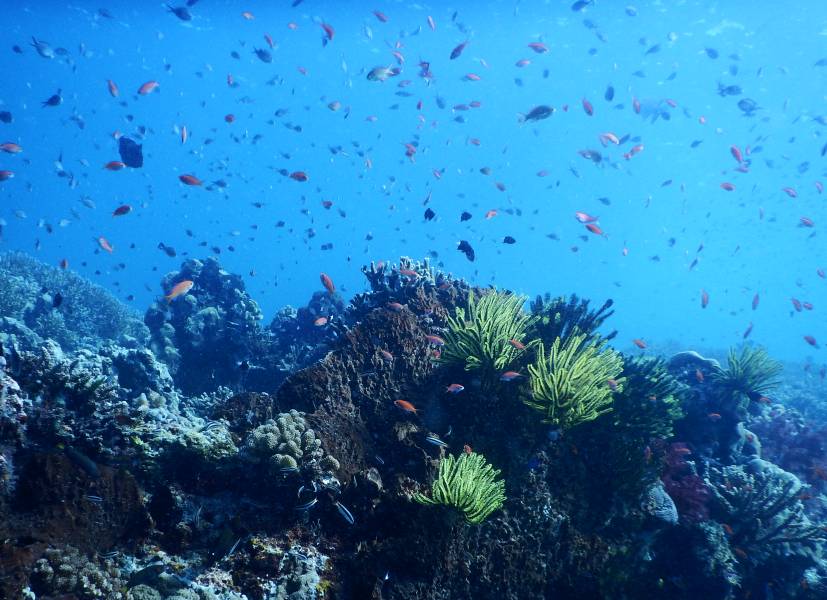
north. But still, it was a coral-rich slope with turtles and the schools of small damsels, anthias, triggerfish
and surgeonfish.
If the current is flowing into the atoll lagoon the drift diving, or even snorkeling, is rewarding with the ocean
water being clear and fast moving (up to 4 knots!). On the outgoing tide, the viz in the pass is murky with all
the fine sand and particulate being swept from the lagoon out the pass. The reef to the south is usually
down-current of the pass, and this accounts for its lower viz.
As of Sept 2016 a resort was being built on the western side of the atoll, on one of the fringing islands.
There is a possibility of a dive operation opening sometime soon in Maratua.
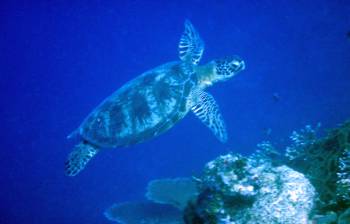
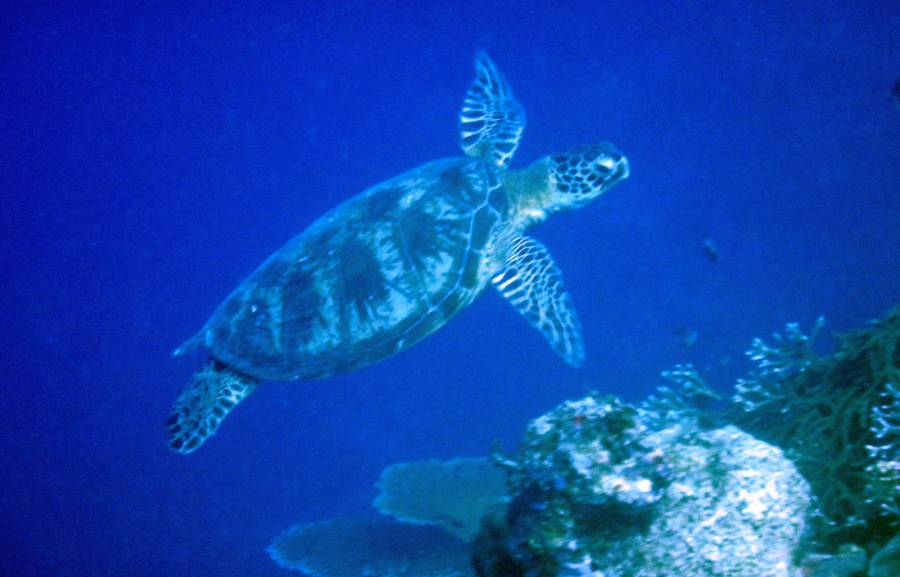
Green turtles are common in Maratua, Kalimantan |
| Maratua North of Pass |
| Type: |
Slope and wall |
| Access: |
Dinghy, needs to be towed. |
| Position: |
02°17'N, 118°35'E |
| Depths: |
20‑80' (6‑27m) |
| Date: |
September 2016 and 2018 |
| Visibility: |
80' (25m) |
| Dive Pros: |
Nabucco Island Resort filled our tanks |
| Snorkeling: |
By dinghy |
| Features: |
Turtles, reef sharks, schooling snappers |
| Divers: |
Jon, Sue, Aosango, Perry |
Nabucco Resort may call this dive site "Lumantang", but we weren't diving to any specified sites.
Maratua is a beautiful atoll off the eastern Kalimantan coast. We were anchored here with several other
cruising boats. So together with Perry, Irie, and Angel Wing we took 2 dinghies
out the narrow (sometimes raging) pass to the bordering reef on the eastern side of the atoll. The strongest
current flows from north to south. We motored north for about 3nm to the second beach, and drift dived
south to the first beach. We towed the dinghies, which is essential. We had chosen a random point to splash, and had we wanted to, we could have
motored farther north along the coast and done any number of dives. In strong winds this coast may not be safe for
dinghies.
This is a vibrant reef, swept by the open ocean currents. Green and hawksbill turtles were abundant, and
we saw cruising black tip reef sharks off in the blue. The reef drops steeply to deep blue, so we hugged the
"shallower" areas, no deeper than 70 or 80 feet, rising to a 15 feet for the safety stop just north of the pass.
If the current is flowing into the atoll lagoon the drift diving, or even snorkeling, is rewarding with the ocean
water being clear and fast moving (up to 4 knots!). On the outgoing tide, the viz in the pass is murky with all
the fine sand and particulate being swept from the lagoon out the pass.
Nabucco Island Resort, literally next to the anchorage, filled our tanks, and were gracias enough to allow
us to walk the island. Dinners may be available there with enough advance notice. With space available
you may be able to dive with them.
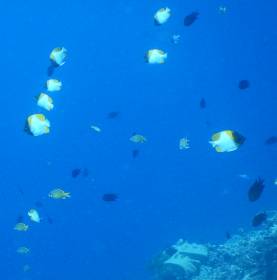
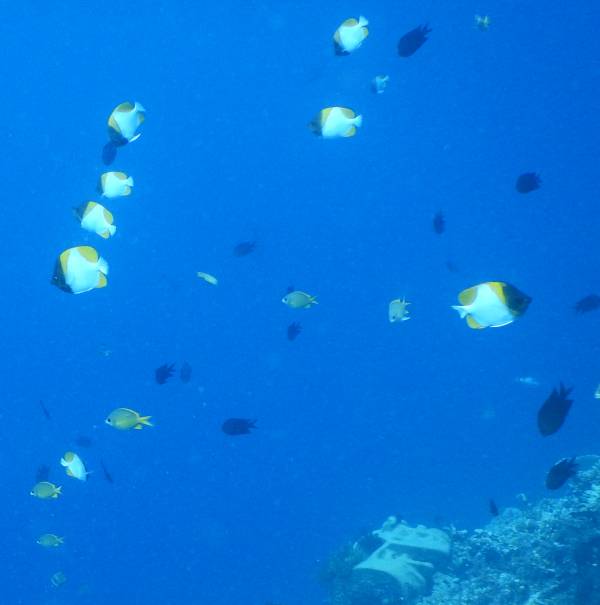
Pyramid Butterflyfish brighten the reef |
| Fish Country, Maratua |
| Type: |
Slope and wall |
| Access: |
Dinghy, needs to be towed. |
| Position: |
02°16.5'N, 118°37.2'E |
| Depths: |
20‑80' (6‑27m) |
| Date: |
September 2018 |
| Visibility: |
80' (25m) |
| Dive Pros: |
Nabucco Island Resort filled our tanks |
| Snorkeling: |
By dinghy |
| Features: |
Turtles, reef sharks, schooling snappers |
| Divers: |
Ocelot, Perry, Irie, Angel Wing |
Nabucco Resort may call this piece of the wall, "Big Fish Country" but we probably splashed in what they
call "Little Fish Country" and drifted south into Big Fish Country.
Maratua is a beautiful atoll off the eastern Kalimantan coast. We were anchored here with a couple other
cruising boats, one of which had a compressor. So together with the Swiss family on Aosango, we took 2 dinghies
out the narrow (sometimes raging) pass to the bordering reef on the eastern side of the atoll. The strongest
current flows from north to south, and we motored north out of the pass and went north for about 1.5nm and towed the
dinghies as we dove and drifted south. We had chosen a random point to splash, and had we wanted to, we could have
motored farther north along the coast and done any number of dives. In strong winds this coast may not be safe for
dinghies.
This is a vibrant reef, swept by the open ocean currents. Green and hawksbill turtles were abundant, and
we saw cruising black tip reef sharks off in the blue. The reef drops steeply to deep blue, but we
chose to dive no deeper than 70‑80 feet, rising to a 15 feet for the safety stop just north of the pass.
In 2018 we dove this again, staying shallower, about 60 feet to enjoy the light and the colorful anthias and
angelfish. The topography changes from rubble slopes to out-cropping of coral, and back to rubble slope.
Never a dull moment!
If the current is flowing into the atoll lagoon, the drift diving, or even snorkeling, is rewarding with the ocean
water being clear and fast moving (up to 4 knots!). On the outgoing tide, the viz in the pass is murky with all
the fine sand and particulate being swept from the lagoon out the pass. Nabucco Island Resort, literally next
to the anchorage, filled our tanks, and were gracias enough to allow us to walk the island. Dinners may
be available there with enough advance notice. With space available you may be able to dive with them.
Nabucco Island Resort, literally next to the anchorage, filled our tanks, and were gracias enough to allow
us to walk the island. Dinners may be available there with enough advance notice. With space available
you may be able to dive with them.
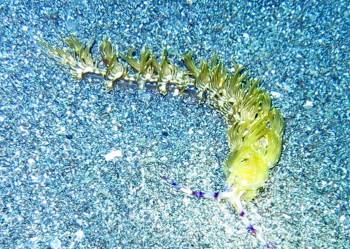
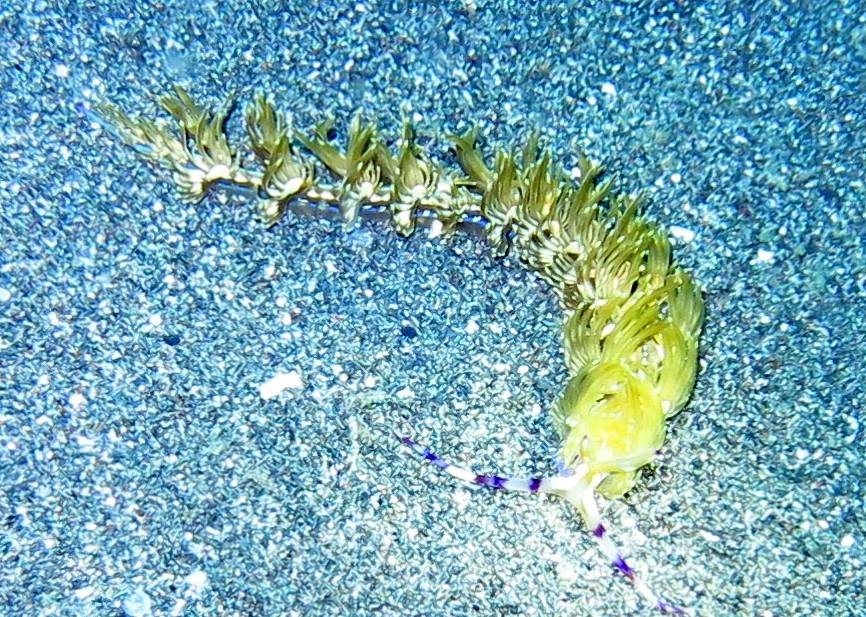
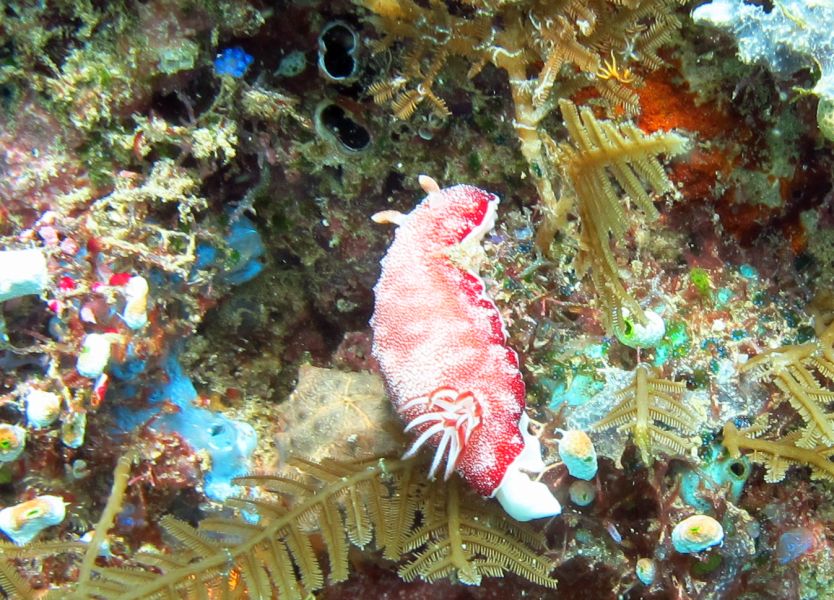
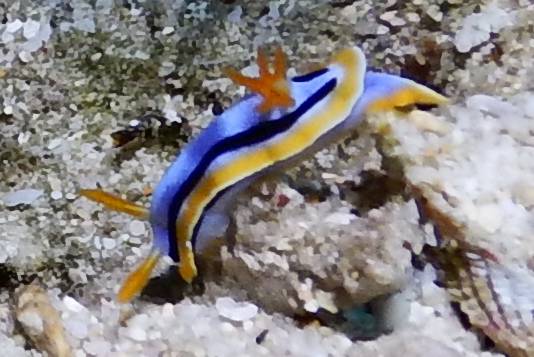
Variation of the "Blue Dragon" nudibranch |
| TK 2, Lembeh Strait |
| Type: |
Black sand slope, muck dive |
| Access: |
Dive boat |
| Position: |
01°29.74'N, 125°14.33'E |
| Depths: |
20‑82' (6‑24m) |
| Date: |
September 2018 |
| Visibility: |
60' (20m) |
| Dive Pros: |
Godlife Divers |
| Snorkeling: |
Yes, possibly along the shore |
| Features: |
Black sand with CRITTERS! |
| Divers: |
Ocelot, Leprechaun |
Finally, we got to dive the famous Lembeh Strait! This was a Rally stop on the Back to Down Under
Rally in northern Indonesia, and we took advantage of the offer to find spaces for several of us cruisers to
go with a dive company for some amazing muck diving.
"Muck diving" is a term we'd heard for years, and to be honest, it put us off. Who wants to dive in
"muck"? It should be called "Black Sand" diving, because in Lembeh Strait that's what it means.
The water clarity can be fantastic, and the sea floor is akin to a black desert, with amazing small critters
highlighted here and there. We saw cool shrimps, nudibranchs, and frogfish. There were lots of
intricately patterned Banggai Cardinalfish around to entertain us as well.
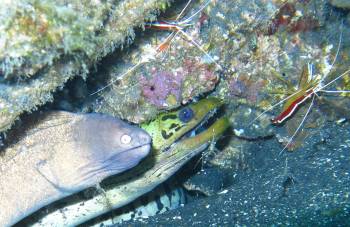
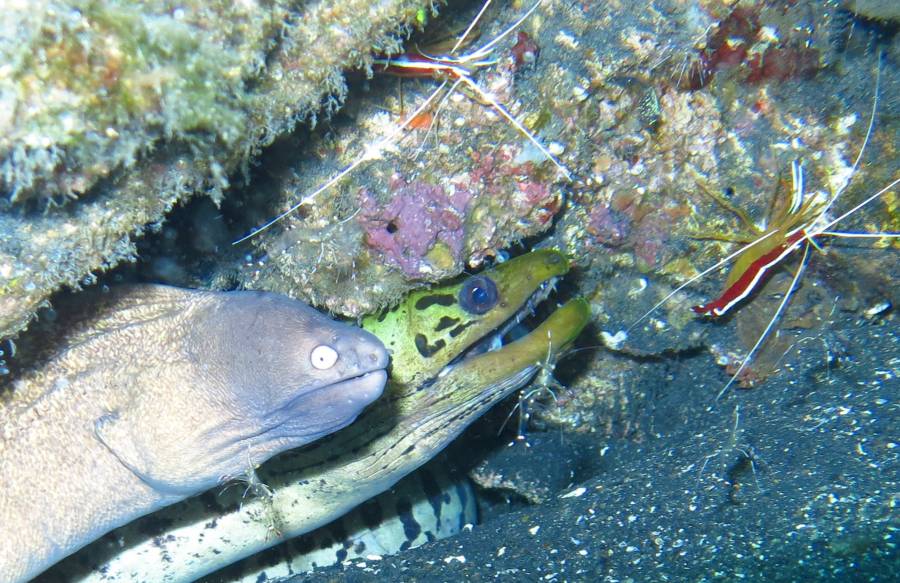
Two moray eels and cleaner shrimp, Lembeh Strait |
| Kungkungan Housereef, Lembeh Strait |
| Type: |
Black sand slope, muck dive |
| Access: |
Shore dive |
| Position: |
01°27.84'N, 125°13.78'E |
| Depths: |
10‑50' (3‑16m) |
| Date: |
September 2018 |
| Visibility: |
20' (8m) |
| Dive Pros: |
Godlife Divers |
| Snorkeling: |
Yes |
| Features: |
Black sand. Critters. |
| Divers: |
Ocelot, Leprechaun |
We had our tanks filled at Kungkungan Resort, then dove right off the village of Tandu Rusa nearby.
This was a bit more what I thought "muck diving" was about, in that there was some rubbish on the
seafloor. But that's to be expected off a village. The interesting thing was all the critters,
like mantis shrimp and a couple moray eels with lots of cleaner shrimp on them.
Splashing in only 10' of water, over black sand, we descended to over 50', exploring each inch of the sea
floor. Our guide, Eddy was very good at finding things, and patiently waiting while we took pictures.
Viz wasn't great, but it didn't matter, as the sun was high, and we were shallow enough and close enough to
the sea floor to see what we wanted. Great fun!
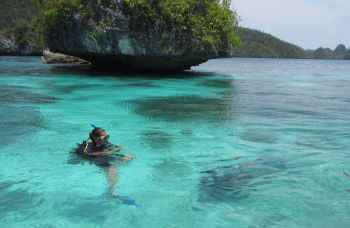
Amanda & Jon dive bright water, Wayag, Raja Ampat |
| Wayag Trail, Raja Ampat |
| Type: |
Protected coral slope |
| Access: |
Dinghy |
| Position: |
0°10.03'N, 130°01.12'E |
| Depths: |
20‑70' (6‑21m) |
| Date: |
October 2014 |
| Visibility: |
60' (20m) |
| Dive Pros: |
None |
| Snorkeling: |
Yes, around rock islands |
| Features: |
Coral fields & lots of reef fish |
| Divers: |
Amanda, Jon |
This was a refresher dive for Jon and Amanda, who dove with Jackie, a dive instructor/cruising friend from the boat
Sloepmouche. The goal was to find a place with minimal current and minimal swell. Outside the protection of
the rock islands of Wayag there are both strong currents and on this day, a lot of wind. So they dove inside the
protection of the islands, around a set of rock islets in the northern bay of Wayag.
Splashing in only 10' of water, over a mix of sand and stag‑horn corals, they quickly moved to deeper water and
circled the rock islands. The visibility improved greatly as they moved to deep water. Sue, on the surface,
snorkeling, was unable to see them at more than 20', but below the warm surface water the viz was over 60'.
This area abounds in schools of fusiliers, countless butterflyfish, triggerfish and other small reef fish. This
is a fun, mellow dive, good for when the wind and currents are too much, or for novice divers wanting a mellow place to
see some active small marine life.
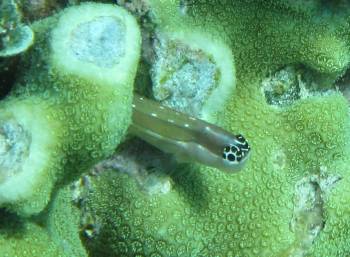
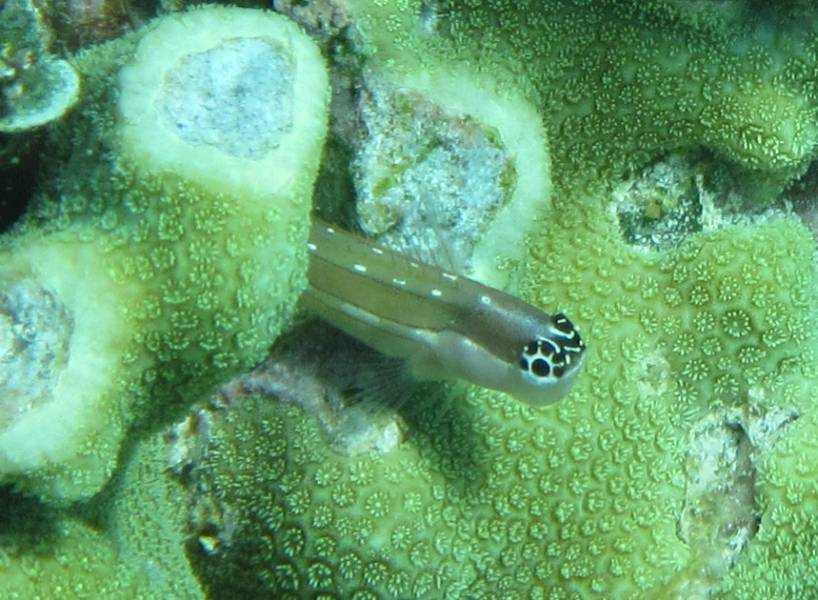
Spoke eye blenny in coral, Wayag, Raja Ampat |
| Wayag Anchorage, Raja Ampat |
| Type: |
Protected inner bay |
| Access: |
Dinghy |
| Position: |
0°10.03'N, 130°01.12'E |
| Depths: |
20‑40' (6‑16m) |
| Date: |
Oriter 2016 |
| Visibility: |
15' (5m) |
| Dive Pros: |
None |
| Snorkeling: |
Yes, along shoreline |
| Features: |
Sand bottom, small bommies |
| Divers: |
Rainer and Aosango |
This was a refresher dive for our nephew Rainer who dove with Pierre, a dive instructor/cruising friend from the boat
Aosango. They chose to dive from the bow of Aosango, using the anchor chain for stability while checking Rainer's
buoyancy. Although this is not an exciting place to dive, they did find some interesting marine life: nudibranchs
and flatworms on the sandy bottom, a spiny lobster and some passing bumphead parrotfish. Snorkelers in this area saw
some interesting anemone shrimp and many juvenile black tip reef sharks. Although the viz was only about 15ft
(5m), there were interesting things to see up close on the small bommies that rimmed the anchorage.
The goal was to have no current or swell. Outside the protection of
the rock islands of Wayag there are both strong currents and sometimes a lot of wind chop or rips.
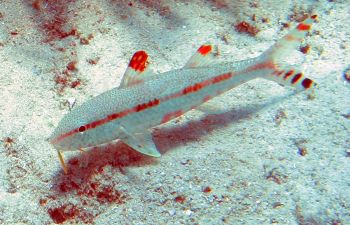
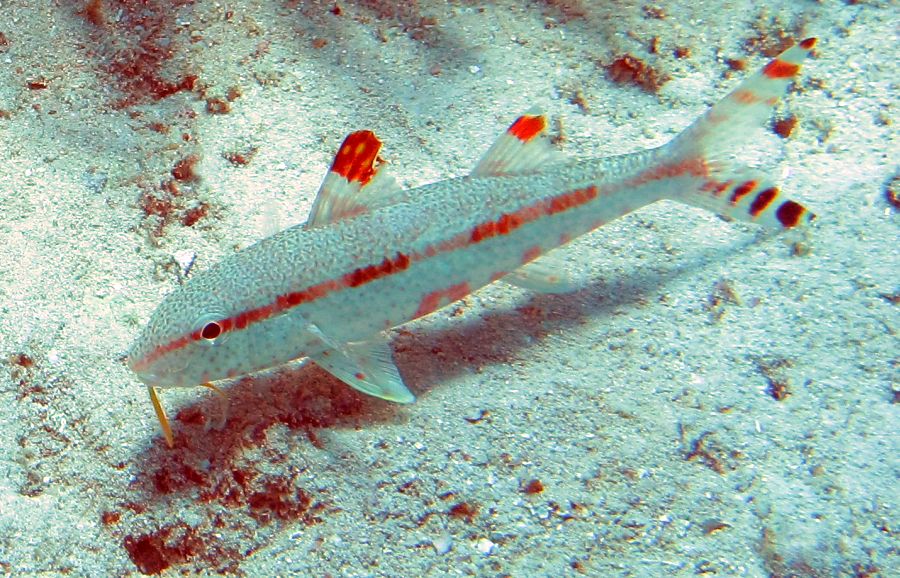
Freckled goatfish uses orange barbels to dig |
| Gam Southeast, Raja Ampat |
| Type: |
Protected shore dive |
| Access: |
Dive boat or dinghy. Beach. |
| Position: |
0°26.4'S, 130°41.6'E |
| Depths: |
20‑70' (6‑21m) |
| Date: |
October 2014 |
| Visibility: |
60' (20m) |
| Dive Pros: |
Raja Ampat Dive Resort |
| Snorkeling: |
Yes, from small beach |
| Features: |
Abundant fish on small bommies |
| Divers: |
Chris, Sue |
Chris and Sue did this as a refresher dive with
Raja Ampat Dive Resort. Because it had been so many years since
they'd been diving they spent a few minutes before the dive with an instructor in shallow water checking skills and
buoyancy. The area was chosen for its accessibility from the beach and the lack of current. The viz was
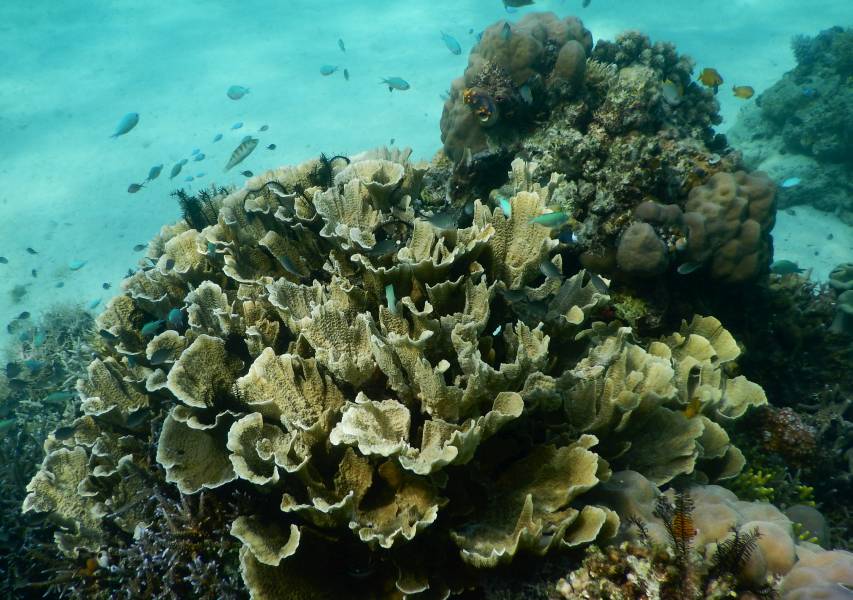
good, and it was great to be diving again! There were many plate corals sheltering reef fish and a sandy slope
with gobies, goatfish and sand‑perch. Here we saw our first sea pen, a sort of feather waving vertically from the sand,
brightly colored violet and pink. Like many marine critters, it looks like a plant but is an animal. We went from small
bommie to small bommie enjoying the bright damselfish, butterflyfish and wrasses.
Despite not having dived for years, both Sue and Chris took to it rapidly. Sort of like riding a bicycle -- you don't forget!
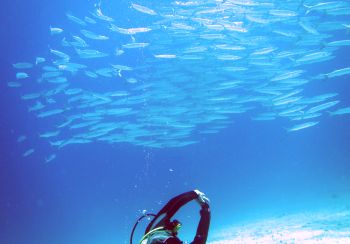
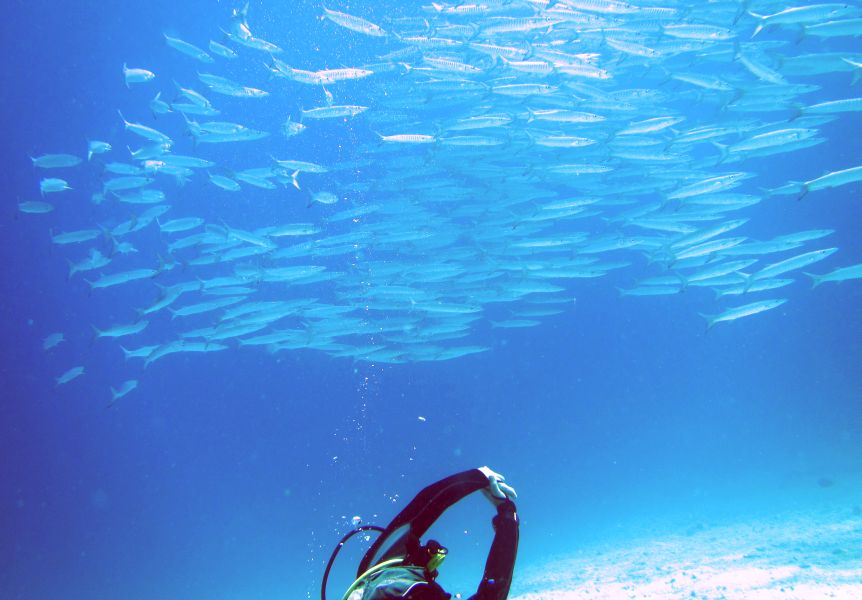
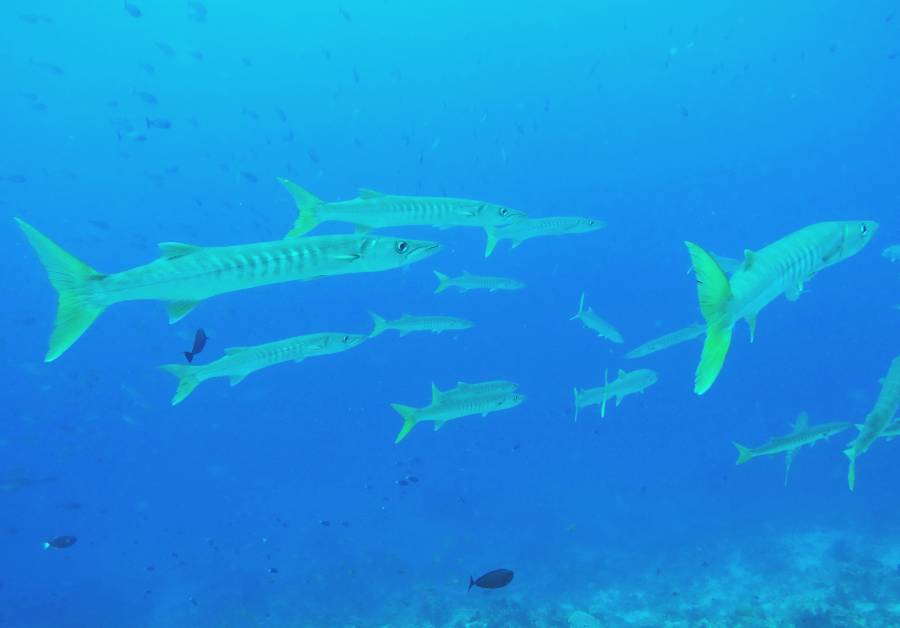
Pick-handle barracuda swirl above us, Raja Ampat |
| Batu Lima, Raja Ampat |
| Type: |
Rocks, slopes |
| Access: |
Dive boat or dinghy. |
| Position: |
0° 26.97'S, 130° 41.9'E |
| Depths: |
20‑70' (6‑21m) |
| Dates: |
Oct '14, Jan '17 |
| Visibility: |
60-100' (20-30m) |
| Dive Pros: |
Biodiversity Eco Resort |
| Snorkeling: |
Yes, around rocks & house reef |
| Features: |
Brilliant soft corals. Big fish |
| Divers: |
Chris, Sue, Jon |
This dive site is located on the southeast coast of Gam Island along the pass into Kabui Bay. Batu Lima (5 Rocks)
is a favorite dive sight listed in the book Diving the Birds Head Seascape. On one dive, due to the strong currents, we
drifted on the eastern side, at about 60‑70', then retuned on the western channel where there was less current,
working our way upwards. A school of pick‑handle barracuda circled above us and coral groupers fled to the
safety of coral overhangs. There was a nice array of sea fans and some black coral whips and bushes. Beautiful
triggerfish skirted by, and banded shrimp‑gobies stood guard in their sand burrows. This area sometimes hosts
feeding mantas, but they were not there on our visit. On another dive here with Biodiversity Eco Resort we dove
the slopes and ledges around the rocks, did the swim-throughs (pretty shallow, and do-able as a snorkel), then completed
our dive heading west along the Biodiversity Eco Resort Home reef which abounds in coral species, rabbitfish,
triggerfish, damsels and batfish. On the 2017 dive we enjoyed watching a young hawksbill turtle forage in the coral then
swim off into the blue.
This site can be easily snorkeled by dinghy, or, for a strong swimmer, you can get here from the house reef at Biodiversity.
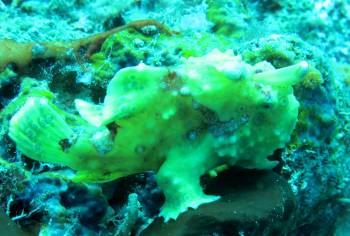
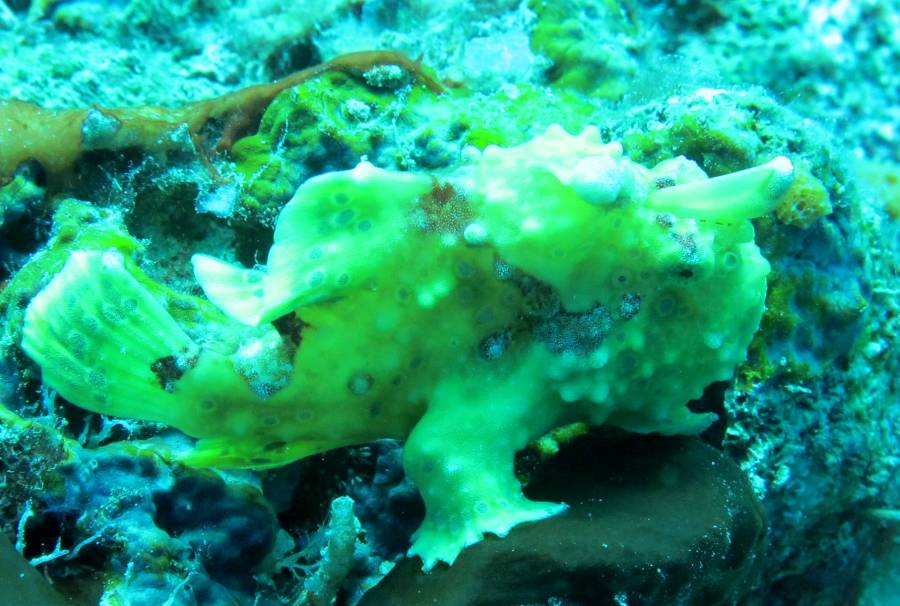
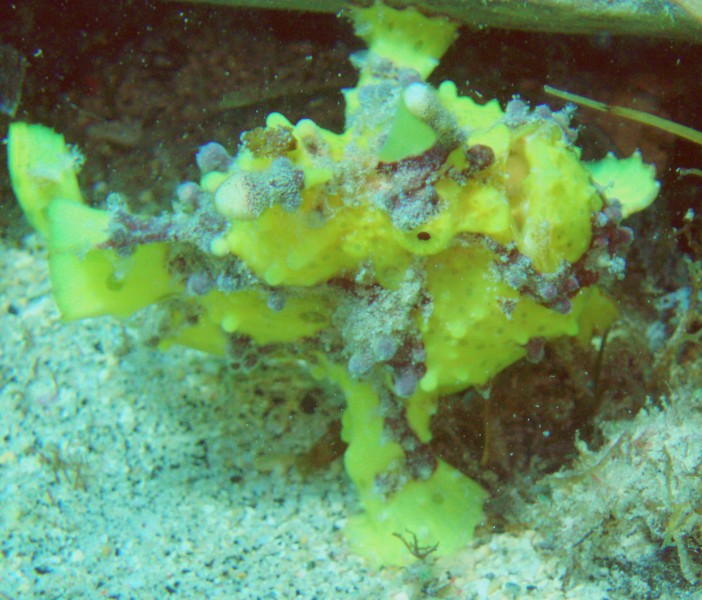
Bright yellow green frogfish blends into the reef |
| Frewin Kecil, Raja Ampat |
| Type: |
Slope |
| Access: |
Dive boat or dinghy. |
| Position: |
0°28.5'S, 130°41.96'E |
| Depths: |
15‑80 (5‑27m) |
| Date: |
October 2014 |
| Visibility: |
60-100' (20-30m) |
| Dive Pros: |
Biodiversity Eco Resort |
| Snorkeling: |
Yes, beware current. |
| Features: |
Wobbegong sharks, critters |
| Divers: |
Chris, Sue |
Also known as Frewin Banda. This is another classic dive sight near the south coast of Gam Island, in Raja Ampat. This
small triangular island features a wall of
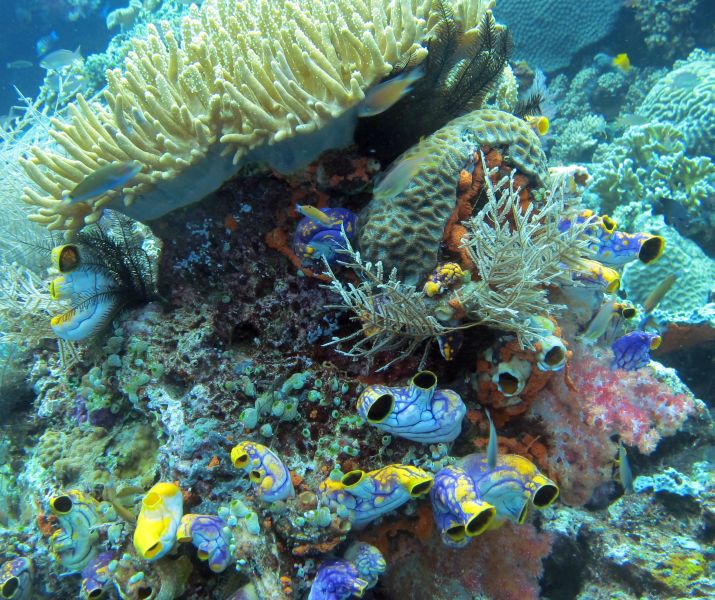
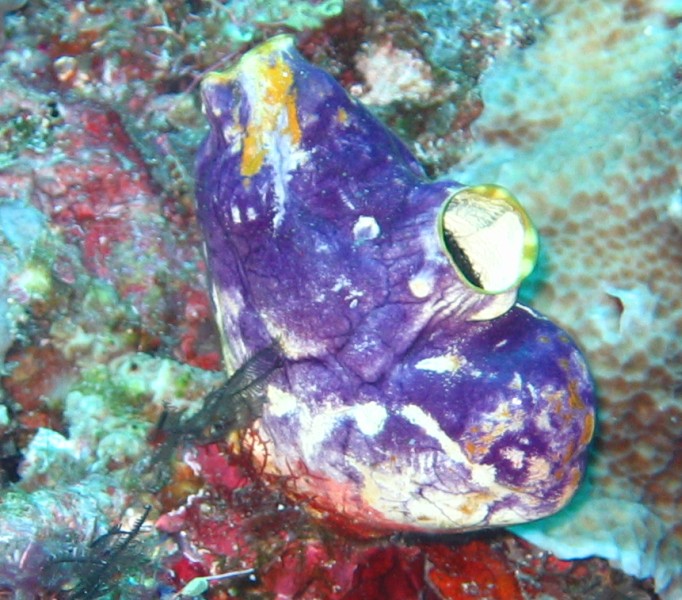
bright corals and tunicates, especially the purple and gold polycarpa aurata or "Heart Ascidian" for which
Indonesia is famous. The current can run quite sharply from north to south, but we were at the time of neap tides,
which was good for us "rusty" divers. We dove this with
Raja Ampat Dive Resort after a refresher dive along the coast of Gam Island.
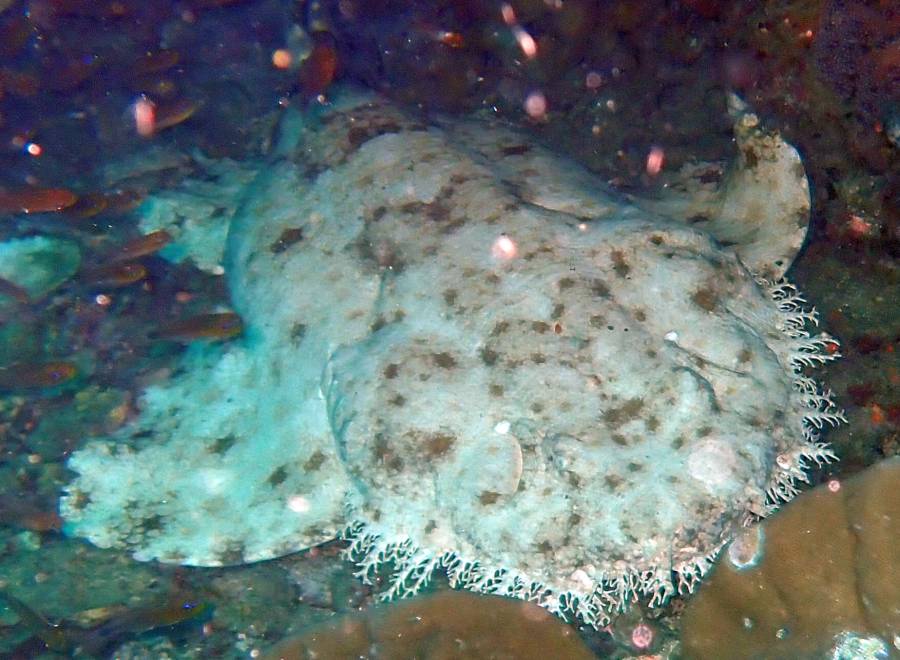
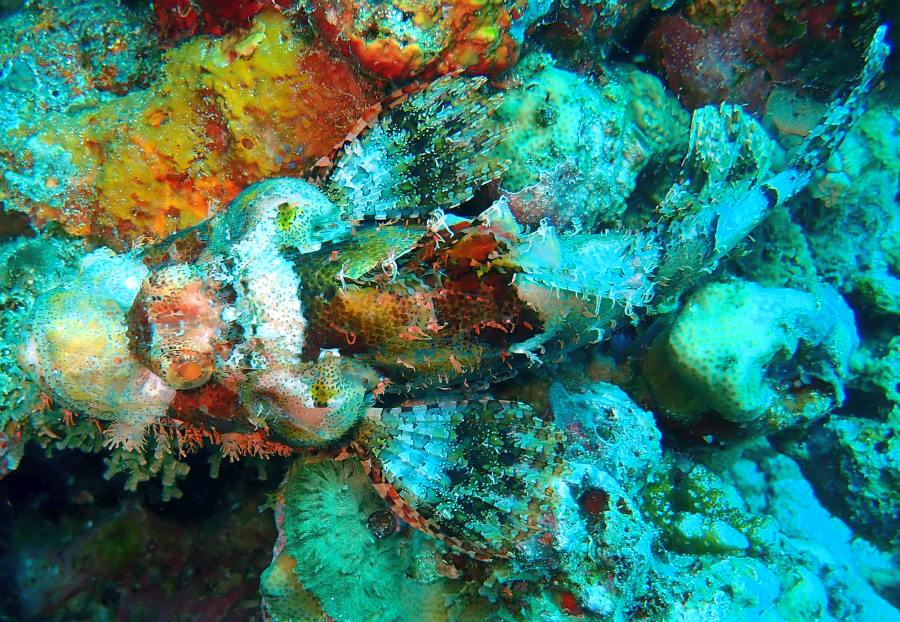
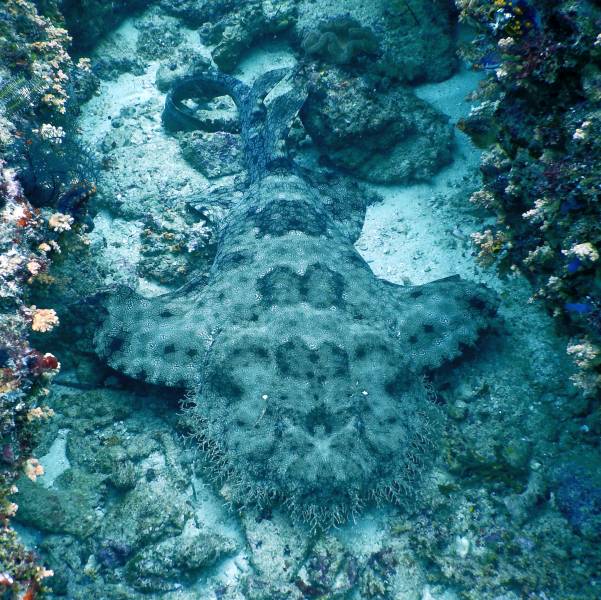
Offshore (of the east coast) were many rock ledges, and under one we were lucky to find a snoozing Tasseled Wobbegong with
its frilly chin tassels and long curving tail. We certainly realized the limitations of our small
underwater camera, as we could not illuminate the entire 4.5' (1.3m) of the shark, to include its wonderfully curly tail
and tasseled chin fringe.
Our dive guide also pointed out a bright yellow Painted Frogfish, which looks like a science fiction character made
of clay. It was balancing carefully on the edge of the rocks, making its way slowly along, using its wide pectoral
fins as feet.
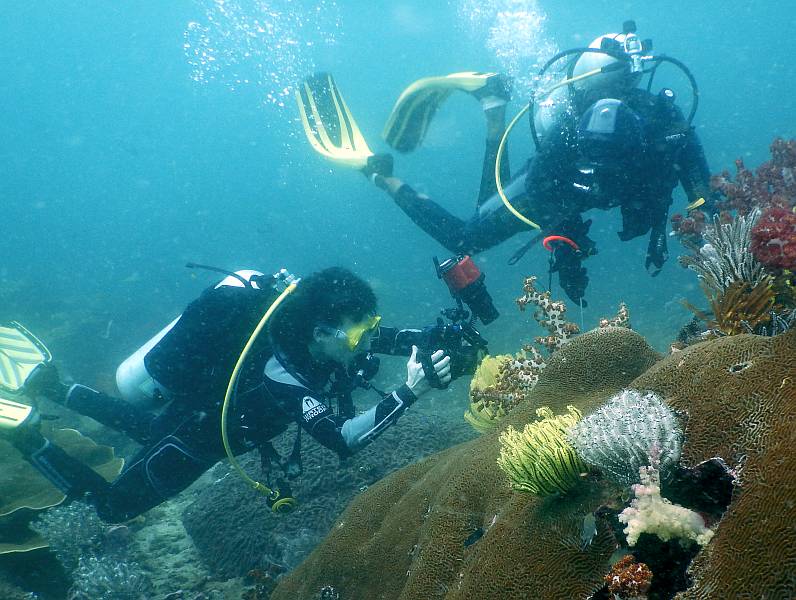
Chris and Sue each took an underwater camera and had fun comparing results once back aboard Ocelot.
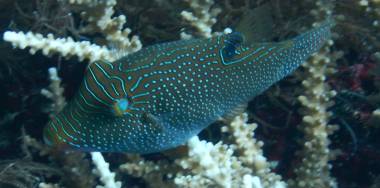
Papuan Toby glides thru hard coral |
| Frewin Banda Laut South, Raja Ampat |
| Type: |
Wall and slope |
| Access: |
Dive boat or dinghy. |
| Position: |
0°28.7'S, 130°41.9'E |
| Depths: |
20‑50' (6‑17m) |
| Date: |
November 2016 |
| Visibility: |
60' (20m) |
| Dive Pros: |
Biodiversity Eco Resort |
| Snorkeling: |
Along wall. Beware of current |
| Features: |
Abundant fish life |
| Divers: |
Jon, Sue and friends |
We dove with Biodiversity Eco Resort, along with friends visiting from the States. Because the currents were
strong from north to south, we splashed part way down the eastern coast of Frewin Banda Laut, ("laut" meaning the
seaward side of the island) and drifted to the south, and then turned the corner to the west, ending the dive on the
sandy slope at the southern coast of this triangular island. There were numerous nudibranchs and flat worms, looking
like bright Picasso paintings on the rocks. This area is filled with colorful soft corals and abundant reef fish. Off in
the blue were large emperors, snappers and groupers.
With strong currents it's very reassuring to have a totally responsible and professional dive company to accompany
you! Bio Diversity dive guides and boat operators were fantastic, and we could dive without a worry.
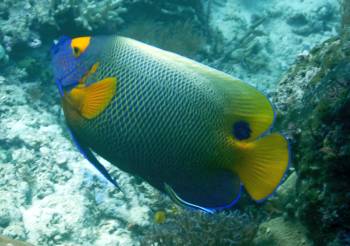
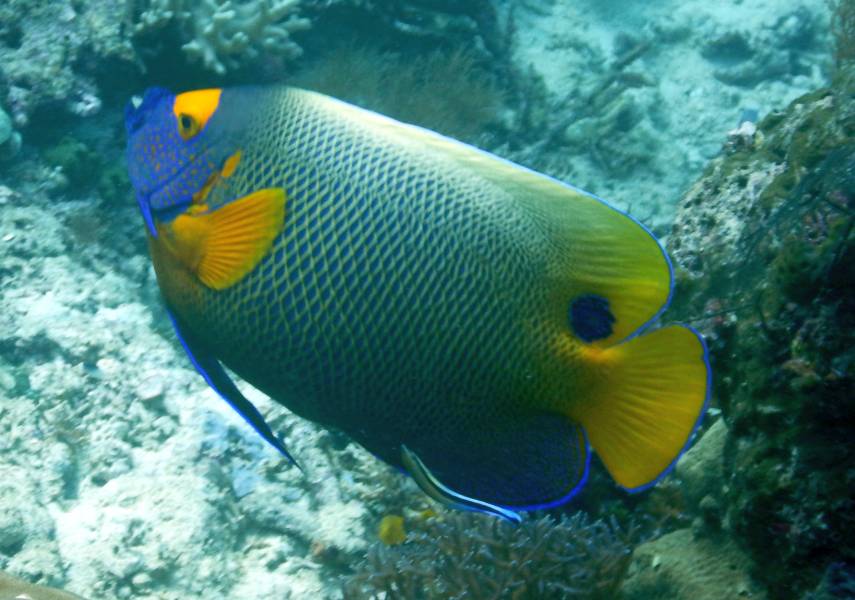
Yellow Masked Angelfish, Frewin, Raja Ampat |
| Frewin Banda West, Raja Ampat |
| Type: |
Slope and wall |
| Access: |
Dive boat or dinghy. |
| Position: |
0°28.6'S, 130°41.9'E |
| Depths: |
20‑50' (6‑17m) |
| Date: |
November 2016 |
| Visibility: |
60' (20m) |
| Dive Pros: |
Biodiversity Eco Resort |
| Snorkeling: |
Along wall. Beware current |
| Features: |
Abundant fish life |
| Divers: |
Jon, Sue and friends |
We made several dives with cruising friends along this "inner" west wall of Frewin Banda (not on the seaward side,
but on the western edge facing Frewin Island). The currents are less strong here than on the outer edge. One can
start at the northern tip of the triangular island and swim south along the western wall, or start part way down the
wall and reach the southern corner with a sandy slope for the safety stop. We either towed the dinghy or one of
our group sat out the dive and tended the dinghies.
This wall is a veritable garden of soft corals, tunicates, sponges and sea fans. Nudibranchs and colorful
flatworms creep among the other animals, finding meals only they can appreciate. It takes a sharp eye to pick out the
blue, gold, orange and black markings of a nudibranch or flatworm on a wall so painted in Picasso colors.
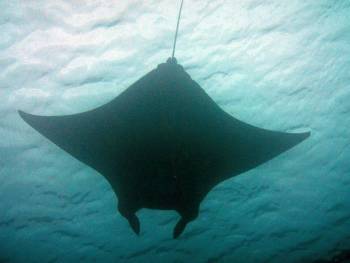
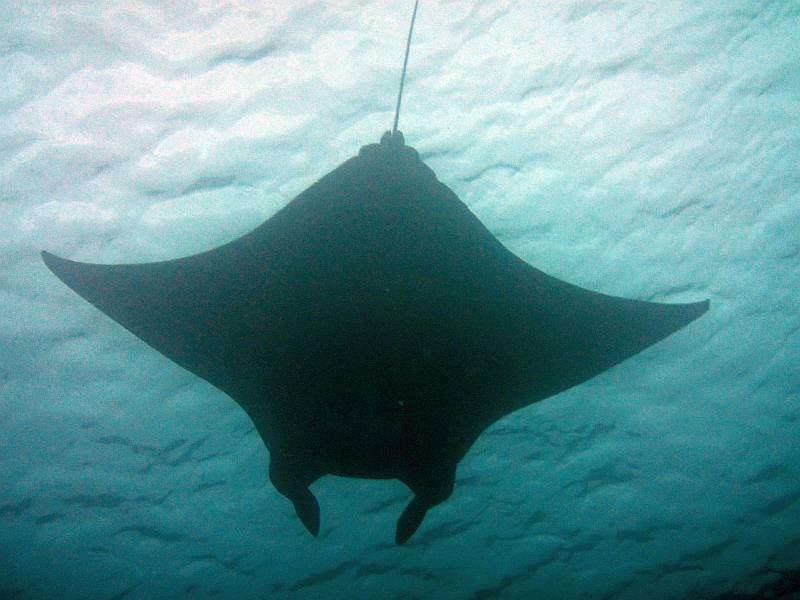
Reef mantas glide over divers at the cleaning station |
| Manta Sandy, Raja Ampat |
| Type: |
Sandy bottom |
| Access: |
Dive boat or dinghy. |
| Position: |
0°26.4'S, 130°41.6'E |
| Depths: |
0 to 50' (0‑15m) |
| Date: |
January 2017 |
| Visibility: |
60' (20m) |
| Dive Pros: |
Biodiversity Eco Resort |
| Snorkeling: |
Yes, from dive boat |
| Features: |
Manta cleaning station |
| Divers: |
Jon and friends |
Starting each year in December or so, the ocean around Raja Ampat fills with krill and the mantas arrive. We
dove in early January with Biodiversity Eco Resort to the amazing manta cleaning
station about 14 miles west of the resort. This is a popular dive site, and in order to be sure the mantas are not
harassed, divers are required to stay on the sandy bottom behind a low wall of coral rocks. Snorkelers overhead
are also advised not to swim over the cleaning stations which are a series of bommies "outside" the divers' wall.
You never know how many mantas will appear, but they seem to come from the deep blue, and suddenly you'll have beautiful
black and white creatures flying by overhead, swooping into the bommie area where they are attended by cleaner wrasse.
Although there are a few other reef fish near the bommies, the main attraction are the mantas. You may see reef
mantas or, if you're lucky, the really immense oceanic mantas. Check the ventral surface of the mantas and note
the pattern of black and white, which is unique for each individual.
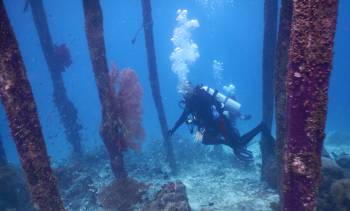
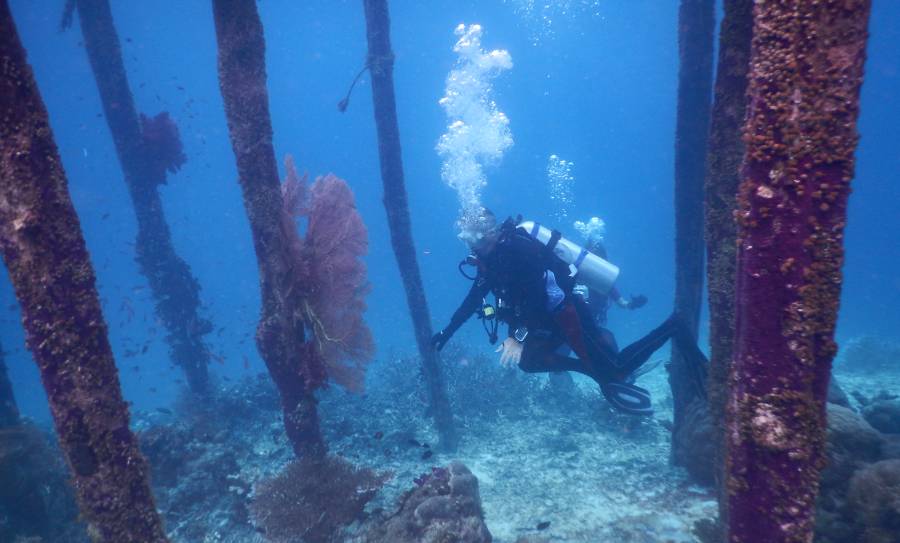
Divers under the Yanbuba Pier with good viz |
| Yanbuba, Raja Ampat |
| Type: |
Slope |
| Access: |
Dive boat or dinghy. |
| Position: |
0°34.2'S, 130°39.49'E |
| Depths: |
10 to 80' (3‑27m) |
| Date: |
Jan '17 Oct Nov Dec '18 |
| Visibility: |
50' (15m) |
| Dive Pros: |
Biodiversity Eco Resort |
| Snorkeling: |
Yes, near pier and bay |
| Features: |
Pelagics, large schools |
| Divers: |
Ocelot, friends, Leprechaun |
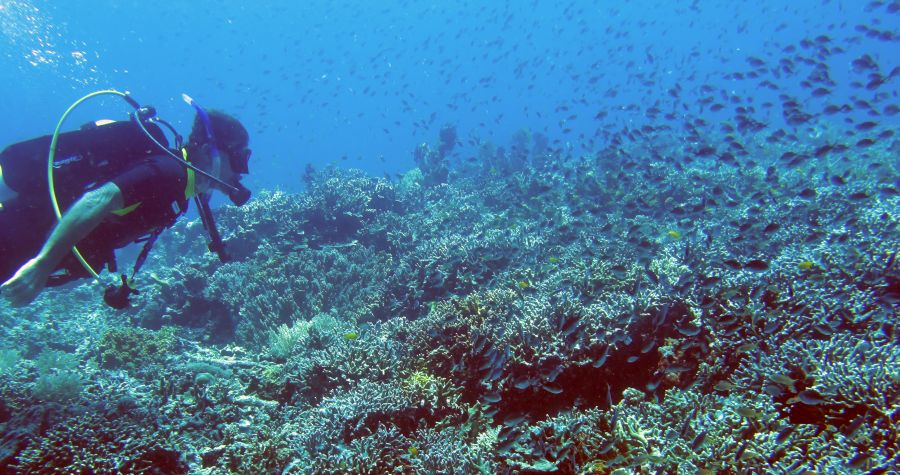
Yanbuba, a small bay and village west of Kri is a popular dive and snorkel site, known for its stunningly clear water
and dense coral gardens. This was Jon's first chance to dive (as opposed to snorkel) the area. Together with
Biodiversity Eco Resort guides, he and our friend Dan splashed near the pier then swam south to the point where they
found schools of trevally and fusiliers. Turtles nosed in and around the coral, huge porcupinefish floated over
the sea floor and a "herd" (they do look like bison!) of bumphead parrotfish wandered by. A school of barracuda
circled overhead and a black tip reef shark cruised by.
January water viz is less than in October or November due to the influx of zooplankton (just what mantas like!) so
even the snorkeling was not its "normal" awesomeness. But even so, under and around the pier ends the schools of
reef fish, dozens of species of butterflyfish and angelfish were astonishing. Diving or snorkeling beneath the
pier and on the surrounding coral-carpeted slope offers one of the best diving visual experiences of Raja Ampat.
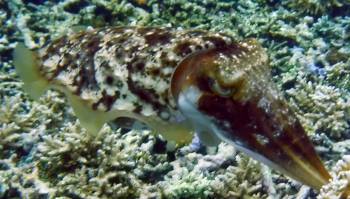
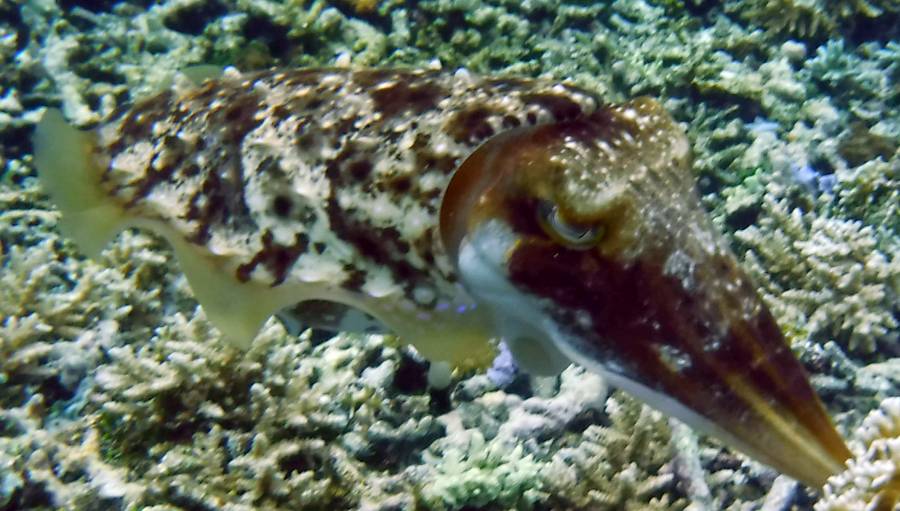
Cuttlefish are masters at camouflage! |
| Ransiwar, Raja Ampat |
| Type: |
Slope |
| Access: |
Dive boat or dinghy. |
| Position: |
0°34.16'S, 130°39.49'E |
| Depths: |
10 to 80' (3‑27m) |
| Date: |
Jan '17 Oct Nov Dec '18 |
| Visibility: |
40' (12m) |
| Dive Pros: |
Biodiversity Eco Resort |
| Snorkeling: |
Yes, near pier and bay |
| Features: |
Turtles, cuttlefish, reef fish |
| Divers: |
Ocelot, Leprechaun |
Ransiwar is the sister dive to Yanbuba, and usually the two are done on one day, with a surface interval on
the dock leading to Yanbuba village. Similar to Yanbuba, but with perhaps a more extensive coral garden
slope, Ransiwar is also known for its stunningly clear water
and abundant fish. There are also several large cuttlefish that are in residence, and are curious about
divers. Turtles are often spotted, and they are unafraid, and swim leisurely by. We have both snorkeled
and dived Ransiwar and Yanbuba and they are without a doubt, a couple of our favorites. They never seem
to disappoint.
The currents can be tricky inside this bay, with water trying to flow out to the north, or south, or
seemingly just swirling. Care should be taken to stay with your dive group, or be sure the surface boat
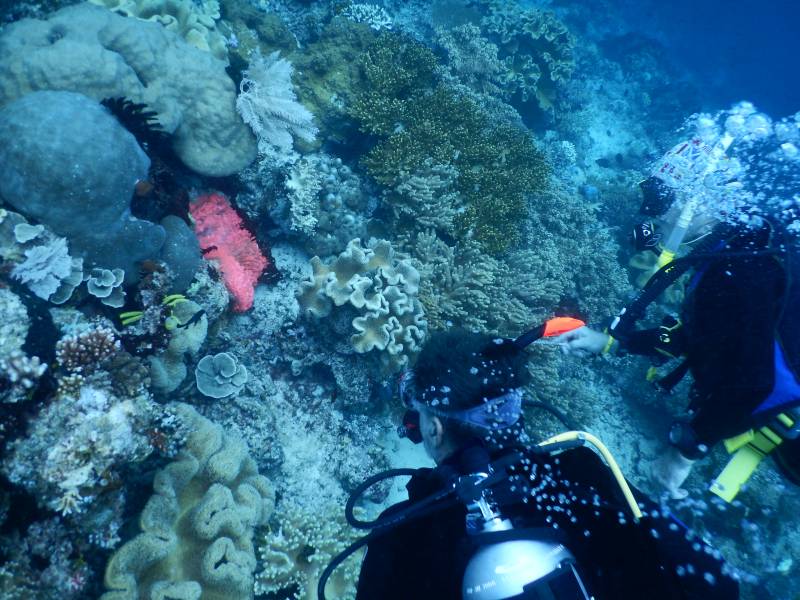
knows how long you'll be down, and what you have for attention (i.e. a whistle, or orange sausage.)
There is no easy anchoring inside the bay, as it is very deep. We have only ever dived here with a
commercial group, usually Biodiversity Eco Resort, which were great.
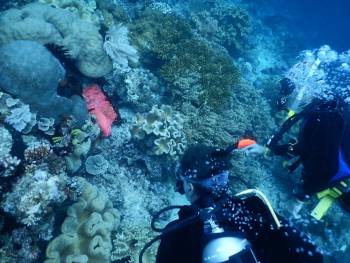
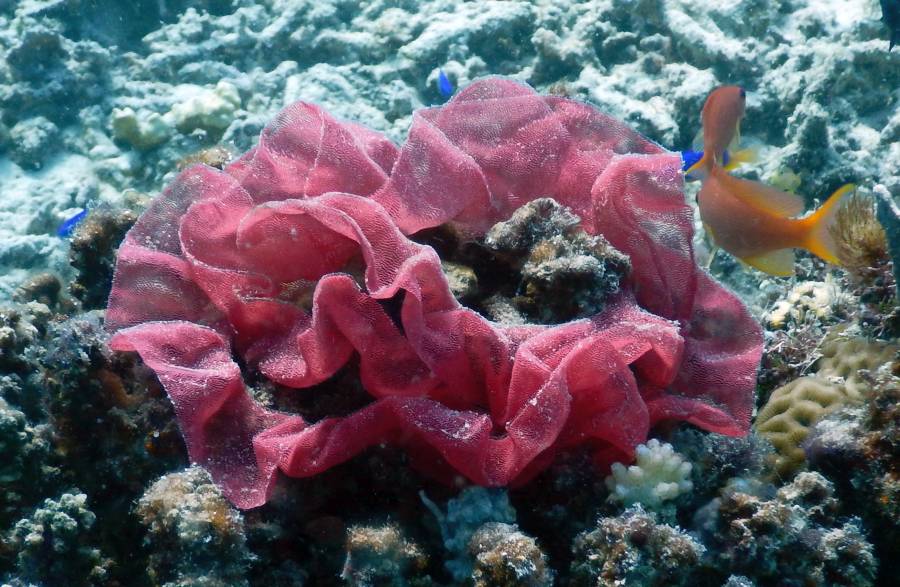
Divers enjoy brilliant colors of a pink anemone |
| Mioskon, Raja Ampat |
| Type: |
Seamount, slope |
| Access: |
Dive boat |
| Position: |
0°29.75'S, 130°43.49'E |
| Depths: |
30‑66' (6‑20m) |
| Date: |
Nov '16 Dec '18 |
| Visibility: |
60-100' (20-30m) |
| Dive Pros: |
Biodiversity Eco Resort |
| Snorkeling: |
No |
| Features: |
Soft corals and big fish |
| Divers: |
Jon, Sue, Amanda, Rachel |
Mioskon is a classic central Raja Ampat dive site off a small forest-covered island in the Dampier Strait, just south
of Biodiversity Eco Resort and the Frewin Islands. Depending on the current (and it can be fierce) your guide will
choose the best splash location. We dropped into 30ft on the eastern side of the island, and with reef right,
followed down to 66ft, slowly working our way up as we swam south and west. At times we had some current, but it
was very gentle, despite it being spring tides.
Colorful bommies decorated the slopes, and schools of snapper surrounded
us. We found a tasselled wobbegong beneath a ledge, and a transparent anemone shrimp lurking in the tentacles of a
fungus coral. Nudibranchs hid on the coral bommies, and several peacock mantis shrimp scurried about. For a
surface interval we enjoyed the white sand beach on the island's northwest corner.
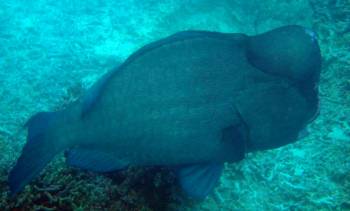
Bumphead parrotfish resemble swimming bison! |
| Fam Island, Raja Ampat |
| Type: |
Slope |
| Access: |
Private boat |
| Position: |
0°34.2'S, 130°39.4'E |
| Depths: |
10-70' (3‑21m) |
| Date: |
November 2016 |
| Visibility: |
50' (15m) |
| Dive Pros: |
None nearby |
| Snorkeling: |
Yes, throughout the bay |
| Features: |
Coral garden, bumphead parrotfish |
| Divers: |
Rainer and cruising friends |
This is an easy, casual dive site for a relaxing time underwater. No current, no surprises. Due to its
distance from the majority of dive resorts and homestays in Raja Ampat very few dive companies get out here to this
north-facing bay on Fam (or Pam) Island. Being on a cruising boat, we can anchor either outside the fringing reef
or cross the reef (with 3 meters beneath the hull) and anchor inside a large sandy bowl just off the beach. From
here, or on the outside anchorage, diving and snorkeling is possible just off the boat.
The water viz in October and November is brilliant here before the NW winds come in brining swells to this bay, and
making it untenable for anchoring. Rainer and our friends on Aosango splashed off Ocelot's stern into the bowl of
swimming pool clear water over the sandy bottom. Schools of fusiliers drifted by and the search was on for
crawling mollusks and flatworms on the sandy sea floor. On the densely coral‑covered reef you can enjoy watching a
multitude of reef fish as they go about their activities of feeding and defending territory.
There is no village here, though locals from Pam Village to the east may come by to offer fish or coconut oil for sale.
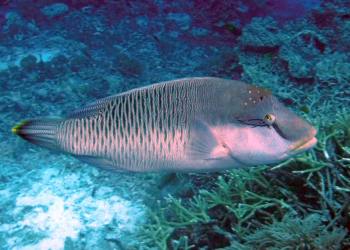
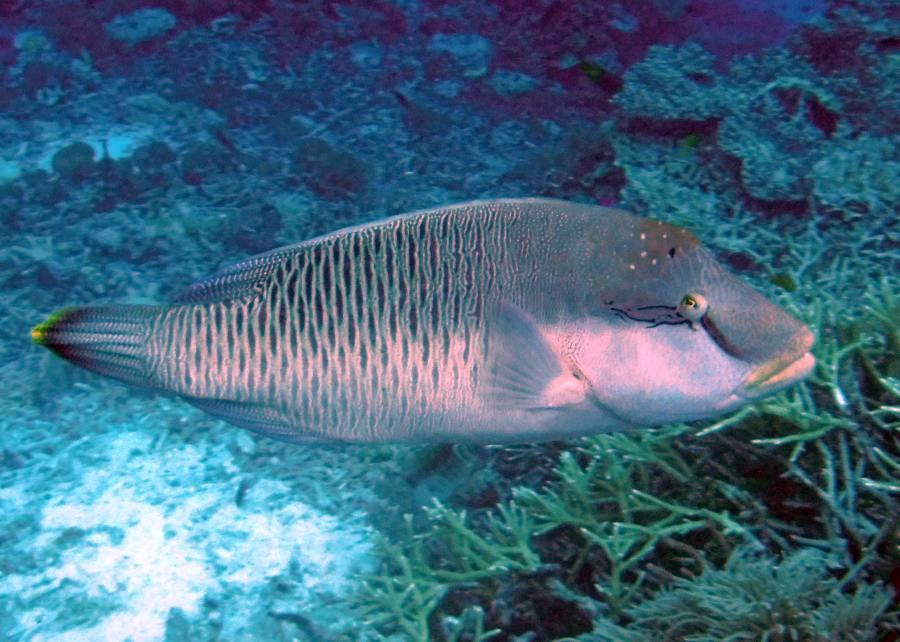
Napolean, or Maori Wrasse, Raja Ampat |
| Sardine Reef Raja Ampat |
| Type: |
Seamount |
| Access: |
Dive boat |
| Position: |
0°32.00'S, 130°42.95'E |
| Depths: |
30-70' (10‑21m) |
| Date: |
Oct '18 |
| Visibility: |
100' plus (30m+) |
| Dive Pros: |
Biodiversity Eco Resort and others |
| Snorkeling: |
No. Deep. Strong currents. |
| Features: |
Pelagics, sharks |
| Divers: |
Ocelot, Leprechaun |
Not for the faint of heart, Sardine Reef sports very lively currents. We splashed and descended
immediately, swimming with the current, with the reef on our left. We passed 2 sharks basking on the sand deep below us.
The terrain is interesting, with sand channels, then large bommies to explore. At the 'corner' we met
another current which was against us, so we swam back. This is one dive I'd not do on my own!
There were heaps of sweetlips, big groupers, barracudas, and a total of 7 sharks. The only down side is
that the top of the sea mount is rubble, whether destroyed by ships or storms it's hard to say, but all the
beauty is along the slopes of the mount, and it's awesome.
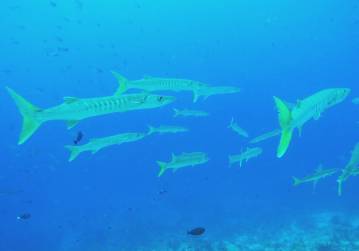
Barracuda circle lazily around divers at Cape Kri |
| Cape Kri, Raja Ampat |
| Type: |
Slope |
| Access: |
Private boat |
| Position: |
0°33.38'S, 130°41.45'E |
| Depths: |
10-70' (3‑21m) |
| Date: |
Oct '18 |
| Visibility: |
100' plus (30m+) |
| Dive Pros: |
Biodiversity Eco Resort and others |
| Snorkeling: |
Perhaps, closer to shore |
| Features: |
Pelagics, turtles, fish, fish, fish |
| Divers: |
Ocelot, Leprechaun |
It was exciting to finally get to dive the iconic Cape Kri, home to big pelagics and schools and school of
fish. Of course, conditions change, and it's not always awesome, but the day we went, it was! We
splashed on the southeast corner of Kri Island and drifted with the mild current to the north. There
were so many fish, so many sharks, and beautiful coral! The viz seemed unreal, like well over 100' (30m).
We took our surface interval on the tiny beach of Koh Island. The currents were so strong it was
tricky wading out to the dive boat!
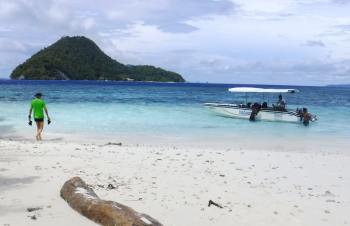
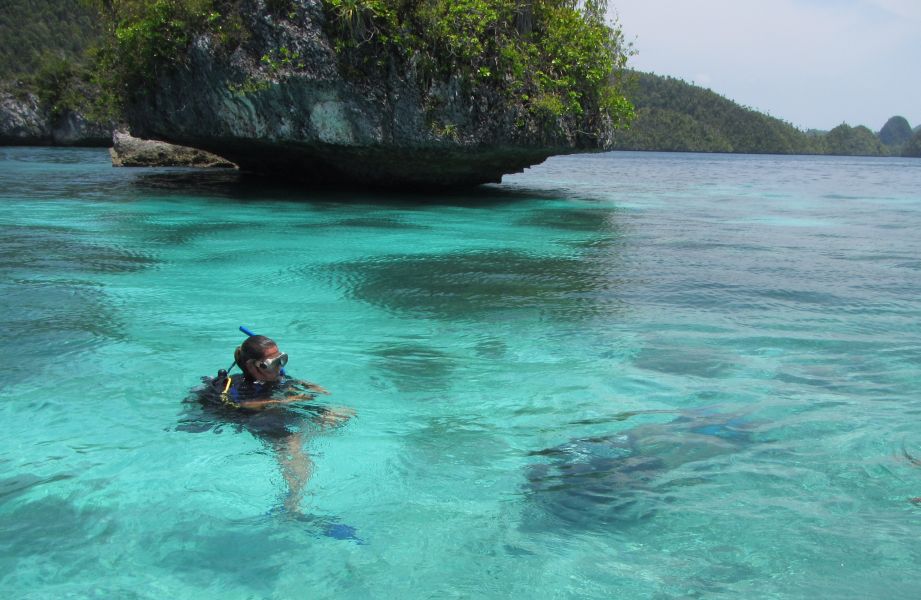
Surface interval on tiny Koh Is, facing Kri Is |
| Koh Island, Raja Ampat |
| Type: |
Slope |
| Access: |
Private boat |
| Position: |
0°33.20'S, 130°41.79'E |
| Depths: |
10-70' (3‑21m) |
| Date: |
Oct '18 |
| Visibility: |
100' plus (30m+) |
| Dive Pros: |
Biodiversity Eco Resort and others |
| Snorkeling: |
No. Deep. Strong currents. |
| Features: |
Pelagics, sharks |
| Divers: |
Jon, Sue, + other divers |
We splashed to the SW of Koh Island, just north of Kri, and followed the reef left down to 72' (22m). We
had great views of both black and white tip reef sharks, groupers, trevally and a tasseled wobbegong shark.
The current was about medium, meaning we could make our way against it if necessary, but often we held onto
rocks to watch the fish parade go by. Very beautiful. We did our surface interval on tiny Koh
Island, on a bit of beach that seems to be there most of the time.
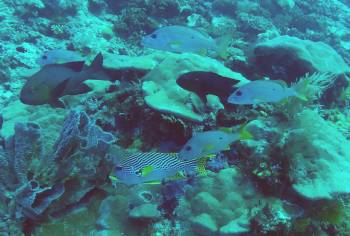
Sweetlips and large reef fish with plate coral |
| Chicken Reef, Raja Ampat |
| Type: |
Dampier Strait reef, sand slope |
| Access: |
Dive boat |
| Position: |
0°32.6S, 130°41.88'E |
| Depths: |
10-70' (3‑21m) |
| Date: |
Oct '18 |
| Visibility: |
40' (13m) |
| Dive Pros: |
Biodiversity Eco Resort |
| Snorkeling: |
No. Strong current, isolated reef. |
| Features: |
Fishy fishy. Pelagics, schools. |
| Divers: |
Ocelot and Leprechaun |
We did a negative entry here (descending immediately upon entering the water from the dive boat). We rode
the current one way, then fought to stay in place. It was hard work, and we had to hold onto the rocks.
The reef itself was pretty ho hum, and there were vast areas of sandy slope. We started at 73' and worked our
way up. While the coral itself was only so‑so, the schools of fish were impressive. Unicorn fish flowed
past us in long parades, and fusilier were bright blue and yellow in the light. This dive is noted for pelagics, but we
didn't see many large fish, maybe some trevally, but nothing very big. Apparently the fish concentration
changes with the currents, and probably the season.
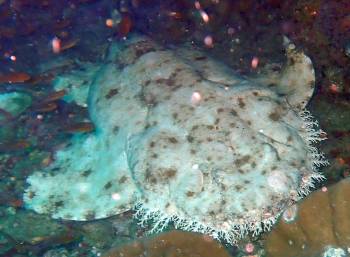
The business end of a Tasseled Wobbegong |
| Francisco, Raja Ampat |
| Type: |
Slope |
| Access: |
Private boat |
| Position: |
0°28.16'S, 130°41.83'E |
| Depths: |
10-75' (3‑23m) |
| Date: |
Dec '18 |
| Visibility: |
50' (15m) |
| Dive Pros: |
Biodiversity Eco Resort |
| Snorkeling: |
Yes, on coast of Frewin |
| Features: |
Multiple bommies |
| Divers: |
Jon, Sue, Amanda, Rach, Tim |
This dive would be easy to do from your own dinghy, but without the guidance of Biodiversity Eco Resort we
would never have found it. It's literally a couple minutes from the Frewin Anchorage, and just offshore
of an area on Frewin island that we'd snorkeled numerous times. Low expectations are good.... because we
were wonderfully surprised and delighted with our dive. There was virtually no current, the viz was
good, and the sandy slope was filled with beautiful bommies covered in soft corals, fans, crinoids, tunicates
and a host of other plant‑looking animals. We found several species of nudibranch and a lively,
defensive mantis shrimp. The water column was filled with fusiliers and unicornfish. Under one overhand
we came upon a Raja classic, the Tasseled Wobbegong shark who posed for numerous photos!
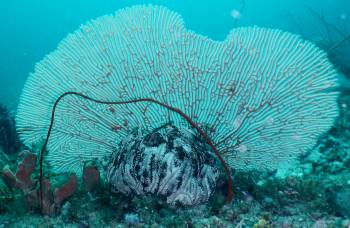
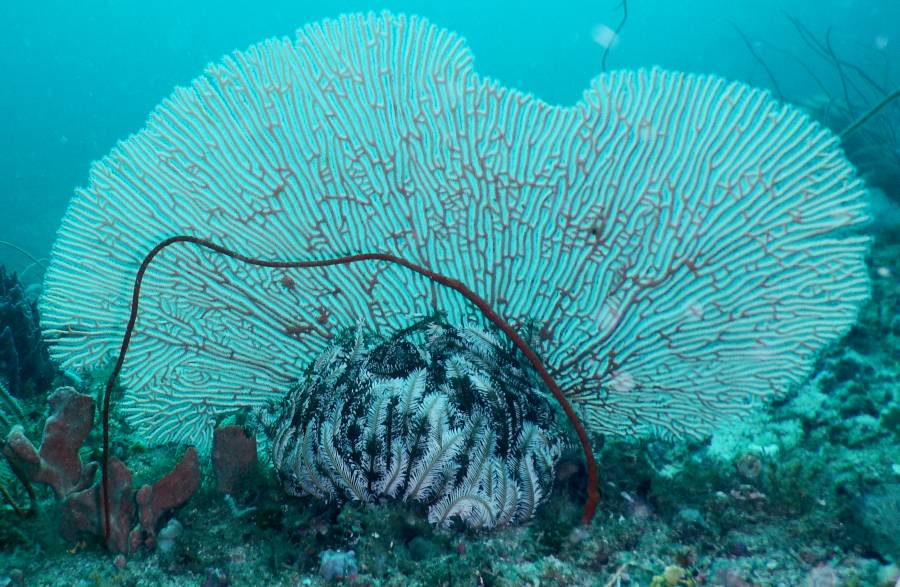
Seafan, whip coral and crionoid at Urai |
| Urai, Raja Ampat |
| Type: |
Slope |
| Access: |
Private boat |
| Position: |
0°24.57'S, 130°41.84'E |
| Depths: |
10-88' (3‑26m) |
| Date: |
Dec '18 |
| Visibility: |
40' (12m) |
| Dive Pros: |
Biodiversity Eco Resort |
| Snorkeling: |
Probably not great |
| Features: |
Coral garden, critters, nudis |
| Divers: |
Sue, Jon, Amanda, Rachel. Tim |
An unusual dive site, in that it's in the Kabui Bay, so isn't washed with clear oceanic water. The
viz was not great, but no matter, as we were in search of little critters and interesting things. Like
electric file clams, fire urchins and nudibranchs. And we found all three! This was a gently
sloping sand and coral bommie area, where we could descend to over 80' (25m), then work our way up searching
for fun stuff. After the hectic strong current dives out in Dampier Strait it was a relaxing and fun way
to dive.
The guide from Biodiversity Eco Resort was awesome, taking time to pint out things, and waiting while we
got photos.
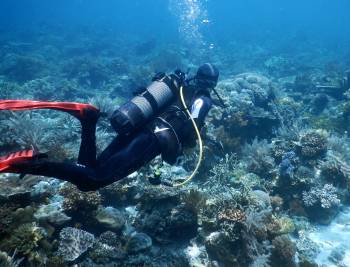
Astrid from Gaia dives on the Swallope coral field |
| Swallope, Kofiau, Raja Ampat |
| Type: |
Wall/Slope (ergo the name) |
| Access: |
Private boat |
| Position: |
1°16.56'S, 129°39.7'E |
| Depths: |
10 to 70' (3‑21m) |
| Date: |
February 2017 |
| Visibility: |
50' (15m) |
| Dive Pros: |
None nearby |
| Snorkeling: |
Yes, along the shore |
| Features: |
Coral garden |
| Divers: |
Sue, Jon & cruising friends |
The Kofiau Islands are part of 2 small archipelagos (Boo and Kofiau) that lie west of the more familiar, main islands
of Raja Ampat. There is only one village in the area, but several small fishing encampments on the beaches.
The islands are low and alive with fruit bats and birds. With no river run‑off, the sea water viz is usually very good.
This dive, dubbed "Swallope" as it includes both a slope and a wall, is along the southern coast of Walo Island.
Swift currents sweep the coast of Walo so you'll have to choose your splash site accordingly. Tow a dinghy for
sure, as the currents can change erratically, and it's best to choose your dive time for your comfort level with
currents and drift diving. We were careful and hit slack, so we could anchor one dinghy at the west end (where
there's an exit from the mangrove estuary) and tow the other for 4 divers.
The coral is prolific here. We saw a big broadfin cuttlefish which did its color and texture change for us,
then drifted away with one tentacle held upright in the defensive position. We photographed and ID'd some new
blennies - beautiful little fish that are recognizable by their curved bodies, balanced on pectoral fins on the coral.
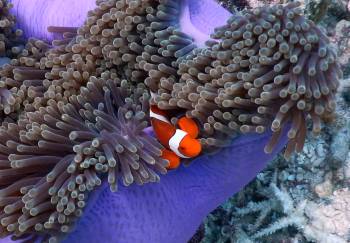
Clown Anemonefish in its anemone, Walo Bommies |
| Walo Bommies, Kofiau, Raja Ampat |
| Type: |
Huge bommies |
| Access: |
Private boat |
| Position: |
1°16.25'S, 129°40.1E |
| Depths: |
10-70' (3‑21m |
| Date: |
February 2017 |
| Visibility: |
50' (15m) |
| Dive Pros: |
None nearby |
| Snorkeling: |
No. Bommies too deep. |
| Features: |
Coral- and fish-rich bommies |
| Divers: |
Sue, Jon, & cruising friends |
If you choose your timing for slack water, this is a great dive site for exploring a number of coral‑rich bommies
just near the area's best anchorage. In gentle current, you can swim between the bommies and hide in their lee.
The bommies are identifiable from the surface, and depending on the current, you can splash at either end of the
chain of bommies. They only come to within 15ft (4m) of the surface, so the snorkeling is not good. Each
bommie is a rounded mount of coral-covered rock, replete with crevices and ledges, and decorated with soft and hard
corals. Reef fish abound. If viz is not good enough to see from one bommie to the next, following a carefully laid
compass course will lead you from one fascinating environment to another, over expanses of white sand where you may see
shrimp gobies and goatfish.
The Kofiau Islands lie to the west of Batanta and Salawati and are distinctly different from the lush hills of most
of Raja Ampat. These islands are low and offer many anchorages in clear sand. With the lack of river
run‑off, the sea viz is generally very good.
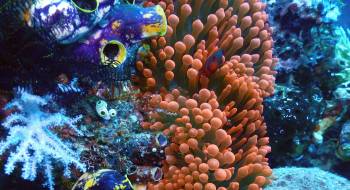
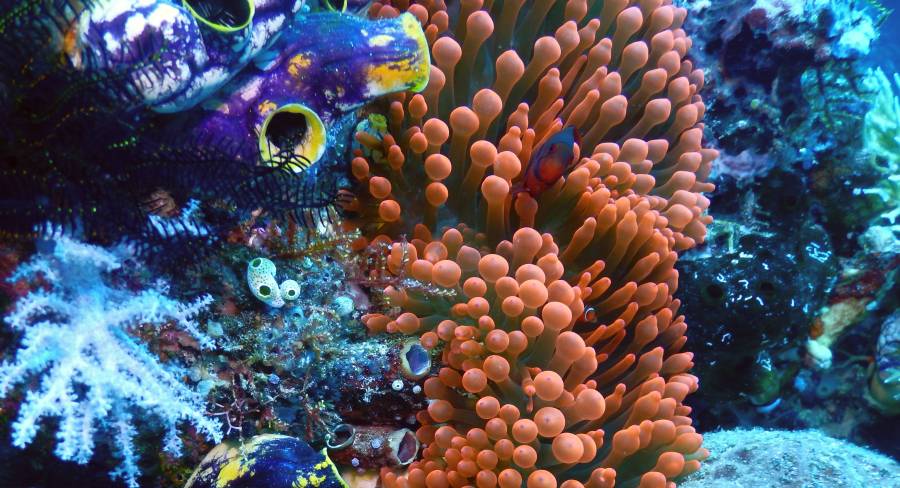
Red bulb tentacle anemone shelters anemonefish |
| Sino Slide, Kofiau, Raja Ampat |
| Type: |
Drift dive |
| Access: |
Private boat |
| Position: |
1°15.32'S, 129°39.93'E |
| Depths: |
10-70' (3‑21m) |
| Date: |
February 2017 |
| Visibility: |
50' (15m) |
| Dive Pros: |
None nearby |
| Snorkeling: |
Maybe, towing dinghy |
| Features: |
Dense coral slope. Current |
| Divers: |
Jon, Sue, cruising friends |
A pretty consistent current sweeps between Walo and Sino Islands, bringing nutrients and fish schools. This
dive is best done when the current flows eastward and you dive on the south side of the island. Begin at the
southwest corner and drift east, keeping Sino Island on your left. You can begin deep on the slope, then swim up
as you drift along.
As with most drift dives, the fun is in the "movie" that slides past you as you traverse the coral slopes. We
found some spots to hang and get pictures, but in general our memory of this dive is one of COLOR! FISH!
BEAUTIFUL! And it all slides past at varying speeds! That's Sino Slide!
Another day we tried to dive the western and northern sides, but were often caught in an eddy that divided the divers
in two directions! The southern side offers the best coral and fish.
Due to the isolation of this area, it's certainly best to tow your dinghy or have someone on live‑boat overhead.
The viz was quite good in January when the winds are still from the northwest in this western part of Raja Ampat.
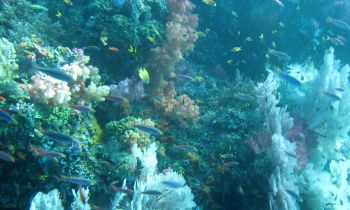
A palette of color on Whale Rock, Raja Ampat |
| Whale Rock, Misool, Raja Ampat |
| Type: |
Rock island |
| Access: |
Dinghy or dive boat |
| Position: |
2°13.16'S, 130°33.56'E |
| Depths: |
20‑70' (6‑21m) |
| Date: |
November 2014 |
| Visibility: |
60' (20m) |
| Dive Pros: |
Misool Eco Resort |
| Snorkeling: |
Yes, around the rock walls |
| Features: |
Coral garden on sloping reef |
| Divers: |
Jon, Sue |
Whale Rock derives its name from its distinctive whale shape when viewed from the south, a whale heading west!
We dinghied from Misool Eco Resort where we'd
moored Ocelot, and joined cruisers from Nalukai who snorkeled above us as
we dove. The currents can be fierce here, and we didn't want to leave the dinghy tied to the rocks. We
started by towing our dinghy, but soon Jeremy took the painter from us so that we were freer to move about. It's not
real comfortable holding a dinghy painter while scuba diving but we had learned from other cruisers that it can be done.
The trick is to not have wind and tide in opposition, as the dinghy has a fair amount of windage. We had a calm
day, but with a fair bit of current.
The viz was great and we enjoyed floating above a garden of hard and soft corals. A hawksbill turtle nosed
about in the coral for a meal. Parrotfish did their noisy coral munching and colorful wrasses zoomed about using
their pectoral fins as mini propellers. The sea floor was carpeted in corals and anemones, while the rock walls of
Whale Rock itself were adorned in bright tunicates, sea fans, and encrusting corals and sponges.
Given the warmth of the southern Raja Ampat water, we wore only 3mm shorty wet suites and closed‑foot snorkeling fins.
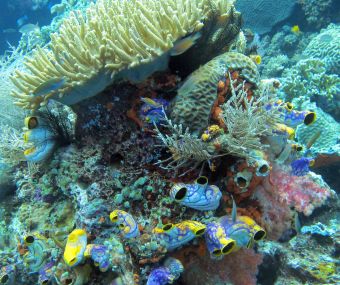
Heart ascidians, soft pink coral & leather coral |
| Kalig East, Misool, Raja Ampat |
| Type: |
Wall |
| Access: |
Dinghy or dive boat |
| Position: |
2°13.04'S, 130°32.8'E |
| Depths: |
20‑70' (6‑21m) |
| Date: |
November 2014 |
| Visibility: |
80' (25m) |
| Dive Pros: |
Misool Eco Resort |
| Snorkeling: |
Yes, top of the walls |
| Features: |
Abundant soft corals, fish, turtles |
| Divers: |
Jon, Sue |
It's hard to go wrong diving along the outer walls of the rock complex known as Kalig, in Misool. There is a
mooring ball inside a protected bay, with a big boat entrance to the east, and a shallow pass to the north. We
took the dinghy to the outer (northern) edge of the pass, and splashed, heading first east, then west along the wall.
At 70' (21m) we hit the sandy slope at the bottom of the wall, so we wove our way back and forth, ever shallower.
The wall and its outcroppings were covered in bright tunicates and encrusting sponges and corals. Sea fans and soft corals added color.
In the blue, to the north, we saw big Napolean wrasse, a couple sharks (maybe a white tip) and hawksbill turtles.
Unicorn‑fish and triggerfish passed by in schools. A large thorny stingray slowly flapped its way into the blue,
and red, green, blue and yellow starfish adorned the rocks.
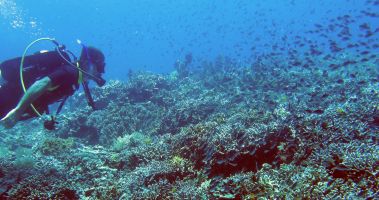
Jon swims with a gazillion reef fish, Misool, Raja Ampat |
| Misool Eco Resort House Reef |
| Type: |
Gentle drift |
| Access: |
From Misool Eco Resort |
| Position: |
2°14.89'S, 130°32.74'E |
| Depths: |
20‑70' (6‑21m) |
| Date: |
November 2014 |
| Visibility: |
50' (15m) |
| Dive Pros: |
Misool Eco Resort |
| Snorkeling: |
Yes, but better on northern reef |
| Features: |
Coral gardens, gentle slope |
| Divers: |
Jon, Sue |
Apparently there is a manta cleaning station on the southwest corner of Batbitiem Island, on which the
Misool Eco Resort is located. With the current
ripping along the west coast, we splashed on the south side of the island,
hoping for a peek at the mantas. No luck. Our friends on Nalukai snorkeled along above us, towing our dinghy.
The corals here were not particularly bright, being mostly hard corals and leather corals, all of a similar color.
But there were the usual butterflyfish and damsels (a million of them!), scattered anemones with several species of anemone‑fish, and a school (more like a
herd) of huge bumphead parrotfish. We did see some new (to us) reef fish, though, and basically racked up another hour underwater.
The best part of the House Reef for the Resort is the northern shore and the northeastern corner both of which can be snorkeled easily.
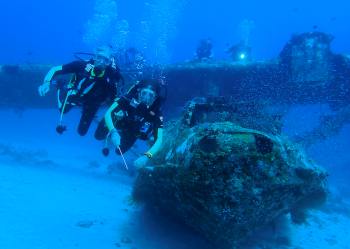
Jon and Sue dive the Catalina Wreck, Biak |
| Catalina Wreck, Biak |
| Type: |
Deep airplane wreck dive |
| Access: |
Dive boat or dinghy |
| Position: |
approx. 01°11.29'S, 136°02.61'E |
| Depths: |
100' (30m) |
| Date: |
Jan 2019 |
| Visibility: |
100' (30m) |
| Dive Pros: |
Julius +62.852.4496.0506 DivePhoria |
| Snorkeling: |
No |
| Features: |
Catalina float plane |
| Divers: |
Ocelot, Soggy Paws, Berserker |
We were picked up on our boats by Julius, who runs DivePhoria in Biak, and taken the 5 minutes' ride to the wreck site.
DivePhoria does not have a web presence. We found Julius on the waterfront by the Ikan Pasar (Fish
Market) wharf, where you can see his dive boats, marked Dive Biak.
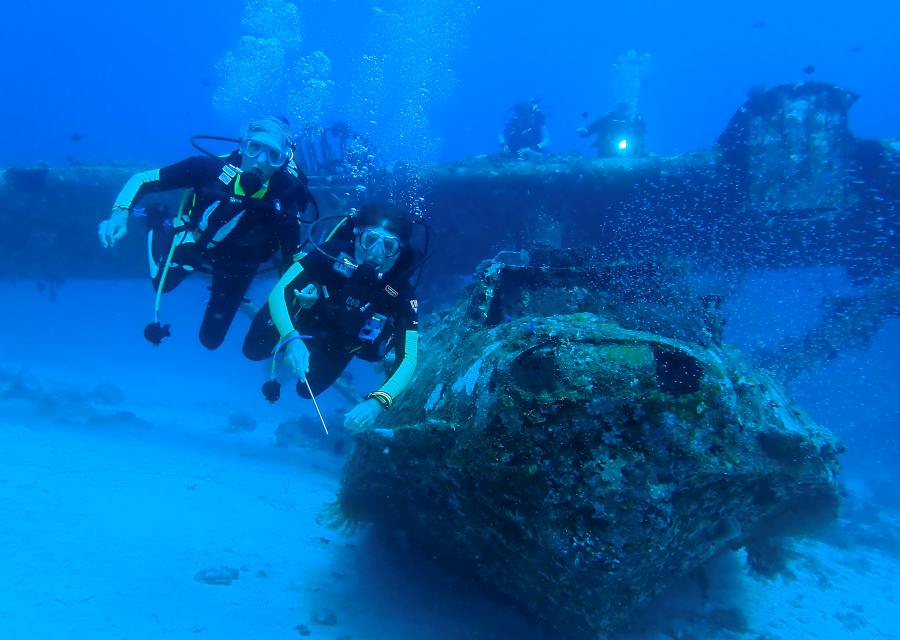
This WWII Catalina float plane lies off the western coast of Biak in 90 feet (27m). The
water was clear with 100ft (30m) viz, and no current. Pretty ideal. The wreck is very intact and
big enough to hold one's interest for as long as air/decompression tables allow. There isn't much coral growth though, and
very few fish. Definitely a dive for wreck enthusiasts.
And we had one with us. Dave McCampbell, on Soggy Paws, was a US Navy Diver and is a WWII enthusiast.
His father flew fighters in the South Pacific in WWII and is the Navy's top Ace. So Dave gave us mini‑lectures on each wreck
dive we did, and made it fun by challenging us to see the details that allowed us to determine which model of
plane we were diving on. This was a long range patrol bomber, PBY5, with a crew of 7‑9, built by
Consolidated in the US or Canada. It had a range of 2100 miles and flew with 2 Pratt and Whitney 900hp
engines. We're not sure how it ended up in the water off Biak. The engines and propellers were
gone, so we suspect it was dumped here on purpose.
We looked for evidence of wheels, but saw none, so it was probably not a PBY5A, (A for Amphibian). You
can learn more about lots of Pacific Wrecks at PacificWrecks.com.
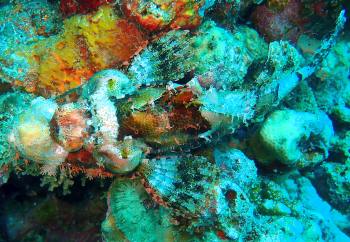
Scorpionfish on Arsenal Bommie |
| Arsenal Bommie, Biak |
| Type: |
Gentle coral-covered slope |
| Access: |
Dive boat or dinghy |
| Position: |
approx. 01°11.35'S, 136°02.70'E |
| Depths: |
20‑70' (6‑21m) |
| Date: |
Jan 2019 |
| Visibility: |
50' (15m) |
| Dive Pros: |
Julius +62.852.4496.0506 DivePhoria |
| Snorkeling: |
Yes |
| Features: |
Coral gardens, WWII relics |
| Divers: |
Ocelot, Soggy Paws, Berserker |
This dive was very close to the Catalina wreck, but in much shallower water. We splashed in about
30' (9m) and descended to 80' (24m), then worked our way along the rubble and bommie-covered slope for 50 minutes.
To find the relics scattered about on the reef was the challenge, and Julius, our guide, sort of let us do our
own thing, making it fun when we found a mortar or parts of a gun, or something interesting. Then we'd
bang on our tank and call Dave over to take a look. Dave McCampbell, on Soggy Paws, was a US Navy Diver
and is a WWII enthusiast. His father flew Hellcat fighters in the South Pacific in WWII and is the Navy's
top Ace. Dave was
great at pointing out bits and pieces lying about, and we were all gathering around to take pictures.
Sue, however, is more interested in living things, so the scorpionfish in this shot got her attention for
longer!
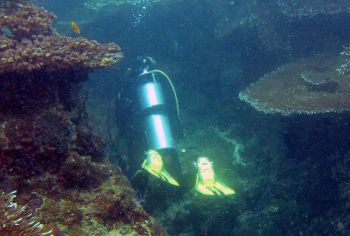
Leeza enters a plate coral canyon, Triton Bay |
| Batu Jatuh, Triton Bay |
| Type: |
Rocky shore |
| Access: |
Dive boat |
| Position: |
3°53.78'S, 134°06.3'E |
| Depths: |
20‑70' (6‑21m) |
| Date: |
March & April 2015 |
| Visibility: |
About 40' (12m) |
| Dive Pros: |
Triton Bay Divers |
| Snorkeling: |
Yes, along the coast near boulders |
| Features: |
Schools of fish, plate coral canyon |
| Divers: |
Sue, Jon, Rachel |
We dove Batu Jatuh (Indonesian for Fallen Rocks) in March with another cruiser, Dana, from Villa G, and with
Triton Bay Divers, using their dive boat
and we dove again in April, 2015. Both times, Triton Bay Divers owner, Leeza, was our guide. Tucked into
the southern end of Triton Bay (just north of Iris Strait), the viz was not great,
but our goal was to stay out of the strong full moon currents. We splashed next to a jumble of fallen boulders,
descending to 40', then heading down slope to about 70'. The boulders and the sand slopes were festooned in soft
corals and bright tunicates, with waving sea fans and black coral bushes and whips. We saw snappers, groupers and
large sweet‑lips. Leeza located some small shrimps inside anemones, and several nudibranchs as well.
After we rounded the fallen boulders we circled back to shallower water and swam through a massive canyon of plate
corals all larger and higher than us! Colors were a bit muted due to the high overcast. Since we hadn't
dived for 3 months, Sue carried the small, palm sized Canon D30 without an external light source
instead of the more bulky Canon G12 in its housing.
We were comfortable in stinger suits and 3mm shorties. We took a surface break at the Conservation
International beach on the eastern shore of Iris Strait.
| Sareneus West, Triton Bay |
| Type: |
Gentle drift, sloping reef |
| Access: |
Dive boat or dinghy |
| Position: |
3°54.85'S, 134°06.03'E |
| Depths: |
20‑70' (6‑21m) |
| Date: |
March & April 2015 |
| Visibility: |
60' (20m) |
| Dive Pros: |
Triton Bay Divers |
| Snorkeling: |
Yes, all around the island. Beware current |
| Features: |
Awesome soft corals, nudibranchs |
| Divers: |
Sue, Jon, Rachel |
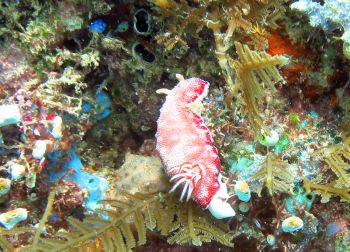
Nudibranch Chromodoris reticulata on rock wall |
Second dive of the morning, and the light was better. This sight is more exposed to the currents of Iris
Strait, and it seemed like the viz was better here than at Batu Jatuh, or maybe it was just the brighter light. We
splashed in 15' over coral that we had snorkeled a few days before. Then we followed the slope down from the
island, with the reef on our left. The sea floor fell away in sort of steps, with overhung edges into which we could peer to see
soldier‑fish and many crevice lurkers. We poked around the slope and boulders, swimming against a light current.
The first time we dove here, in March, we had hoped to do an easy drift dive down the west side of the island, but the negative current abated, and then we
were in slack. We found several new nudibranchs and schools of pink and lavender anthiases with their pointy
snouts and streaming first dorsals. We were visited by a lone bump‑head parrotfish, a big, old guy, and a lone pinnate
spadefish, the first we'd ever seen. There were many pairs of mature blue-ringed angelfish and six-banded
angelfish, so unafraid of us divers! Sue was feeling more confident so she took the Canon G12 in its housing, with an external video light. This was a
great boon to light up the bright soft corals and tunicates for which Triton Bay is so famous.
Our April dive with Rachel was a whole different experience! Again, we splashed at the
northern end and zigzagged around the boulder formations and the fields of bushy black coral, where
a scorpion fish hid on the rock ledge and huge plate corals invited size comparison. Some were
over 2m wide! At the NW corner the colors began emerging from the soft corals, and instead of the
white and blue of the quiet reef, we were suddenly amidst the dazzling yellow, white, pink, red and
dark green of the living reef, open to the nutrients in the swift current. And then we stopped
taking pictures and turned on the video, as the world swirled by. Nothing to do but to go with
it. We hugged the ledge and kept the reef on our left so as not to get out where there could
be a downdraft current. A few minutes later Leeza tucked into the shelter of a protected cove
between big boulders and we rested, caught our breath and poked around for the smaller things that
inhabit these unmoving areas. Rachel and Sue had their new pointer sticks and loved the
ability to balance on the tip of a metal pointer while getting a close up photo. No more having to madly kick to
hold position, or having to put a fin or knuckle onto the reef for support.
The Canon G12 had suffered a mechanical failure just before Rachel arrived, so she had
brought us a small point and shoot Nikon, the AW130, which is able to go to 30 meters and has a built
in depth gauge with a warning when you're too deep for the camera. Sue used that, while Rachel
enjoyed the small Canon D30.
As a drift dive this is incomparable for color and density of reef life! Amazing!
Just don't wander too far off the reef shelf, or you'll be snagged by unbelievable current and
the possibility of a downdraft. In fact, while we rested in our cove we watched fusiliers and
parrotfish swim in place, in vertical position, heads up. Guess what they were swimming
against? We hugged the reef more tightly, and then, at a sign from Leeza, let go and flowed
southward to a fully protected big cove where there was no current and we could hang out and await
the pickup boat.
| Stumpy Rock, Triton Bay |
| Type: |
Boulders & Reef slope |
| Access: |
Dive boat or dinghy |
| Position: |
3°55.2'S, 133°59.6'E |
| Depths: |
20‑70' (6‑21m) |
| Date: |
March & April 2015 |
| Visibility: |
80' (25m) less in April |
| Dive Pros: |
Triton Bay Divers |
| Snorkeling: |
No, too exposed and isolated |
| Features: |
Lots of big fish, amazing soft corals |
| Divers: |
Sue, Jon, Rachel |
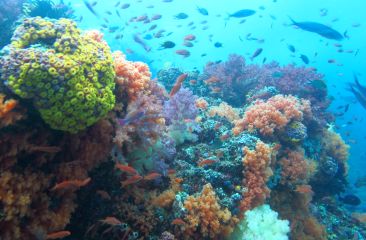
So many soft corals and fish, Stumpy Rock, Triton Bay |
This and Pinnacle can be combined into one dive, but when we arrived at Stumpy in the morning the viz was so good,
and the fish life so abundant we spent an hour perusing the slopes. There were so many schools of banner‑fish,
spadefish, trigger‑fish, unicorn‑fish and fusiliers that we almost forgot to look closely at the coral walls for
nudibranchs and other macro photography subjects. Huge groupers sped between coral valleys, or lazed about, half
visible, under rock ledges. Massive schools of surgeonfish glided by, and we were suspended in an aquarium of fish.
The water temperature was a pretty steady 28°C, so very comfortable in a Lycra stinger suit under a 3mm shortie wetsuit.
This would not be a good snorkeling site, as most of it was quite deep, and there is really no
shelter from the prevailing winds. The sea was very rough, so it was a case of splashing quickly, diving, and then
hopping quickly back into the dive boat. The dive boat driver for Triton Bay Divers was excellent at getting us in
position, then retrieving us quickly once we surfaced.
Our memories of such incredible visibility in March had us anxious to return to Stumpy and
Pinnacle in April with Rachel. The winds were less in April so that the ocean entries were
less hectic, but the viz almost as good. This time we dove both Stumpy and the Pinnacle in one
circuitous dive, crossing the deep sand bridge between Stumpy and the Pinnacle, circling Pinnacle,
then returning to the sheltered walls of Stumpy. It wasn't quite as fishy as it had been in march,
but we still had schools of unicorn fish and graceful longfin bannerfish. We saw an adult
barramundi, which was fun, and Rachel got shots of a pygmy seahorse on a sea fan, thanks to Leeza's
torch and pointer stick helping us locate it. Hats off for Leeza's great eyes in spotting a 3/4"
(2cm) pink and white spotted creature entwined around pink and white sea fan arms.
This rates as one of the TOP DIVES for the Ocelot crew!
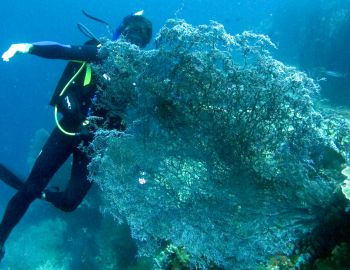
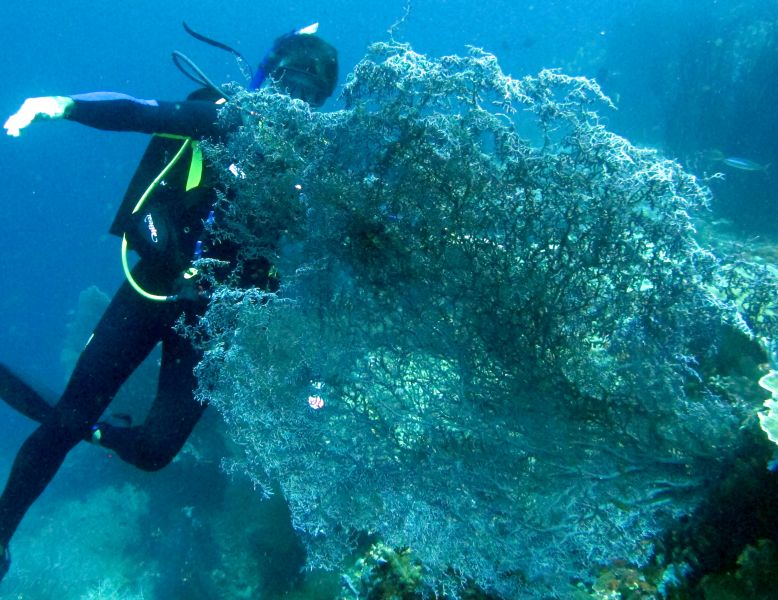
Jon tries to measure a huge sea fan |
| Pinnacle, Triton Bay |
| Type: |
Undersea pinnacle |
| Access: |
Dive boat or dinghy |
| Position: |
03°55.2'S, 133°59.6'E |
| Depths: |
20‑90' (6‑28m) |
| Date: |
March, Apr 2015 |
| Visibility: |
About 70' |
| Dive Pros: |
Triton Bay Divers |
| Snorkeling: |
No, too deep |
| Features: |
Walls, soft corals, amazing fish |
| Divers: |
Sue, Jon + Rachel in April |
This dive begins at the same splash point as Stumpy Rock (which is the only visible marker for the dive site).
The pinnacle bears about 150° magnetic from the rock, and is linked to the slopes of Stumpy with a shoulder at
about 60‑70 feet depth. The dive then continues around the pinnacle itself, ending on a shallower shoulder that
links back to the slopes under Stumpy for a safety stop.
Like Stumpy Rock, the undersea landscape is one of brilliant gardens of soft corals and an amazing number of
schooling fish. When the current is running the corals open their polyps to feed and the landscape blooms into
even brighter color. The visibility was so good, and the fish so prolific that it was hard to know where to look.
But we did focus in close, occasionally, to find juvenile bright yellow sea cucumbers that look like punk spiky
nudibranchs, small commensal shrimps in anemones, and some bright nudibranchs camouflaged on the brightly colored boulders.
This rates as one of the TOP DIVES for the Ocelot crew!
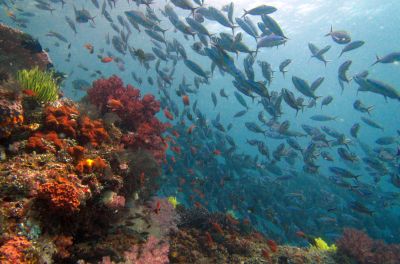
Fusiliers & Surgeonfish fill the water at Dramai Rock |
| Dramai Rock, Triton Bay |
| Type: |
Boulders & Rubble slope |
| Access: |
Dive boat |
| Position: |
4°02.5'S, 134°14.2'E |
| Depths: |
15‑70' (6‑21m) |
| Date: |
March 2015 |
| Visibility: |
60' (20m) |
| Dive Pros: |
Triton Bay Divers |
| Snorkeling: |
Probably too deep and rough |
| Features: |
Lots of fish, coral covered boulders |
| Divers: |
Sue, Jon |
Situated at the southern end of Iris Strait, Dramai Island is a big landmark, but the dive site is a smaller rock, just offshore,
within the strait. We splashed on the eastern side of the rock to avoid the strong full moon current. There
are small rocks visible to the north and south of the splash zone, and these demarcate the best diving area. At
high tide there is a swim through from east to west, but we were unable to navigate it, as the water was low, and the
waves were crashing.
This site has a wonderful array of boulders and interesting landscape to play around. It's not a very big site,
so we took it easy, staying out of the current, and winding our way back and forth around the boulders from about 70'
(21m) deep up to our safety stop an hour later. Jon located a nice big moray under a rock ledge and we came upon a young
hawksbill turtle foraging at the base of a boulder. The usual schools of surgeonfish and fusiliers accompanied us,
and large sweet‑lips and snappers watched warily from behind coral bushes. The rocks were adorned in an array of
pastel soft corals, with schools of pink and violet anthias.
This would not be a good snorkeling site, as most of it was quite deep, and there is really no shelter from the
prevailing winds. The sea was very rough, so it was a case of quick out, and then quick back into the dive boat.
| Christmas Rock, Triton Bay |
| Type: |
Boulders & Rubble slope |
| Access: |
Dive boat or dinghy |
| Position: |
4°00.8'S, 134°12.2'E |
| Depths: |
15‑60' (5‑18m) |
| Date: |
March 2015 & 2017 |
| Visibility: |
50' (15m) |
| Dive Pros: |
Triton Bay Divers |
| Snorkeling: |
Yes, all around the island. Beware current |
| Features: |
A bit of everything: fish, soft corals, contours |
| Divers: |
Sue, Jon |
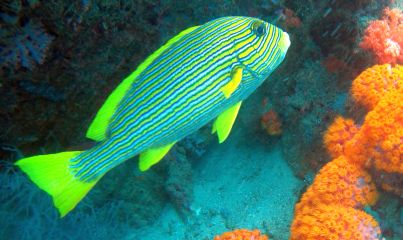
Ribbon Sweetlips cruises by soft coral, Christmas Rock |
Christmas Rock lies on the southern end of Iris Strait, on the western side of the channel, before the open ocean.
Currents can be strong here, so prepare for a drift dive on at least one side of the rock. Reasonable shelter can
be found at the northern and southern sides. We splashed on the north, and proceeded with reef on our left, to the south.
Just near the splash site at about 40' we hovered over a field of Spaghetti Garden Eels. Hundreds of eels, some poking out
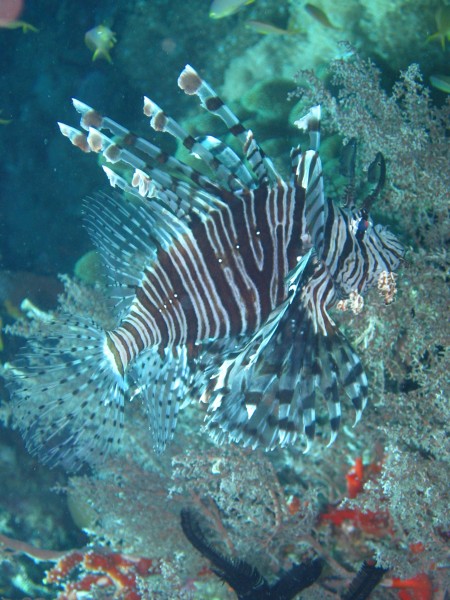
of the sand more than 20" (0.5m), others barely visible. Under a boulder ledge we saw a family of 6 lionfish,
5 adults and a dark black juvenile. Around them swam a school of semi transparent cardinal‑fish.
The landscape alternated from soft coral covered boulders to rubble slopes, but always with plenty to see. We
approached quite close to a huge Thorny Stingray which had lost its tail, and now sported only a short stub.
Tall purple sea fans sported an array of colorful crinoids (feather stars) that clung to the fan branches to catch
passing nutrients. Sometimes we saw the crinoids walking on their stalk like "legs" along the fans. Nearby,
the billowing orange, yellow and pink soft corals made colorful backgrounds for the schools of small damsel and
cardinal‑fish.
This is a good snorkeling site, as the boulders and corals are quite shallow close to the rock. With luck you
may be able to swim the whole way around the rock. But snorkelers
must beware of the fierce currents, perhaps towing a dinghy rather than tying up.
| Aquarium, Triton Bay |
| Type: |
Boulders & Rubble slope |
| Access: |
Dive boat or dinghy |
| Position: |
3°54.9'S, 134°06.2'E |
| Depths: |
10'‑55' (3‑17m) |
| Date: |
March 2015 & 2017 |
| Visibility: |
45' (13m) |
| Dive Pros: |
Triton Bay Divers |
| Snorkeling: |
Good all around Sareneus Is. Beware currents |
| Features: |
Lots soft coral on boulders & wall |
| Divers: |
Sue, Jon |
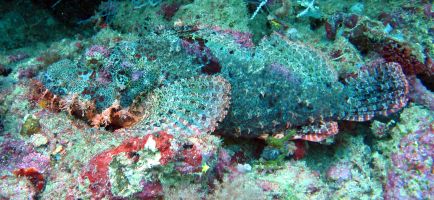
An adult Tasseled Scorpion-fish blends perfectly against the reef |
Aquarium is a protected, relatively current-free bay on the south eastern side of Sareneus Island. This island is locally
known as Pulau Arus, which means "Current Island" due to its reputation for having swirling, changeable currents.
We splashed in about 20' and descended to about 70' then made our way up the slopes, zigzagging from boulder to boulder
and over some rubble slopes. At the southern end of the bay, with the reef on our right, we attempted to round the guardian rock, but the
current was too strong against us, so it was not worth wasting air just to see another bay of pretty coral and fish,
when it was quite beautiful where we were. So we saved Little Komodo itself for another day, another dive.
This site has a wonderful array of boulders and walls to explore. We found several large lobsters lurking under ledges.
We located 2 scorpion‑fish, who let us photograph them quite close, but the schools of fusiliers sometimes got in the way! Scorpion‑fish
are so well camouflaged that it is one more reminder of why NOT to touch the reef! Leeza, the dive guide, located
2 new (to us) nudibranchs, including the white circular egg casing of some nudibranch. Too bad the parent wasn't
hanging out nearby.
The boulders are covered in bright pink, yellow and white soft corals, and blue tubular and green spherical tunicates
adorn the rocks. There's just so much to see, so many details to take it, one could dive here over and over and
barely begin to know it all. We weren't there on a particularly fishy day, but we were able to approach quite
close to several big Many Spotted Sweetlips.
Snorkeling is excellent in this protected bay with rock formations adding to the intrigue. Just beware of
currents if you venture too far offshore.
| David's Rock, Triton Bay |
| Type: |
Boulders & Rubble slopes |
| Access: |
Dive boat or dinghy |
| Position: |
3°54.4'S, 134°06.6'E |
| Depths: |
15‑60' (6‑18m) |
| Date: |
March 2015 |
| Visibility: |
30' (10m) |
| Dive Pros: |
Triton Bay Divers |
| Snorkeling: |
Possibly along the coastal wall. |
| Features: |
Contours, colorful coral, swim through |
| Divers: |
Sue, Jon |
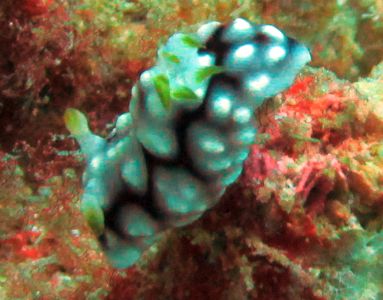
Nudibranch Chromodoris geometrica heading downhill |
This dive is in a fairly protected coastal area, and the tide was falling, so viz was not great. We
concentrated on seeking out the nudibranchs, shrimps and lurking creatures. Previously named Kathy's Rock, it was
redubbed David's Rock after world renowned underwater photographer David Doubilet lost his camera here. We had no
luck finding it!
We splashed near the coast, and dropped to 60' (18m) where the big boulders met a rubble slope dotted with leather
corals, huge barrel sponges, and small bommies of hard corals. Swimming amongst the waving branches of the soft
corals and the stiff arms of hard corals were hundreds of bright pink, violet and orange anthiases, together with
colorful damsels, chromis and dascyllus. A real-time aquarium! Our dive guide, Leeza, found several nudibranchs
feeding on tunicates and sponges. The bright Chromodoris geometrica raises and lowers its white
forebody as it moves, looking more like a tail waving, than a head going up and down. Unfortunately, it was hard to
capture this motion! Leeza also pointed out small fish that live on the whip corals and sea fans, but many of these were
too small for us to see clearly! We probably need a magnifying glass!
We had the usual surgeonfish and triggerfish around us, but also several lionfish, including a smaller species than
the Common, called the Spotfin Lionfish. The current picked up a bit as we moved towards the point of land, so we
circled up and around as much as possible, ending up near a big swim-through at the head of the peninsula. Leeza
pointed to it, just for information, but Jon went on through. When he got to the far side and saw no one behind
him, he swam back through, and finally surfaced to see us at the boat.
In conditions with higher visibility (rising tide, maybe) this could be a good snorkeling site, as the boulders and
corals are quite shallow close to the rocky shore. But snorkelers would do best to tow a dinghy.
| C.I. Rocks, Triton Bay |
| Type: |
Boulders & terraced slopes |
| Access: |
Dive boat or dinghy |
| Position: |
3°54.63'S, 134°06.85'E |
| Depths: |
15‑70' (6‑20m) |
| Date: |
May 2017 |
| Visibility: |
30' (10m) |
| Dive Pros: |
Triton Bay Divers |
| Snorkeling: |
Yes, all around the island. Beware currents |
| Features: |
Contours, colorful coral, swim through |
| Divers: |
Sue, Jon, cruising friends |
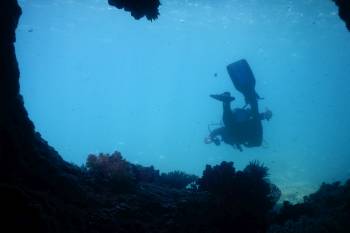
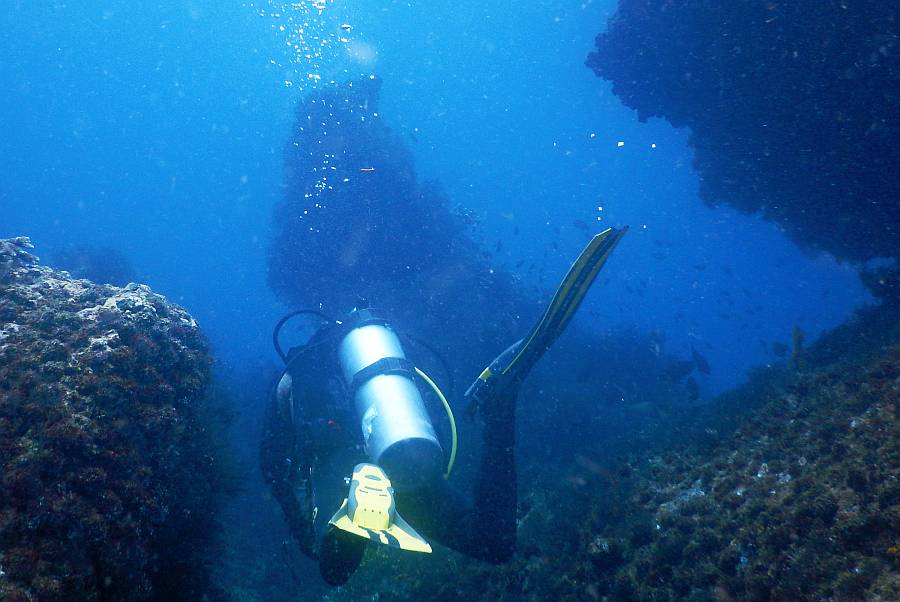
Jon exits the swim-through at C.I. Rocks |
This dive is just off shore of the Conservation International beach, on the eastern side of Iris Strait. Not a
"named site" per se, we chose to dive here when the currents were too strong to venture into the strait without a live
boat. We were able to anchor 3 dinghies on the eastern side of a small island and circumnavigate it. We
found very little current even on the western side, but the fish were plentiful and the landscape was very changeable.
Several swim-throughs made for an interesting end to the dive.
Nudibranchs seemed to love this area, and we checked off several new ones as we peered into the colorful masses of
life on the rocks.
Lionfish are very common here, and we had to be careful not to bump one when peering closely at the walls for
nudibranchs. The current picked up a bit as we approached the south end of the islet, but was not a worry.
In conditions with higher visibility (rising tide, maybe) this could be a good snorkeling site, as the boulders and
corals are quite shallow close to the small island. But snorkelers would do best to tow a dinghy if venturing on
the Iris Strait (western) side.
| White Rock, Triton Bay |
| Type: |
Boulders & sand slopes |
| Access: |
Dive boat or dinghy |
| Position: |
3°54.72'S, 134°07.25'E |
| Depths: |
15‑80' (6‑24m) |
| Date: |
May 2017 |
| Visibility: |
30' (10m) |
| Dive Pros: |
Triton Bay Divers |
| Snorkeling: |
No. Mostly too deep. |
| Features: |
Interesting boulders. Macro site |
| Divers: |
Sue, Jon, cruising friends |
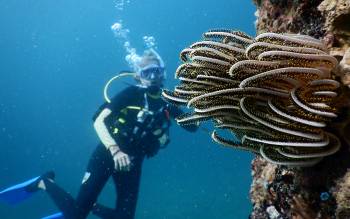
Sue dives White Rock with bright crinoids |
By staying on the eastern side of White Rock this is a mellow, pretty site with colorful soft
corals on the boulder sides and gently sloping sand that houses many gobies and sea fans. It is not a large area,
so you have to dive with the intention of poking along, studying sea fans for pygmy seahorses and peering into clusters
of colorful marine life to fins nudibranchs. IF you ventuyre too far from the protected eastern side you may
encounter strong currents.
We found a nice Taselled Wobbegong shark under a shelf, which was perfect timing as Rainer was
working on a report for marine biology on wobbegong sharks! Lurking on the walls of the boulders were several
camouflaged scorpionfish. I hate to think how many we DIDN'T see! One good reason to use the stainless steel
pointer to touch the reef if necessary, and not your fingers!
We were happy to find that the many ribboned sweetlips were unafraid, meaning they are not hunted
with spear guns. We found a blue and black globular urchin and many huge barrel sponges. Black coral bushed (which
are white) adorned the slopes. There was lots of the dark green knobbly hard coral that looks like trees.
Some crevices were filled with ring tailed and possibly spot-naped cardinalfish. Some of our friends spotted several
new nudibranchs and flatworms (which are more colorful and beautiful than the name "worm" would imply!)
| Little Komodo, Triton Bay |
| Type: |
Boulders & Rubble slopes |
| Access: |
Dive boat or dinghy |
| Position: |
3°54.99'S 134°06.18'E |
| Depths: |
10‑60' (3‑18m) |
| Date: |
April, May '15, Mar, Apr '17 |
| Visibility: |
70' (22m) in Apr, 40' (12m) May |
| Dive Pros: |
Triton Bay Divers |
| Snorkeling: |
Yes, but beware of current offshore |
| Features: |
Interesting contours, colorful soft coral |
| Divers: |
Sue, Jon, Rachel, Peter |
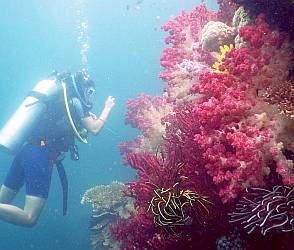
Rachel & soft coral bommie, Little Komodo |
Little Komodo is a small dive site packed with beautiful coral and loads of fish and critters.
Named for the bountiful dive sites in the Komodo National Park in southern Indonesia, this site does
not disappoint. Due to its protected location at the southern end of Sareneus Island, it is a
preferred dive site when the currents are running too strongly on the eastern and western sides of
the island. Visibility ranges from a low 9m to a more typical 15m. On our first dive we
had many fish and great viz, but a few days later, in mid-April the viz was down and we concentrated
on the critters, hunting for the tiny, secretive Potohoni seahorse, which we found, but had trouble
photographing with our small camera. The May 1 dive had considerably worse viz as the winds had
started to turn to the SE bringing disturbed water and nutrient clouds.
On April 11 we began diving with our wonderful "other daughter" Rachel, from Australia.
Unfortunately her own BCD had a broken tank strap which we could not jury rig in time, so while we
dove, she snorkeled above us. We splashed near the island and quickly dropped to about 60' (18m) where the big boulders met a rubble slope dotted with
black coral bushes, huge barrel sponges, and bright sea‑fans (home to the pygmy seahorses!)
Peter, from the boat Per Ardua, was diving with us on his birthday, so Leeza arranged to
present him with a can of beer and a Happy Birthday sign on her white board during the dive. Fun!
Rachel got to dive the site a few days later and we were rewarded with a young hawksbill turtle
and more nudibranchs. We were often in company with schools of sweetlips and emperors.
This is a great snorkeling site, as the boulders covered in brilliant soft corals rise to within
a meter or so of the surface, right up against the island's walls inside the protected cove.
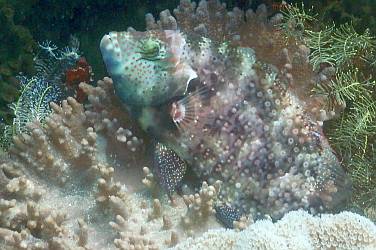
Floral wrasse hides in the folds of leather coral |
| Bo's Rainbow, Triton Bay |
| Type: |
Boulders & Rubble slopes |
| Access: |
Dive boat or dinghy |
| Position: |
03°54.784'S 134°07.33'E |
| Depths: |
15‑50' (6‑15m) |
| Date: |
April 2015 & 2017 |
| Visibility: |
About 30' |
| Dive Pros: |
Triton Bay Divers |
| Snorkeling: |
Possibly along the coastal wall. |
| Features: |
Colorful coral, nice swim through |
| Divers: |
Sue, Jon, Rachel, Rainer |
This dive is located on the eastern side of Iris Strait and is well named, for we found a true
rainbow of colors of soft corals and bright fish. We were accompanied by a small school of
very friendly long‑fin spadefish (aka batfish) as we poked around the coral formations on a sandy slope. We saw a
floral wrasse hiding (not too effectively) inside soft leather coral, but quite unafraid. Venturing down the sandy
slope to 60 or 80ft you might be lucky to find a pygmy seahorse coiled about the branches of a sea fan, but it takes
really good eyes!
This site also yielded several nudibranchs, and a huge porcupine‑fish. At the end of the dive
is a nice swim through, one of those not very challenging, but still fun underwater adventures.
Rachel and Sue had been trying to learn to identify many species of crinoid (feather stars) and
were excited to see some of the less common species here. Some large scorpionfish hide on the rocks.
Bo's Rainbow is on one of the small rocky islets in the Iris Strait, and as such is subject to
strong currents. Snorkelers would be advised to tow a dinghy or to have a dive boat nearby.
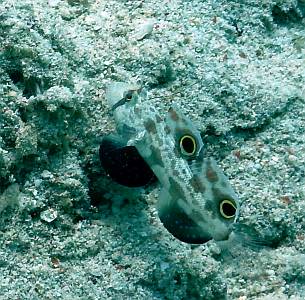
Signal Goby with twin spots and dark fins |
| Third Rock, aka Froggies, Triton Bay |
| Type: |
Macro lens, wall |
| Access: |
Dive boat or dinghy |
| Position: |
3°54.24'S, 134°06.75'E |
| Depths: |
15‑45' (6‑14m) |
| Date: |
April '15 and '17 |
| Visibility: |
30' (10m) |
| Dive Pros: |
Triton Bay Divers |
| Snorkeling: |
Not great |
| Features: |
Wall |
| Divers: |
Sue, Jon, Rachel |
This dive site is tucked right up against the mainland, on the eastern side of Iris Strait, not
far from the Conservation International post. We chose it for its low current on this morning
of super heavy currents. Rachel had not been diving in a long time, so we wanted to ease into
it for her. In 2017 we re-dove this site with our nephew, Rainer, who had also not had many dives.
We splashed right on the coast, and dropped to about 45' (14m) where we began poking around all
the small formations on the sand. Looking in the anemones we found graceful anemone shrimp and
bubble shrimp in the bubble corals. We were even lucky enough to get photos of them.
Leeza from Triton Bay Divers helped us find several nudibranchs such as a sky blue phyllidia (nicknamed a "warty" for
the bumps on its dorsum) and a chromodoris species of nudibranch with bright blue and red orange
colors.
The highlight of this dive was finding several pairs of signal, or walking gobies, on the sandy
slope. What beautiful little fish!
This dive was mellow, without current and a real eye opener to what can be found if you're
patient enough to look. It was also on this dive that Rachel and Sue decided that Leeza's
pointer stick was a great idea, as she was able to use it as a crutch as well as a pointer. We
promptly bought 2 of them from Triton Bay Divers on our return.
Due to poor visibility (which may not change much over the course of the day) this is a less than ideal snorkeling site, as everything of interest lies on the sandy bottom, and
is hardly visible from the surface. The sandy/small bommie area to the west of the dive site is abundant in anemones and anemone fish.
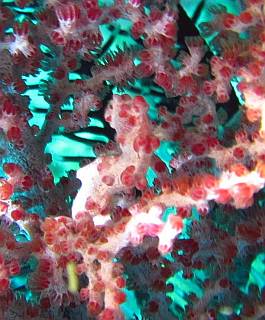
Pygmy seahorse in sea fan. Camo! |
| Andy's Point, Triton Bay |
| Type: |
Wall & drift |
| Access: |
Dive boat or dinghy |
| Position: |
3°54.35S, 134°06.41'E |
| Depths: |
10‑60' (3‑18m) |
| Date: |
April 2015 & Mar 2017 |
| Visibility: |
30' (10m) |
| Dive Pros: |
Triton Bay Divers |
| Snorkeling: |
Good along the rock wall |
| Features: |
Coral covered sandy slope. |
| Divers: |
Sue, Jon, Rachel |
This dive was a challenge because the currents were ferocious along the coast of this tiny
island, just west of the Conservation International post. We began the dive in the NE corner
of the island, nosing around the clumps of bushy black coral. In some sea fans Leeza found a
pygmy seahorse, hanging upside down just to make seeing it tougher for us! We would have seen it,
really! Or not! We flipped the photo just to make it easier for you!
We had several lionfish, doing their lovely lazy lionfish dance out of the current, amongst bushy
black coral that is actually white. When we rounded the corner to the east we were caught by
the current and could do nothing but drift along with it, enjoying the ride.
In calm conditions with high visibility this is a lovely snorkeling site, as the boulders and
corals are quite shallow close to the rocky shore. On the northwest corner, soft corals adorn the boulders, and
large groupers lurk beneath the rocks. Snorkelers would do best to tow a dinghy
or have a dive boat nearby in case the currents pick up.
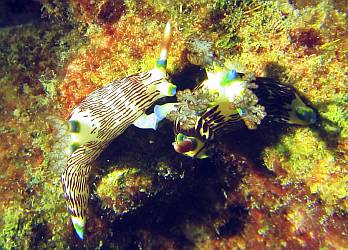
Hermaphroditic mating Nembrotha Sp nudibranchs |
| Pink Beach, Triton Bay |
| Type: |
Coral slope. Sunset |
| Access: |
Dive boat or dinghy |
| Position: |
3°55.85'S, 134°06.92'E |
| Depths: |
10‑45' (3‑14m) |
| Date: |
April 2015 |
| Visibility: |
20' (6m) |
| Dive Pros: |
Triton Bay Divers |
| Snorkeling: |
Possibly along the coastal wall. |
| Features: |
Flasher wrasse |
| Divers: |
Sue, Jon, Rachel |
This dive is just a mile north of Triton Bay Divers and makes for a great sunset dive. We
splashed at about 16:30 into 5 meters onto a sandy slope. Weaving back and forth we descended
to about 15m max, then worked our way back up.
As usual, Leeza was our guide, using her bright underwater torch to illuminate sea fans, anemones and
bubble coral looking for lovely critters. We found some great little shrimp and a few lined nembrotha
nudibranchs, including a couple busy naughty nudibranchs doing their hermaphroditic thing to make
more nudis! 
We got to use the hand signal of a closed fist fairly often as we encountered several species of
lionfish including the lovely (but dangerous) spotfin lionfish and the amazingly camouflaged tassled
scorpionfish playing "you can't see me" on the coral covered rocks.
This might be a good beach entry snorkeling site in bright daylight, but it's hard to gauge
what you might see or how the viz would be as we only saw it at sunset.
| TBD House Reef, Triton Bay |
| Type: |
Gentle slope. Sunset |
| Access: |
Beach swim or dinghy |
| Position: |
3°56.14S, 134°07.35'E |
| Depths: |
10‑45' (3‑14m) |
| Date: |
April 2017 |
| Visibility: |
20' (6m) |
| Dive Pros: |
Triton Bay Divers |
| Snorkeling: |
Yes, but not for flashers |
| Features: |
Flasher wrasse. Soft coral |
| Divers: |
Sue, Rainer |
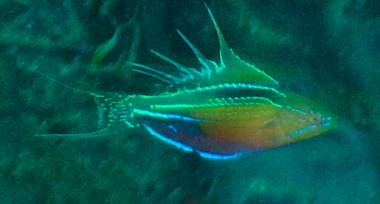
A male Flasher Wrasse in full display. Photo by Rainer |
This dive off the beach and cliffs of Triton Bay Divers makes a great sunset dive. We
splashed at about 16:00 into 5 meters onto a sand and rubble slope. We were on the hunt for
Nursalim Flasher‑Wrasse, which are possible endemic to Triton Bay. We descended slowly over the uniformly gray/green rubble and finally
spotted schools of small red fish. Amidst this harem of female flasher wrasse we could see a few males with their
long white filaments on a yellow body with a deep red anal fin. They went into display posture, and their dorsal fins stood erect, the
classic "flash" of the flasher wrasse. Beautiful! Of course, we spent a lot of time trying to get good
photos, but it sure was tough as you never knew which male would flash or when. The low light at day's end didn't help!
In good light, and with good visibility, this whole coast off the resort is alive with reef fish and small critters lurking
among the occasional small bommies. We've seen sea snakes here, guitar rays, many huge sea cucumbers, nudibranchs,
shrimp gobies, and the usual damsels, butterflyfish, triggerfish and puffers. Near the twin rocks that guard the
entrance to the bay along the strait the bommies and boulders are festooned with crinoids and soft corals in a rainbow
of colors. At the right tide, there is a nice swim‑through on the southern-most rock.
This whole area makes for excellent snorkeling, but you need to pick your tide right to get the best viz. As
with elsewhere in Triton Bay, the best viz is found in the October to March season, with more cold water and plankton
arriving in late April and May. The bay is free of currents, but outside the twin rocks you'll find either a
north- or southbound current, so beware.
| Southwest Aiduma, Triton Bay |
| Type: |
Boulders |
| Access: |
Dive boat or dinghy |
| Position: |
About 4°01.9'S, 134°12'E |
| Depths: |
15‑73' (5‑24m) |
| Date: |
May 2015 |
| Visibility: |
30' (10m) |
| Dive Pros: |
Triton Bay Divers |
| Snorkeling: |
unknown |
| Features: |
Interesting contours |
| Divers: |
Sue, Jon |
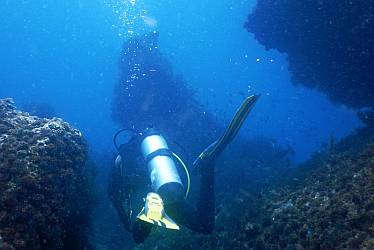
Leeza explores rock formations at 20m off Aiduma |
This was one of 3 Explore Dives we did with Triton Bay Divers in one day. The goal was to
search for potential new dive sites. We would dive for about 8‑10 minutes, then surface if
it wasn't interesting, or stay down for a maximum of 15 minutes, then surface, no matter what we
found. Then we'd move on to another site. This one, on the southwest coast of Aiduma had
lots to offer. There was an offshore bommie onto which we splashed. Sue and Leeza buddied and
meandered in and out of boulder gardens down to 24 meters. There were lots of schooling fish,
and soft corals. Jon and Jimmy Thai (the other owner of Triton Bay Divers) ended up closer to
the coast and were swept along with the current to the south, and saw very little of interest.
It will be interesting to see if this site is explored more and becomes one of the resort's named locales.
Sea fans and multi‑colored crinoids (feather stars) adorned the boulders, and we swam past huge
puffer fish and coral‑munching parrotfish. At 24 meters the boulders gave way to a sandy
slope. Leeza continually searched the fans and anemones for small critters, lighting up patches of
coral with her strong torch, and pushing back the deep blue of the ocean.
One of the other 2 Explore dives was in the protected waters in the southeastern corner of Iris
Strait, north of Dramai Island. Although the surface water was a beautiful blue, the viz was
mediocre due to silt and no current flushing action. Here we found a profusion of sand
critters, such as walking gobies, a bright colorful mantis shrimp lurking hesitantly just inside the
burrow and small commensal shrimp on sea whips. Someone with a good macro lens and lots of
patience would love it.
| Batu Jeruk, Triton Bay |
| Type: |
Boulders & Drift |
| Access: |
Dive boat or dinghy |
| Position: |
4°01.61'S, 134°12.66'E |
| Depths: |
15‑90' (5‑27m) |
| Date: |
May 2015 & March 2017 |
| Visibility: |
50' (15m) |
| Dive Pros: |
Triton Bay Divers |
| Snorkeling: |
Yes, on the rock wall and around rock |
| Features: |
Orange colored soft coral on rocks |
| Divers: |
Sue, Jon |
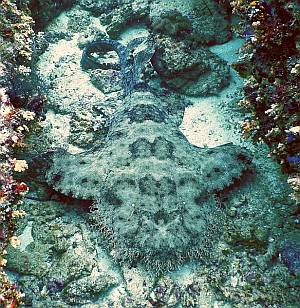
Weirdly beautiful tasseled wobbegong shark |
This dive is among our top favorites for Triton Bay. We splashed on the SE corner of Aiduma
Island, in the Iris Strait, under a huge rocky cliff. Dropping down to 57' (17m) we swam round
rock formations covered in bright orange soft corals which give the site its name "orange rock".
There was a mild current but enough for the polyps of the tubastrae species of soft corals to be
open, creating bright yellow "flowers" outside the spongy orange bases. Leeza and Sue peered
into the dense coral growth on the rocky walls, and were lucky enough to find several species of
nudibranchs. Jon and Jimmy swam down to 27m (90') to check out schools of snappers and some
large groupers. Under a rocky ledge Leeza spotted a lazing wobbegong shark, with tassels on
its head, beautiful mosaic markings on its back and a long tightly curled tail. Minutes later Jon
spotted another wobbegong, this one larger and possibly an ornate wobbegong, lying in a deep
crevice. This one allowed us to swim over the top of it and get a great view.
In the sea fans on the rocky substrate Leeza located both a Pontohi and a pygmy seahorse, each
less than 1" (about 2cm)! Sue, in her excitement to photograph them, forget a basic maneuver
on the new camera, which was to slide the focal length to full wide angle before employing the macro
function. Result: out of focus seahorses. Dang! But at least we DO get to say that we've seen
them now.
Our dives in 2017 yielded more wobbegongs, some big bumphead parrotfish, Napolean wrasse and a white tipped reef shark.
With a mind to the current, this is an excellent snorkeling site with lots of fish and colorful soft corals.
You might be able to swim around Orange Rock itself (current allowing!), and also explore the rocks that tumble
into the sea to the north east of the rock. For safety, a dive boat should be nearby, or a dinghy should be towed.
This was an awesome Grand Finale for our 2015 diving adventures in Triton Bay.
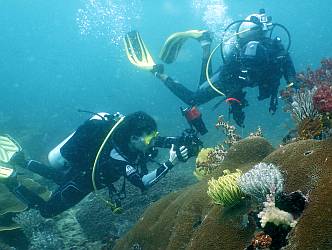
Connie, from Germany, moves in for a shot |
| GPS Point, Triton Bay |
| Type: |
Offshore pinnacle |
| Access: |
Dive boat or dinghy |
| Position: |
Not sure. Southern Triton Bay |
| Depths: |
24‑65' (7‑20m) |
| Date: |
May 2015 |
| Visibility: |
36' (11m) |
| Dive Pros: |
Triton Bay Divers |
| Snorkeling: |
No |
| Features: |
Isolated bommie |
| Divers: |
Sue, Jon |
This was a new dive for Jimmy from Triton Bay Divers, one that had been found by Andy, their
Indonesian dive guide. This is a bommie that rises to within 24' (8m) of the surface, but is
never exposed. After maneuvering around for a few minutes over dark blue/green water, Andy
announced our arrival. We splashed onto the top of a shelf of sand and coral, then swam down
keeping reef right to the base at about 20m. Viz wasn't great, but we didn't expect it to be, given
how deeply we were tucked into Triton Bay. We had sailed to the northeastern corner of the
bay, and knew that the water viz dropped to zero with all the wash from 2 rivers.
On the walls of the bommie were huge white sea fans and soft white corals. Big groupers
prowled the edges and seemed unafraid of us. We found nudibranchs on the rock shelf and
commensal shrimp on some of the sea fans. This was more of a macro photography site than a wide
angle site, due to low viz and the lack of abundant color. Not to say the occasional gardens
of crinoids and soft corals weren't great! We found a big spiny lobster peeking from his hole
and huge adult blue ringed angelfish.
This dive has to be timed for minimal current, as there is no where to drift to, if you are
carried off. There would be nothing to see in the depths of the Bay.
Diving SOUTHERN INDONESIA
|
Southern Indonesia includes a variety of islands and underwater landscapes. Stretching from the low, sandy Kai
Islands in the east to the rugged mountainous islands of Timor and Alor, the dry desert‑like islands of Komodo National
Park, to the volcanic islands of Flores and Bali there is a lot to explore!
Many of our dives in southern Indonesia in 2006 and 2015 were done in the clear and relatively un‑fished
waters of Komodo National Park. The park covers a handful of small islands
between the larger islands of Flores to the east and Sumbawa to the west.
Although the park includes one small fishing village, the over‑fishing
we'd noticed throughout this region of Indonesia seems to have been curtailed.
This, combined with a good flow of sea water through the various channels between
the islands, makes for excellent visibility and a wonderful variety of marine life.
In 2006 and 2015 we often dove with other cruising friends who had compressors
on board. As is customary we either paid for the fills at the going rate of
about $5‑8/tank, or we traded fills for gasoline for their compressors. After
our Sabolan Besar dive we moved the boats to Labuan Bajo
and were able to get professional fills (again about $5/tank) from Bajo Dive Center.
We dove with professional dive companies in Lombok and Bali. From our anchorage in Lovina Beach, on the north Bali
coast in 2015 we dove with a professional outfit who organized the truck ride to Northwest Bali National Park, the
boat to Menjangan Island, the dives, and the return trip to Lovina Beach, making it an all‑day outing.
In September 2017 we anchored on the NE corner of Bali, and went by jeep to the Liberty Wreck dive site,
with Bintang Divers in Amed.
|
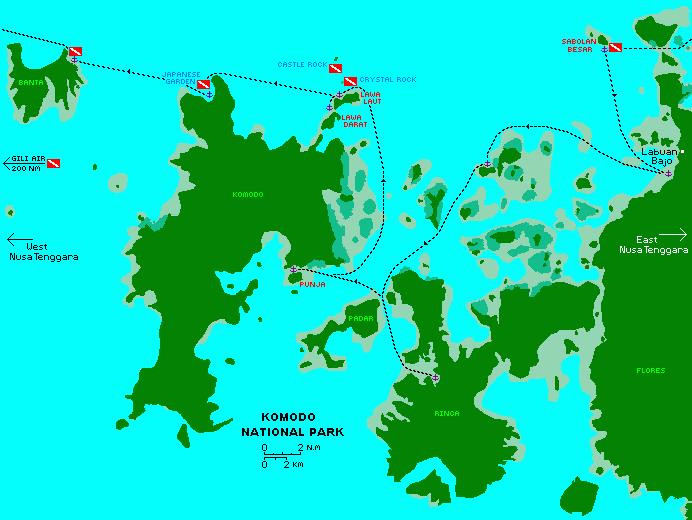
Our track through Komodo National Park. Click on a
dive-flag to go to our description of that dive. |
In 2006 this was our first diving since Fiji, and our
primary underwater photographer (Chris) had left, so Amanda was learning to
do most of the underwater photography. She was also the only one who could
read the camera underwater. By 2015, on our way around Indonesia once again, Sue had become the primary
photographer, and had invested in a prescription mask, though it was
always fun to turn the camera over to friends or family who wanted to give it a try!
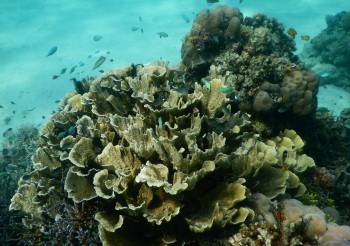
Small bommies of coral highlighted Gilibodo |
Gilibodo Island |
Type: |
Shallow bommie dive |
Access: |
Small sandy anchorage off the east end of the island |
|
Position: |
8° 24.0'S, 119° 48.8'E (note: charts are 1/4nm off) |
Depths: |
10-20' (3-7m) |
Date: |
August 2015 |
Visibility: |
About 40' (12;5m) |
Dive Pros: |
16 miles SSE in Labuan Bajo, Flores Island |
Snorkeling: |
Yes, on the reef near where we dove |
Features: |
Easy no-current dive |
We anchored in the protected bay on the western side of Gilibodo (Sabibi?) Island where we were
protected from the SE winds. Sue joined John from Millennium and another cruiser for a casual off-the-boat dive.
We dove near the boats, towing the dinghy through the anchorage, as we weren't sure if there would be a current or
not. The entire island is surrounded by great looking coral and one could probably do several different dives
here. Saw lots of anemones and small reef fish, mostly old friends.
This was my first chance to use the new gear I
brought back to Ocelot over a year ago, so I was happy to have it be a relaxing,
virtually no-current dive along the wall of the island. We swam north at about
65' (20m) until there was current, then returned, moving up the slope for
different sea life and less depth. There weren't many healthy hard corals, but
the soft corals and anemones were bright and lively.
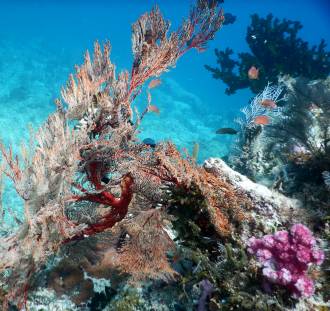
Beautiful sea fan like a bonsai tree |
Shotgun Alley |
Type: |
Drift dive |
Access: |
Dinghy. |
|
Position: |
8° 28.6'S, 119° 33.2'E (note: charts are 1/4nm off) |
Depths: |
13-40' (10-12m) |
Date: |
August 2015, and snorkeled in 2017 |
Visibility: |
About 40' (12.5m) |
Dive Pros: |
in Labuan Bajo, Flores Island |
Snorkeling: |
Yes, with a dinghy in tow |
Features: |
Many fish, bright corals, possibly strong current. |
Sue dove here with a cruising friend, towing a dinghy due to the current. The seascape is varied, with patches
of sand and small bommies, then some larger bommies that can be quite shallow so while drifting you have to be careful
of your depth. It's essential to tow a dinghy if you dive this on your own.
With the strong current, this is an especially fishy area, and with luck the viz will be excellent. Fusiliers,
snappers, triggerfish and butterflyfish were all abundant. A hawksbill turtle swam lazily along with us before
diving into the deeper part of the channel.
Large bommies are decorated in sea fans, crinoids and soft corals. Colorful anthias harems swarm the reef and
it's fun trying to find the attendant male anthias.
This pass is good for snorkeling because you can choose your depth and drift along close to the coast, or out over
some shallow bommies. You definitely need to tow a dinghy, though, if you're on your own.
Sabolan Besar |
Type: |
Wall dive |
Access: |
Small sandy anchorage off the east end of the island |
|
Position: |
8° 24.0'S, 119° 48.8'E (note: charts are 1/4nm off) |
Depths: |
20-70' (6-21m) |
Date: |
Aug 2006 |
Visibility: |
About 80' (24m) |
Dive Pros: |
8 miles SSE in Labuan Bajo, Flores Island |
Snorkeling: |
Yes, on the reef nearby to the north |
Features: |
Nice and easy wall dive |
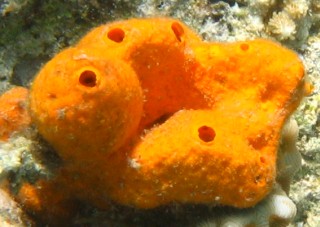
One of many bright sponges seen in Indonesia |
(Jon) This was our first dive in over a year, so we
decided to start with a pretty easy dive. We circumnavigated the island
in Ocelot, looking for a decent anchorage but the only place was off the
eastern point in a nice patch of sand, so we anchored there with fellow cruisers
Vagabond Heart and our dive partners
Rob and Dee off Ventana.
We dove north of the anchorage, but the entire island is surrounded by great
looking coral and one could probably do several different dives here. We
anchored the dinghies in a small sandy patch and splashed into 15' (4m) on the
edge of a drop-off. Continued down the wall to about 60' (18m) and headed
north along the wall into a slight current. Saw lots of fans, sponges, and
colorful soft corals. Most of the deeper hard corals seemed old and dead
but the soft corals and fans were stunning. Saw several small fish, mostly
old friends. After about 20 minutes we ran into a strong current (just as
I saw some big fish feeding in the distance) so we turned around. Came up
to about 40' (12m) for the trip back which made for better light, brighter colors, and
more concentrated growth. A good refresher dive after not diving for so long.
(Sue) This was my first chance to use the new gear I
brought back to Ocelot over a year ago, so I was happy to have it be a relaxing,
virtually no-current dive along the wall of the island. We swam north at about
65' (20m) until there was current, then returned, moving up the slope for
different sea life and less depth. There weren't many healthy hard corals, but
the soft corals and anemones were bright and lively.
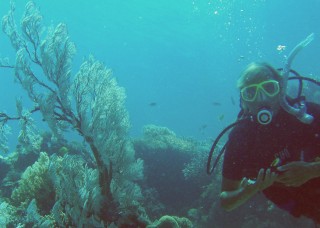
Sue making friends with a sea fan |
(Amanda) This was a nice mellow dive to start off our
several-week diving frenzy. We got a list from one of the local boats of all the
good dive spots - this meant we frequently had a dive boat come into our
otherwise peaceful anchorage, but we also got to see the absolute best of Komodo
National Park underwater. And while the best was actually closer to Komodo
Island, this site was nice too.
We could probably have dived anywhere around Sabolan Besar, but chose the SE
corner because there was a small sand patch we could anchor on. We dove north of
the sand patch (on the east coast) because it looked like it dropped off faster,
but the reef looked just as nice (from the surface) on the south coast.
Unfortunately, while the region is a national park, that designation doesn't
really apply to the water - or it's just not enforced. There were several
fishing boats around the island when we arrived, all on the west side. But
once we got in it was obvious they'd been all around the island. There
weren't any large fish, though we saw some nice small ones. But the reef was
intact - colorful corals and crinoids, lots of small blue-veined red sponges
that look like hearts, and several large (3'+, 1m) barrel sponges.
We swam north along the wall, then turned around when we hit a slight current
to drift back with it. We made our safety stop on the reef/sand line and
ascended. Mom and I snorkeled back to Ocelot, but the sand was devoid of life
except for a few little shrimp gobies.
Castle Rock |
Type: |
Sea-mount dive |
Access: |
Dinghy - 2 Boat moorings in NW Gili Lawa Laut bay |
|
Position: |
8° 25.934'S, 119° 33.784'E (take your GPS) |
Depths: |
20-70' (6-21m) - deeper if you want |
Date: |
Aug 2006 |
Visibility: |
100' (30m) |
Dive Pros: |
In Labuan Bajo |
Snorkeling: |
No - top of sea-mount is 20' (6m) deep |
Features: |
Vast schools of fish, good corals, but watch the current |
A large Jack swims by at 20 m (66 ft) |
(Jon) This was actually my favorite dive
for this area. In the NW corner of Gili Lawa Laut island (Komodo National
Park) is a small bay with 2 good moorings, used by both dive-boats and
yachts. We tended to leave Ocelot on a mooring even though a
little swell can make it into the anchorage. An alternate and usually
quieter anchorage is about a mile to the SSW, off the pass between the islands,
but it's difficult to anchor without damaging the coral. (Some dive-boats
complained to the 8 yachts anchored there that they were breaking the coral -
which was shamefully true - so it was suggested that the dive companies or park
put in some more moorings so boats wouldn't have to anchor.)
Make sure you take a portable GPS with you as the sea-mount is unmarked except for
a slightly lighter color in the water. We splashed into 20' (6m) and set the dinghy anchor firmly
in the bare rocks (NOT live coral) as the currents can run strongly here (we actually had to abort a later
dive here because of current). Dropped down the side of the sea-mount to about 60'
(18m) and started circling the mount, heading into the current initially.
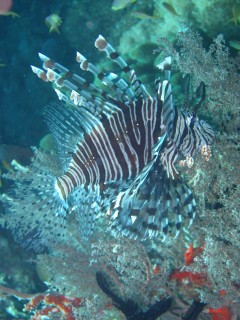
We've seen lots of lionfish in Indo |
We were immediately struck by the vast array of fish swarming around us.
Many different schools could be seen, keeping together but intermingling as
well. I don't think I'd ever seen a whole school of Moorish Idols before.
When I'd try to get a picture of a particular fish, another would often get in
the way, they were that thick around us. The walls of the mount were also
covered in both hard and soft corals, giving us lots to look at
and appreciate.
After our initial circumnavigation of the mount we came up to about 40' (12m)
and did another slow circumnavigation, seeing more and different scenery.
Even our safety stops at 30' and 15' (10m and 5m) had new and varied scenery.
Truly a world-class dive.
(Sue) This was my favorite dive so far in Indonesia with
seemingly endless soft corals, gorgonians and lots of fish! We splashed
into 20' (6m) onto the top of the sea-mount, then descended, clockwise to
about 75 feet (23 m). The water was comfortably warm in just 3 mm shortie
wetsuits, and the visibility was over 100' (30m). Meandering slowly along
the slope of the mount we did 2 circumnavigations in 45 minutes, spiraling
upwards. On the eastward side the currents (which were still very weak)
converged and attracted many pelagics, especially tunas and trevally. Schools of
snapper circled above us. Lionfish hovered above the corals, and schools of
damsels and angelfish brightened the scene. The sheer range of new (to us)
species of fish was a bit overwhelming, but wonderful. Fat groupers (3' or 1m)
slid between the plate coral tables, and eyed us with caution. Fishing is
prohibited on the sea mount, but the lure of the big fish must be irresistible
-- a dive operator out of Labuanbajo, Flores Island almost had to ram a local
fisherman off the site a few days before we got there. Komodo National Park is
struggling, and needs more international support to maintain its underwater beauty.
(Amanda) A beautiful dive! The water was warm, the coral
was bright and colorful, and the fish were abundant and new! On the east side
there must have been some sort of convergence because we had to swim through the
massive schools of fish that congregated there. We started deep on the dive
(getting to 75') and spiraled our way up, but really there's just as much to see
in the middling depths (50' was great). Coral gave way to rock at about 20', and
the current was more noticeable there, too.
One thing that sticks with me about this place is the variety of life. Soft
corals, hard corals, plate corals, crinoids, sponges, anemones... the list goes
on and on, and then there's fish as well! Big titan triggerfish, jacks and
trevally, slender fusilier in schools as far as you can see, angelfish,
clownfish, rabbitfish, squirrelfish, butterflyfish, and lionfish. Read the last
six types and you'd almost think they were anything but fish, but they
were and they were everywhere and they were wonderful.
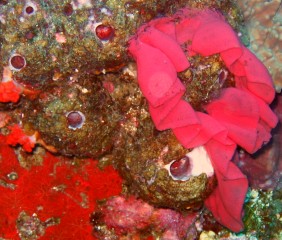
Brilliant pink nudibranch egg case |
Crystal Rock |
Type: |
Pinnacle dive |
Access: |
Dinghy - 2 Boat moorings in NW Gili Lawa Laut bay |
|
Position: |
8° 26.4'S, 119° 34.0'E - top of rock is exposed |
Depths: |
0-100' (0-30m) - deeper if you want |
Date: |
Aug 2006 |
Visibility: |
100' (30m) |
Dive Pros: |
Not really but dive boats come most days |
Snorkeling: |
In the big-boat anchorage - look for manta rays |
Features: |
Fantastic - fish, hard and soft corals |
(Jon) Crystal Rock is apparently the classic beautiful
dive for this area. From the anchorage mentioned above you
can see a small rock that just breaks the surface to the north. It's best
to do a live-boat or live-dinghy dive here, as anchoring on the coral is
prohibited. Just watch the currents -- they can be strong.
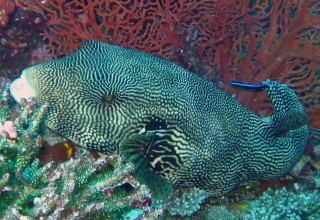
A Map Puffer sits sedately at a cleaning station
Note the blue-striped Cleaner Wrasse by his tail |
We splashed into about 12' (4m) and headed down the wall of the pinnacle
to about 60' (18m). Started our initial circumnavigation by swimming
into what current we could feel (not much). We didn't see the
vast schools of fish here as we did at Castle Rock
but there were certainly lots of fish and very impressive corals, both hard
and soft, all vibrantly competing for the available nutrients.
After our initial deep circumnavigation of the pinnacle we came up to about 40'
(12m) and made another circuit, reveling in the greater light, more vibrant
colors, and different scenery. Another world-class dive.
(Sue) Another primo dive in Indonesia! Thank goodness for
Komodo National Park and their preservation activities. The tide was low when we
did this dive, and that may have contributed to the sediment in the water (not
as clear as Castle Rock, the day before). Or it could have been the wave action
on the exposed rock. No matter. The sea life was again fantastic. Amanda took
the camera and did a good job juggling dive computer, gauges, floatation and
camera. I stuck close by her, as the photographer often lags behind (to take
pictures!) or follows a "subject" down a few meters, and has to be coaxed back
up to the correct depth. The dive was a feast of fish, corals, sea fans, and sponges.
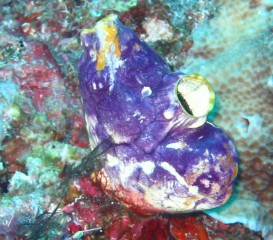
A lovely & common tunicate in Indonesia |
(Amanda) Camera dive! After most of our pictures from
Castle Rock came out black, due to Dad not being able to see the settings, the
camera was handed off to me and my "young eyes." Unfortunately, this entire
period of diving coincided with one of our infrequent battery shortages, so we
weren't able to use the slave strobe - and while the visibility and light
quality really were excellent, everything would have been better with the big
flash. (As it was, I used the small built-in flash on the A-80 which seemed to
be enough light in this very clear water, especially if I was taking close-ups.
It's the fish far away that were hard to capture without the strobe.) Plus I
haven't spent as long as Chris did fiddling with the camera and
finding out all its quirks and settings. But I think I did okay for my first
attempt. I'm afraid Mom did sort of have to keep chasing after me, as I have a
habit of seeing the coolest fish only when they're 10 feet below me and swimming away.
At times I had to tell myself to turn the camera off for a while and just
enjoy the dive. Otherwise, I would have lagged behind and not seen the big
picture. And the big picture was gorgeous. This dive site is an excellent one.
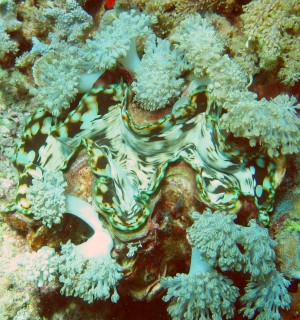
A colorful clam surrounded by soft corals |
| Japanese Garden
|
Type: |
Wall dive |
Access: |
Dinghy or Dive boat |
|
Position: |
8° 26.20'S, 119° 27.16'E |
Depths: |
0-50' (0-15m) |
Date: |
Sept 2006 |
Visibility: |
80' (24m) |
Dive Pros: |
No |
Snorkeling: |
Yes, lots of nice shallow coral |
Features: |
Relaxing easy dive, lots of big sea-fans |
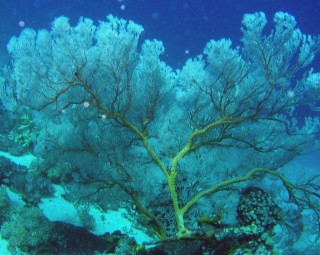
The Japanese Garden was full of sea fans |
Update 2015: This anchorage has obviously been used by too many boats, probably including large
phinisies with huge anchors. The sea floor was swept clean, and almost nothing remained of the lovely
isolated bommies that we enjoyed so much in 2006. We were very disappointed to see this. Continue
reading if you want to know the paradise that was trampled. Sad.
(Jon) After our last couple dives, this was a nice, easy,
relaxing dive. We anchored Ocelot in the southeast corner of Telok Batu Montjo bay
(on the northwest corner of Komodo Island) and took the dinghies to a convenient
sand patch off the northernmost beach on the eastern shore. Splashed into
standing depth, where the sand sloped off gradually. Decided to work our
way out to the point of the bay as the current seemed to be running gently into
the bay. Dropped down the slope to about 40' (12m) where the sand leveled
off and headed north, turning around when we'd breathed half our air and coming
up a bit for some different views as we returned to the dinghy.
The coral was laid out more in isolated clumps than the vast fields we'd
seen lately, but they were very pretty. In fact, the whole place seemed to
have been put together by some ancient Japanese gardener with infinite time on
his hands. Each clump of coral had several varieties of both hard and soft
corals placed just-so for maximum artistic effect, and each had
a cloud of small fish around it. Several different types of sea-fans were
present, some almost 10' (3m) across. We also saw several 2' (.6m) clams,
the first we've seen since Australia. Very picturesque.
(Sue) "Japanese Garden" is our own name for this
dive, because it seems to fit the beautiful layout of perfect coral bommies teeming with
colorful fish, all gently interspersed with white sand. It would be a wonderful
learning dive site as there was so much to see even in about 25' (8m).
(Amanda) If I hadn't already been certified, this spot
would have been a great place to do it. Beautiful soft white sand in 15 feet,
with little bommies of beautiful coral all around it. Of course, there was no
dive Pros there so I doubt anyone has ever had that pleasure.
The Japanese Garden wasn't as abundant in life as some other dives we've
done, but it was a nice change. The small blobs of coral were close to each
other but obviously separate. Here was a field of soft corals. There's a big
rock with an anemone and a moray eel. That one's got a huge sea-fan. Over there
is a giant clam, colorful spotty mantle protruding beautifully. It was a
wonderfully-laid-out site.
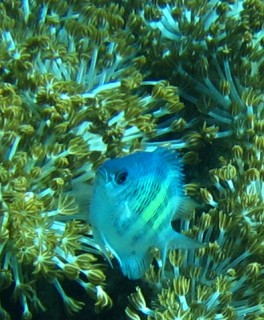
Staghorn Damsel in Starburst Anemone |
Pulau Banta |
Type: |
Gently sloping field |
Access: |
Dinghy or Dive boat |
|
Position: |
8° 24.40'S, 119° 19.24'E |
Depths: |
0-70' (0-21m) |
Date: |
Sept 2006, Update 2015 |
Visibility: |
80' (24m) |
Dive Pros: |
No |
Snorkeling: |
Yes, lots of nice shallow coral |
Features: |
Relaxing easy dive, lots of soft corals |
(Jon) This was another fairly easy dive. The bay
offered a nice big sandy patch to anchor Ocelot in 15-20' (5-6m) and then we
took the dinghy just a bit north, although we could have started right off
Ocelot if we'd wanted to. Splashed into about 10' (3m), reset the dinghy
anchor to avoid the coral, and headed up current and down slope to about 50'
(15m) where it started to level off.
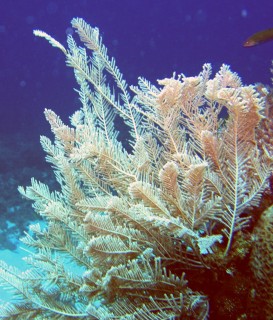
A stinging hydroid off Pulau Banta |
The most remarkable thing to me about this dive was the profusion of soft
corals. There were certainly some hard corals - we saw brains, elk-horn,
plates, and several new varieties in bright red and another in dark green - but
the colorful soft corals were what really caught the eye. Vast fields of
them growing one on top of another, for as far as we could see, augmented by
sponges and sea-anemones with some new varieties of anemone-fish.
As normal for us, we turned around (and came up a bit) when we got to half a
tank of air (1,500 psi or 100 bar) but we were surprised to find that
we returned to the dinghy so quickly. We'd actually been swimming into a
fairly stiff current and hadn't realized it. Something to remember...
(Amanda) Mom, Dee, and I took the dinghy out before the
dive to check currents, since the site we'd chosen was pretty exposed to Selat
Sape, the large pass between Komodo and Sumbawa Islands. As it was, the current
on the wall was too strong, so we dove on the northwest side of the bay we were
anchored in.
Detail of Ice Crystal coral. Looks cool, huh? |
The bay was rather shallow (as diving goes, not judging by anchorage) and
sloped off gently to about 70' (21m) where it turned to sand. But we weren't
really planning to go deep, and a lot of the best stuff to see was between 10
and 30 feet, where there was light. As Dad said, there was a lot of soft coral,
plus sea fans and an interesting orangey-red brain coral. I took the camera, but
we were down to Indonesian-made batteries which didn't give us many shots,
especially with the flash.
(Sue) Since we had returned to the dinghy with so much air left, I
took the camera and dove right from Ocelot in about 10-15' (3-5m) just around
the sand and bommies near the bow of Ocelot where there was no current, and very
good visibility. No, one is not supposed to ever dive alone, but given the high
viz, the lack of current and dangerous fish, and the fact that I was within
spitting distance of the boat and in very easy snorkeling depth, I felt very
comfortable. This kind of time alone is very relaxing for me as I can sit on the
sand and study the fish, or float just off the bottom, motionless, next to a
bommie of busy fish. To me, this is one time the camera is a great friend. It's
nice not to feel pulled along by the other divers who have an agenda, or route
to follow.
NOTE from 2015: This area has been stripped clean probably by anchor chains, and was devastated with broken
and dead coral. Very distressing to see. We didn't get out to the wall where we dove in 2006 to see how it was
doing.
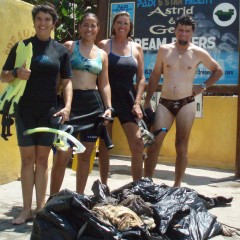
Kyle, Mandy, Sue & Jon post-dive |
Air Home
Reef |
Type: |
Drift wall and gently sloping field |
Access: |
Dive boat or beach entry, beach exit |
|
Position: |
8° 21.5'S, 116° 5.4'E |
Depths: |
0-60 (0-16m) |
Date: |
16 September 2006 |
Visibility: |
80' (24m) |
Dive Pros: |
Dream Divers, Gili Air |
Snorkeling: |
Yes, drift snorkel |
Features: |
Drift dive, then Clean-up Dive |
(Amanda) We found out about this dive completely by chance.
Dream Divers, the
dive Pros on Gili Air (off Lombok) had a poster out proclaiming "Splash
for Trash - International Coastal Cleanup." It sounded like a great idea
- a free dive in a new spot to clean up the ocean! We spread the news, but Mom,
Dad, and I, plus Kyle from Estrela, were the only people to show up in the
morning for the dive - Mom dove in the afternoon as well, along with Doug from
Estrela. The people at Dream Divers were very happy and got us all
set up with gear and plastic garbage bags and showed us the sort of trash we
were looking for. The four of us, plus the divemaster and three other local
divers and a couple snorkelers, piled into the "spider boat" (a
trimaran-outrigger with two big outboards) and we started up the east coast of
Gili Air.
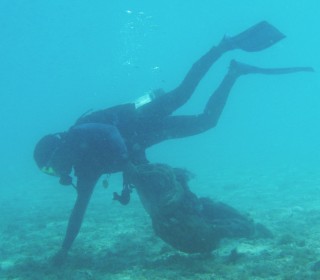
We cleaned 4 big bags of trash off the sea floor |
We splashed into about 30 feet (10m) and immediately started drifting south. The
current was really ripping! I had the camera, and a plastic bag in my pocket,
but for the first 5 minutes or so it was all I could do to keep track of my
depth, my buddy (Mom) and the wall as it went shooting by. When I finally got
used to it, it was rather fun flying along. I saw 2 turtles and a stingray, and
there were lots of fish and coral where a corner of the island protrudes into
the current. There wasn't much trash on the wall, which is a good thing because
if we'd seen any, we'd have been hard pressed to get back up-current to it.
The current abated in a sandy patch off the dive Pros, and that was where we
found the majority of the trash - big sheets of plastic, ropes, monofilament
fishing line, cans, bottles, plastic wrappers, and big pieces of cloth. I shot
pictures of the few fish swimming above the sand in between picking up cans and
bits of plastic, and Manik (the divemaster) pointed out something we haven't
seen before - what we believe to be a Warty Frogfish. The dive was fun, and we
pulled up 3-4 large bags of junk.
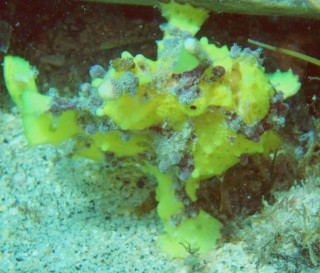
A Warty Frogfish off Gili Air. Yes, this really is
a fish! You just have to use some imagination. |
(Sue) This was one of the most satisfying and in some ways challenging
dives I've done. After hearing my NAUI drill sergeant (actually a university
professor!) still in my head after all these years saying, "Don't touch anything.
Don't stir up the sediment or sand" it was very strange to be grabbing
hold of things (even if they were plastic bags or ropes) and pulling at them.
Staying organized with the other clean-up divers was interesting...you'd be
swimming along, looking for trash, then realize your buddy was behind you --
pulling on some monofilament line tangled around coral heads. Back you'd swim,
lending a hand, gathering in the line as it was pulled free, all the while stirring
up gobs of sediment so that visibility went from a nice 80' (24 m) to about 3'
(1 m). I was really glad I was not using my own BC or regulator set with
all that sand in the water! The camera housing needed a thorough cleaning after
the dives, though!
It helped me (psychologically) to know that we were in only about 15-20'
(5-7m) the whole time so decompression times weren't an issue. Holding
onto a big black plastic bag was interesting too -- the bags all had their
corners cut out so that the water could flow through, but that meant that the
smaller bits of trash washed out as well. I ended up hugging my bag to try and
keep everything enclosed until we got to the surface. Okay, so now add trying to
take photos while doing all of this, and you begin to get the picture!
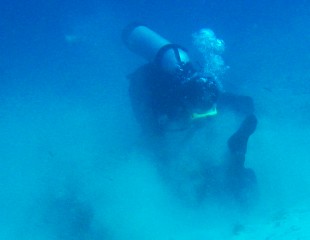
Viz dropped radically as we pulled up trash! |
(Jon) Chris and I had actually done a clean-up dive years
earlier in Tonga, but this was very different. In Tonga, there was no
current and it had just rained buckets, so the ocean surface had a layer of
sediment (muddy stream runoff) that was thick enough to obscure some light, and
which slowly sank as the fresh and salt water mixed. Also, Tonga had an
incredible amount of junk on the bottom of Neiafu Bay - I think the 30 or so
divers pulled up about a ton of junk.
The diving was also very different from Tonga. The Gili Air water was
clear and bright, but the current was amazingly strong. Unfortunately,
they didn't really impress on us beforehand just how strong the current would
be, so it took several minutes for me to get used to the reef whizzing by on my
right as I concentrated (hard!) on my depth, orientation, the other divers, and
all the ganglia that divers have hanging off them.
Thankfully, Gili Air didn't have that much to clean up. I got the
impression that they participated in International Coastal Cleanup Day because
all PADI dive-Pros did, but they didn't really need to. We picked up a
fair amount, but most of it was fishing refuse (monofilament, ropes, netting,
bags, etc) that had drifted in on the current and settled where the current
eddied back towards the beach.
Having a dive-master with us was fun. As he was picking up an old bag
he noticed a Warty Frogfish that I certainly would never have
recognized as a fish, or even any sort of animal!
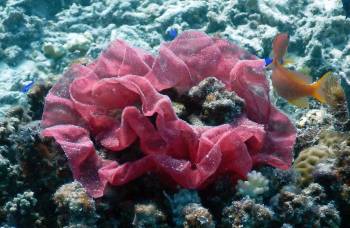
Egg casing of a Spanish Dancer Nudibranch. Moyo |
Moyo Island |
Type: |
Coastal drift dive |
Access: |
By boat, Amanwana Resort on w. Moyo Is |
|
Position: |
8° 15.6S, 117°29.3'E |
Depths: |
20-40' (7-13m) |
Date: |
Sept 2015 and Sept 2017 |
Visibility: |
About 60' (18m) |
Dive Pros: |
Dive school at Amanwana Resort, west Moyo |
Snorkeling: |
Yes, on the reef near the resort pier |
Features: |
Gentle current dive |
Moyo is a beautiful, isolated island off the western end of Sumbawa. The entire island is a
nature reserve, and there are only a couple places to stay: one very rustic camping "resort" and the very posh (but
friendly) Amanwana Resort which has hosted such folks as Princess Di and Bill Gates. We anchored south of the Amanwana
Pier on the western coast of Moyo island, and took the dinghy north from there to splash over the reef
north of the Tanjung Sarahetor. I dove with John on Millennium, and we towed the dinghy with us, as we didn't know how strong
the current would be.
To prolong our dive, we stayed shallow, enjoying the bright colors and reef fish. We saw some bright egg
casings of nudibranchs and many schools of bright anthias. Just past this sloping reef the sea floor drops
sharply and there must be some great dives along those walls.
In 2017 we anchored in the same area, but Rainer and Sue dove along the shoreline to the west. Viz was only
about 30' (10m). Some eels, and many of the normal small reef fish. The resort in 2017 did not
grant permission to snorkel or dive on the house reef. They feed the fish there, so it was less
appealing, anyway.
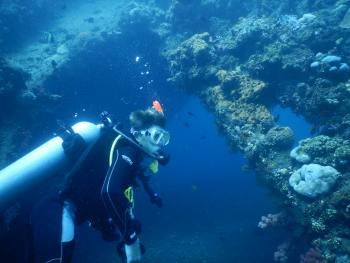
Rainier dives the SS Liberty Wreck Bali |
Liberty Wreck, Bali |
Type: |
Shore entry, wreck dive |
Access: |
Shore entry, maybe through surf |
|
Position: |
8° 15.30S, 115° 35.1'E
|
Depths: |
40-90' (14-30m) |
Date: |
Sept 2017 |
Visibility: |
About 40' (13m) |
Dive Pros: |
Bintang Divers, Amed, northern Bali. |
Snorkeling: |
Yes. Shallowest part about 15' deep |
Features: |
SS Liberty Wreck, and all the visiting fish |
We were anchored off Amed, northern Bali, and planned a 2-dive trip with the local dive shop ashore. We
arranged with Bintang Divers to take 4 divers to the wreck early the next morning. This involved ashort,
7 mile truck ride, to the car park and facilities on shore for the historic dive. There were shelters
there, and restrooms, showers and changing rooms. But we did have to schlep our gear to the beach, about
a 5 minute walk on rough trail. Local women are hired to carry tanks, and they did an amazing job
balancing them or the extra gear boxes on their heads!
The surf entry was tricky because of the footing on rounded boulders. Sue choose to wade out past the
breaker and have someone deliver her gear where she donned it. Jon donned on shore and made his way
through the breaker somehow. The wreck is not far offshore, and is down a long sandy slope with not much
to see along the way. The viz improved greatly as we descended, from only about 10' (3m) to more than
30' (10m), but due to the breakers on shore, the water was pretty stirred up. ON the first dive we
circled the wreck, from the deep keel at 15m to the gun at 28m.
Besides the shipwreck to see, there is a lot of coral growth, with resident shrimps, leaf fish, and even
pygmy seahorses on sea fans.
After a surface interval (another wade through the breakers!) we returned to the wreck where we swam
through superstructure to the "tunnel" (maybe an elevator shaft?) which never felt enclosed or scary,
but was interesting. Both dives were equally deep.
The USAT Liberty is a well documented wreck. It was a cargo ship, 120 neters long and equipped with 2
guns.It was torpedoed by a Japanese submarine while anchored off the Lombok coast. No one was badly
hurt, luckily. It was towed to the north coast of Bali to be unloaded, and stripped bare. It was
supposed to rest in the harbor in Singaraja, but was forgotten, and stayed at Tulamben. In 1963 when Mt
Agung erupted the lave flow pushed the ship offshore to where it currently rests.
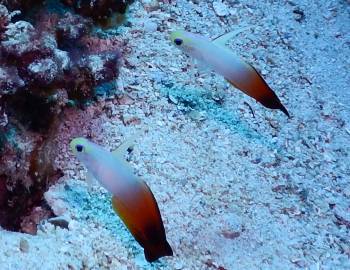
Fire dartfish are usually seen in pairs. Bali |
POS II, Menjangang Island, Bali |
Type: |
Slope and wall dive |
Access: |
By boat, north of the pier in NW Bali National Park |
|
Position: |
8° 05.80S, 114° 30.6'E
approximately |
Depths: |
20-66' (7-20m) |
Date: |
Sept 2015 |
Visibility: |
About 60' (18m) |
Dive Pros: |
Sunrise Divers, Lovina Beach, northern Bali. |
Snorkeling: |
Yes, on the reef near where we dove |
Features: |
Trevally, nudibranchs, pygmy seahorses. |
We were anchored off Lovina Beach, northern Bali, so we scouted out dive shops ashore. We
arranged with Sunrise Divers to take us, 4 divers, plus Jon's dad as a snorkeler, to the Northwest Bali National Park.
This involved an 2-hour truck ride, then a local boat ride out to Menjangan Island where our 2 dives took place.
The first dive was along a drop-off, called POS II. We found lovely soft corals and swirling schools of trevally.
On a sandy slope were a couple bright fire dartfish, always fun to see. The area is bright with soft and hard
corals and our usual firneds, the butterflyfish, triggerfish, damsels and surgeonfish. Our guide was good at pointing out small
critters. But as is always the case, until you've dived with a guide a few times, he/she doesn't really know what
you're interested in or what you've seen before making a one-day dive experience more of a potluck situation.
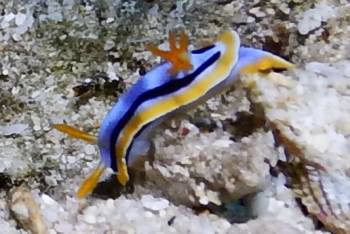
A chromodoris species of nudibranch, Bali |
|
Coral Garden, Menjangang Island, Bali |
Type: |
Slope and wall dive |
Access: |
By boat, north of the pier in NW Bali National Park |
|
Position: |
8° 05.8'S, 114° 30.3'E approximately |
Depths: |
20-80' (7-26m) |
Date: |
Sept 2015 |
Visibility: |
About 60' (18m) |
Dive Pros: |
Sunrise Divers, Lovina Beach, northern Bali. |
Snorkeling: |
Yes, on the reef near where we dove |
Features: |
Coral garden with bright nudis and fish |
Our second dive on Menjangan Island, Bali was at Coral Garden which was aptly named as it
teamed with small reef fish and bright soft corals. This was also on a narrow shelf, then a wall with nudibranchs
and sea fans. We were very new at locating nudibranchs so every one we found was a treat. Having
prescription lenses in the mask really helps for seeing those small critters!
Diving here was a fun adventure and a taste of the beauties of the national park. However, it's a long drive from the
resort areas in the north and south of the island, so it wouldn't be my recommended way to do a dive trip here. Better
to anchor nearby or stay at a dive resort near the national park.
Diving Pages:
Up | Diving Bonaire | Diving Tahanea | Diving Fakarava | Diving Toau | Diving Tahiti | Diving Moorea | Tonga (commercial) | Tonga (private) | Diving Fiji | Diving Indonesia | Diving Thailand | Diving Maldives
Underwater Pages:
Reef Animals | UW Photo How-to | Scuba Diving
Indonesia Pages:
Indonesia Home | Diving Indonesia | Cruising N&E Indo | Cruising S&W Indo | Indonesia Letters | SE Asia Flora/Fauna
Top Level:
Home |
Destinations |
Cruising Info |
Underwater |
Boat Guests |
Ocelot |
Sue |
Jon |
Amanda |
Chris |
Site Map |
Make a Comment
 |
Lifetime
Commodores
of the
Seven Seas
Cruising
Association |
 |
|
If our information is useful,
you can help by making a donation
|
Copyright © 2000‑ Contact:
Jon and Sue Hacking -- HackingFamily.com, svOcelot.com.
All rights reserved.