Wrasse & Parrotfish
There are over 185 species of wrasses (Family Labridae), and
they are some of the most commonly seen fish on the coral reefs of the South Pacific.
Like parrotfish, wrasses swim primarily with their pectoral fins and are
generally very colorful. Unlike the parrotfish which scrape algae from the
reefs, wrasses fed on invertebrates such as crabs, shrimps and gastropods. They
have a prominent set of canine teeth. One of the challenges of identifying
wrasses is that many change size and color as they mature; some even change
shape. Not noticeable to a diver is that they also change sex as they mature,
and the terminal phase fish are all males at the height of their reproductive
activity.
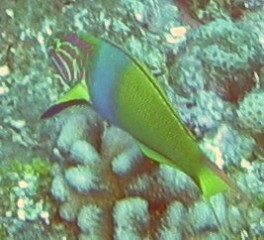
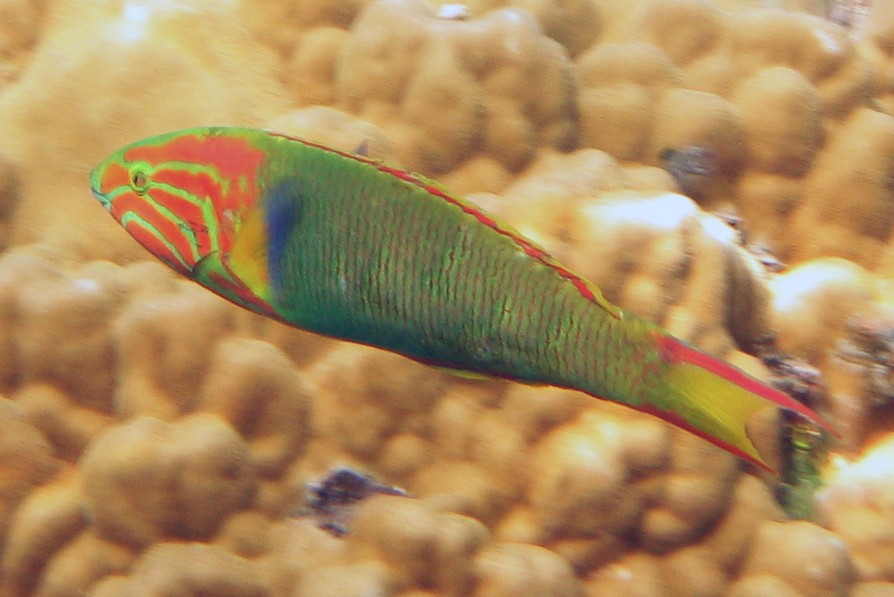
An intermediate phase Sunset Wrasse Thalassoma lutescens, still showing the light
green body and vertical blue band. Juveniles of the species are all
yellow. The yellow pectoral fin with blue trim is characteristic in all
phases. (Society Islands, Fr. Polynesia) |
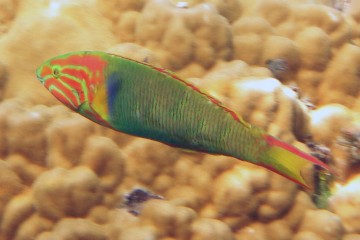
A terminal phase Sunset Wrasse with the reddish-pink head with
green line. This species forms groups and is found on sand, rubble, and
coral patches both inside and outside lagoons. (Society Islands, Fr. Polynesia) |
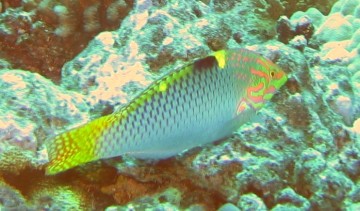
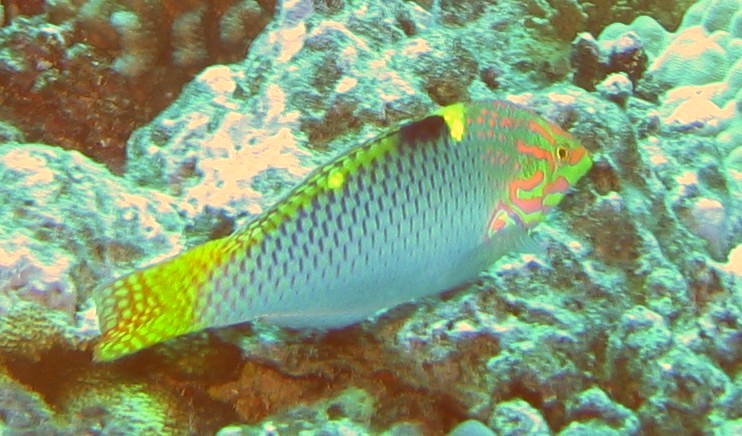
The intermediate phase Checkerboard Wrasse Halichoeres
hortulanus is common on the French Polynesian reefs,
noticeable for its bright yellow saddle spots. It is often solitary. (Tahiti) |
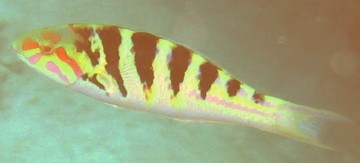
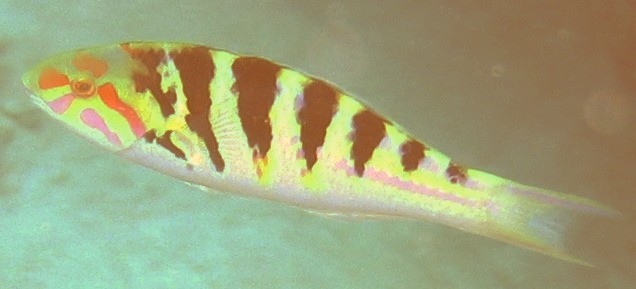
The Six-bar Wrasse Thalassoma hardwicke (10" or 25cm) is the same in intermediate and
terminal phase, and easily recognized by its 5 to 6 black saddles that
decrease in size towards the tail. These fish are often in groups and
live on reefs both in lagoons and outer reefs. (Moorea) |
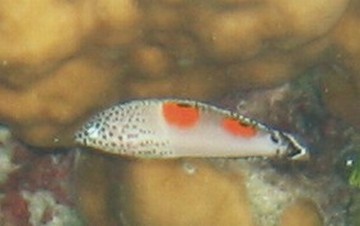
A Juvenile Clown Coris Coris aygula (3" or 8cm, also
in the wrasse family) is one of the bright spots of color on the
reef. they are found on sand and coral rubble bottoms, up to 35 m.
deep. (Society Islands, Fr. Polynesia) |
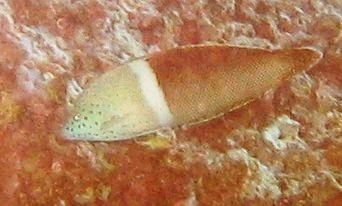
An intermediate phase Clown Coris (up to 16" or 40cm) has
lost the bright orange-red spots of the juvenile. The terminal
phase clown coris can attain a length of 4' or 1.3m (we never saw
one) and are found near reefs in 6-100' or 2-30m. (Society Islands,
Fr. Polynesia) |
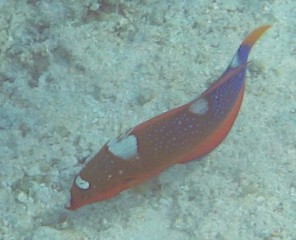
| This Juvenile Yellowtail Coris Coris gaimard
(right, part of
the wrasse family) is partially changed to its intermediate phase when
the white saddles will be gone and the blue and green body will be
speckled by bright blue spots. These are solitary fish, found on sand
and coral rubble bottoms of lagoons. (Society Islands, Fr. Polynesia) |
 |
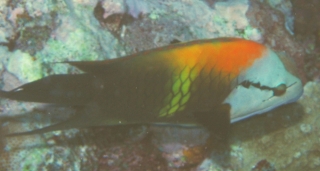 |
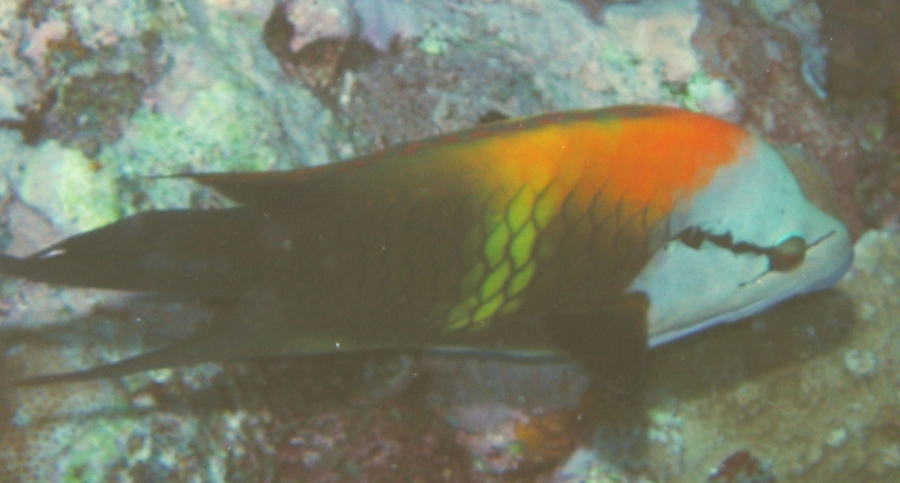
The Slingjaw Wrasse Epiulus insidator grows to over 35cm (14") long found to
over 50 meters deep on both inner and outer coral reefs. It has
a large body, with a distinctive white head, a black line running from
the eye to the gill. The lower jaw protrudes prominently. (Tonga) |
 |
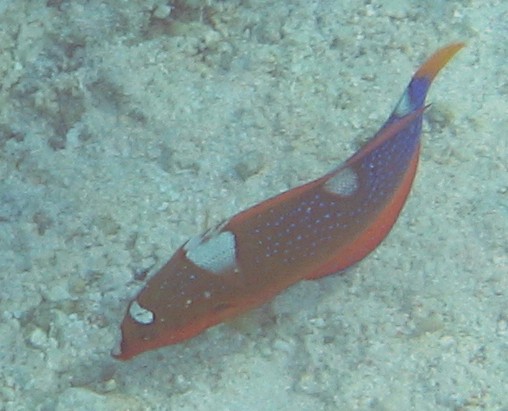
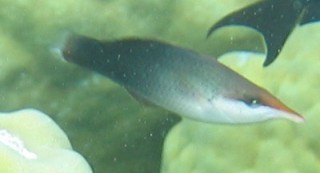
Bird Wrasse Gomphosus varius (left and right, intermediate phase with orange
snout) have very elongated snouts, and like other wrasses change color
when changing from juvenile to intermediate to terminal phase. |
 |
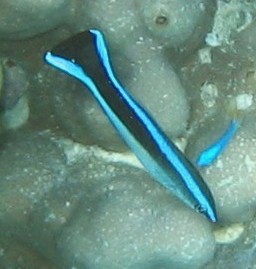 |
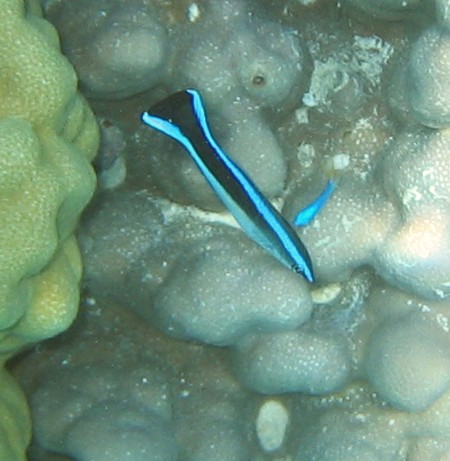
The Bluestreak Cleaner Wrasse Labroides dimidiatus is one of many species of
wrasse which have a commensal arrangement with other fish. Setting
up cleaning stations (which they fiercely defend), they await a customer
from whom they will clean parasites. Cleaner wrasses even go inside the
mouths of larger fish, knowing, somehow, that they will not become
dinner. Most swim with jerky motions to attract customers.
Unfortunately, they often confuse human legs and arms with large fish,
and we have been nibbled by these fierce little housekeepers while
diving throughout the South Pacific (so we're relatively parasite
free). |
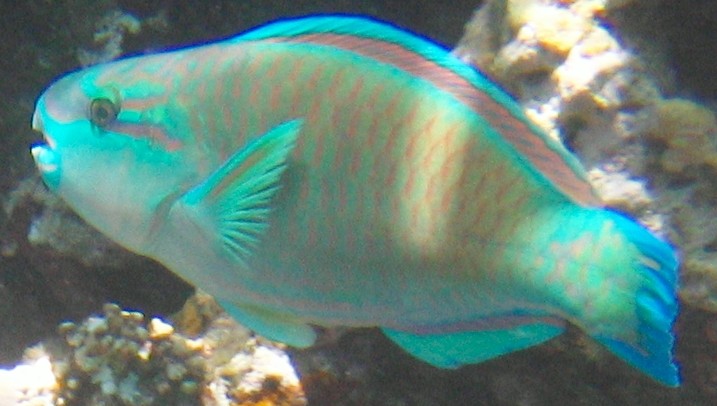
| Parrotfish (Family Scaridae) are often some of the most noticeable fish on
tropical reefs -- not only for their size, but for their noisy crunching of coral
upon which they feed. In the Pacific they tend to be one of the less colorful
fish, though still quite large. The females range from 2-6" (5-15 cm), while the
males are larger (from 10-30", or about 25-80 cm) and more colorful.
They are closely related to the wrasses, and like them, change sex from female
to male, swim with pectoral fins, and have complex social systems. Most parrotfishes live in
harems with one dominant terminal phase male. When he dies, one of the
females undergoes a 2-3 week transformation to male, changing not only sexual
organs, but receiving a bright new set of colorful scales. We think this is a
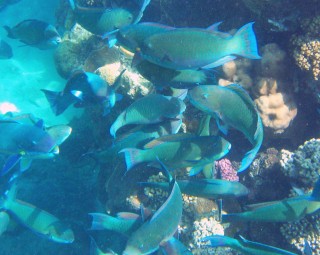
harem of Tricolor Parrotfish Scarus tricolor. (New Caledonia) |
 |
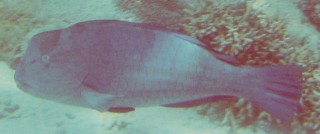 |
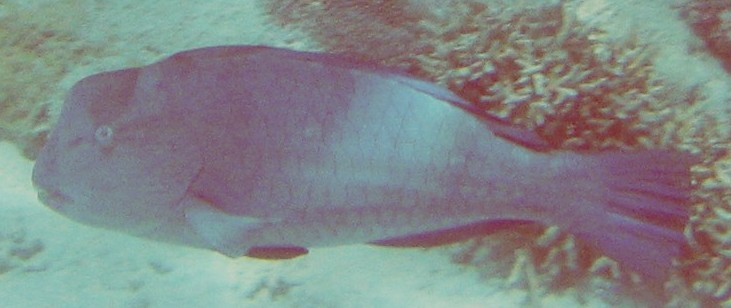
Unlike other species of parrotfish, the Steephead Parrotfish
Chlorurus microrhinos tends to be solitary. Identified by its very prominently vertical
forehead, this fish can grow to over 2' (up to 80 cm) long. There is
also a red variation, with yellow fins. These fish are found from Bali,
Indonesia, to east of French Polynesia. (New Caledonia) |
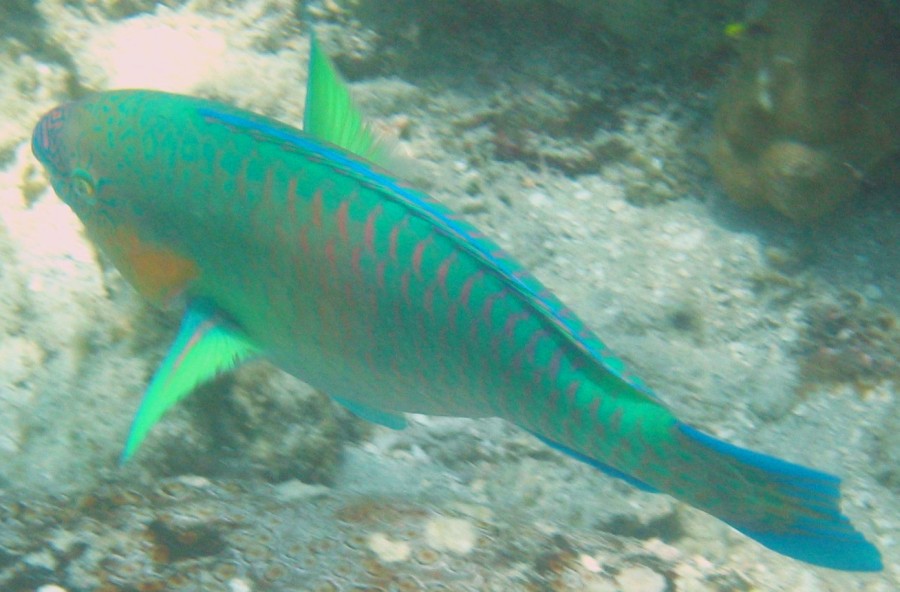
| The fused front teeth of the parrotfish act as a rasp to scrape off
the coral they feed on. Seventy-five percent of what they eat is
inorganic, and if you've ever followed a parrotfish around, you'll know
that what leaves the body is sand. According to our Reef Fish
Identification Guide a single large male can deposit up to
5,000 pounds (2.5 tons)
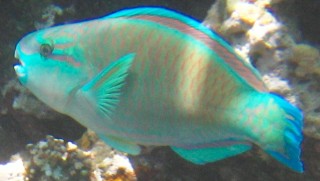
of sediment (sand) per year! We're not sure of the identification of
this one -- could it be a Bullethead parrotfish Chlorurus
sordidus? There are
only about 40 species of parrotfish in the Indo-Pacific but they are
surprisingly hard to identify. The juveniles change dramatically as they
mature, and females can change to males, thus changing their colors as
well. Confusing! (New Caledonia) |
 |
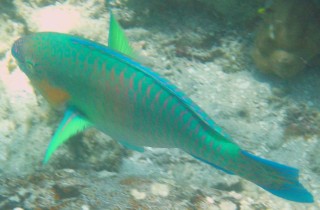 |
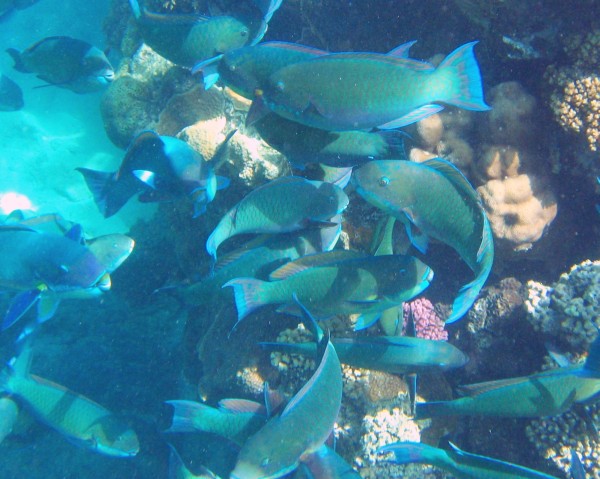
Although our guide book gives a range for the Surf parrotfish
Scarus rivulatus only
as far east as New Caledonia, we saw schools of this medium-sized
parrotfish in western Fiji where they were attracted to the fish-feeding
off Treasure Island. The large orange patch in front of the pectoral fin
is a distinguishing mark. (Fiji) |
Up | Nudibranchs | Coral Reef | Venomous Animals | Angelfish | Butterflyfish | Damselfish | Puffers | Sharks & Rays | Snappers & Breams | Surgeon/Rabbit Fish | Triggerfish | Wrasse & Parrotfish | Other Reef Fish
Reef Animals | UW Photo How-to | Scuba Diving
Top Level:
Home |
Destinations |
Cruising Info |
Underwater |
Boat Guests |
Ocelot |
Sue |
Jon |
Amanda |
Chris |
Site Map |
Make a Comment
 |
Lifetime
Commodores
of the
Seven Seas
Cruising
Association |
 |
|
If our information is useful,
you can help by making a donation
|
Copyright © 2000‑ Contact:
Jon and Sue Hacking -- HackingFamily.com, svOcelot.com.
All rights reserved.